

33
2.3.2 Dissolved Oxygen in Seawater
Atomic and molecular gases readily dissolve into seawater from the atmosphere
where their concentration is a function of their atomic or molecular mass, of their
prevailing atmospheric partial pressure (the fraction of the total of 1 atmosphere
pressure, or 101.3 kPa, exerted by the gas in question) and the temperature and
salinity of the water mass. The resulting dissolved gas concentration in seawater is
termed atmospheric equilibrium concentration (AEC). The bulk of gas in solution
is made up of the most abundant atmospheric gases of the atmosphere. Aside from
argon (about 1%), heavier gases are scarce in the atmosphere. Oxygen is slightly
heavier than nitrogen (32–28 atomic mass units) and is thus slightly more soluble;
the proportion of these gases in solution in seawater thus differs from the atmospheric proportion of molecular nitrogen (N 2 ), about 78%, and molecular oxygen
(O 2 ), about 21%. Solubility is a nonlinear function of temperature, so mixing of
water masses with differing temperatures results in supersaturation and spontaneous
degassing across the air-sea interface is possible.
Weather-induced changes in local atmospheric pressure and in air bubble dissolution can produce changes in gas concentrations but these tend to be small. By and
large, biological and geological effects are most pronounced. For dissolved oxygen
(DO), biological photosynthetic production occurs in the surface layers where light
is available and slight supersaturation (concentration in excess of AEC) can be
observed. Biological consumption on the other hand can occur throughout the water
column depending only on the availability of organic matter for food. At geological
time scales, production and consumption throughout the world ocean are maintained close to equilibrium by the availability of phosphorus, a key but scarce nutrient and at shorter time scales, by nitrogen availability. Inputs of excess fertilizers
and livestock and human wastes have disturbed nutrient cycles in many nearshore
environments bringing about excessive consumption of available oxygen resulting
in decreased DO content termed anoxia (DO absent), suboxia (DO <10 μmol.kg
1
),
or hypoxia (DO significantly below AEC), conditions that exclude many motile
animals and result in metabolic inhibition and decreased scope for growth even for
tolerant sessile species. These anthropogenic oxygen minimum zones (OMZ) have
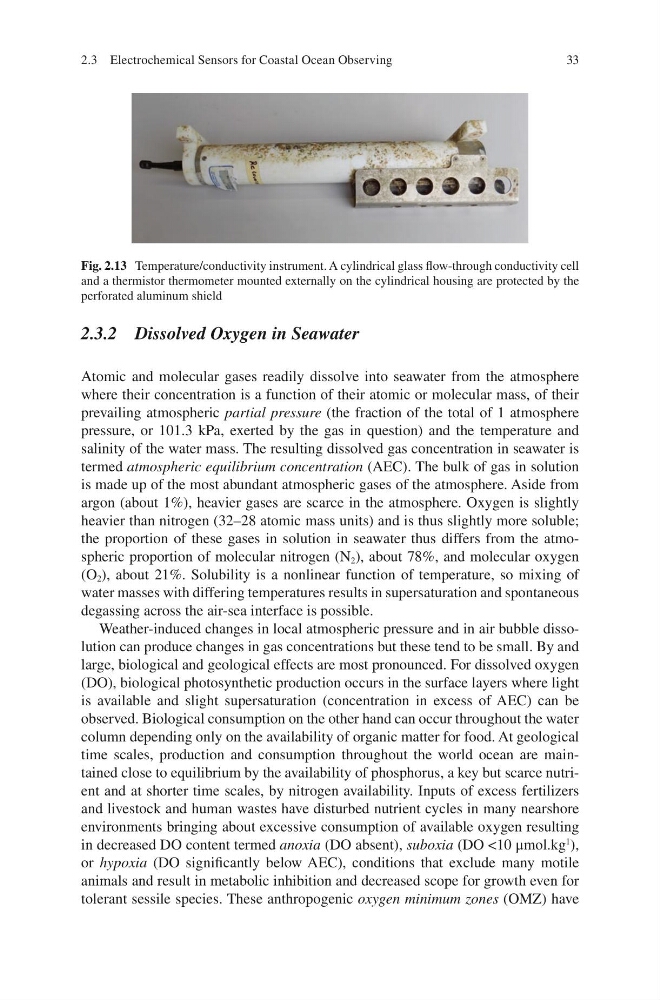
Fig. 2.13 Temperature/conductivity instrument. A cylindrical glass flow-through conductivity cell
and a thermistor thermometer mounted externally on the cylindrical housing are protected by the
perforated aluminum shield
2.3 Electrochemical Sensors for Coastal Ocean Observing
2.3.2 Dissolved Oxygen in Seawater
Atomic and molecular gases readily dissolve into seawater from the atmosphere
where their concentration is a function of their atomic or molecular mass, of their
prevailing atmospheric partial pressure (the fraction of the total of 1 atmosphere
pressure, or 101.3 kPa, exerted by the gas in question) and the temperature and
salinity of the water mass. The resulting dissolved gas concentration in seawater is
termed atmospheric equilibrium concentration (AEC). The bulk of gas in solution
is made up of the most abundant atmospheric gases of the atmosphere. Aside from
argon (about 1%), heavier gases are scarce in the atmosphere. Oxygen is slightly
heavier than nitrogen (32–28 atomic mass units) and is thus slightly more soluble;
the proportion of these gases in solution in seawater thus differs from the atmospheric proportion of molecular nitrogen (N 2 ), about 78%, and molecular oxygen
(O 2 ), about 21%. Solubility is a nonlinear function of temperature, so mixing of
water masses with differing temperatures results in supersaturation and spontaneous
degassing across the air-sea interface is possible.
Weather-induced changes in local atmospheric pressure and in air bubble dissolution can produce changes in gas concentrations but these tend to be small. By and
large, biological and geological effects are most pronounced. For dissolved oxygen
(DO), biological photosynthetic production occurs in the surface layers where light
is available and slight supersaturation (concentration in excess of AEC) can be
observed. Biological consumption on the other hand can occur throughout the water
column depending only on the availability of organic matter for food. At geological
time scales, production and consumption throughout the world ocean are maintained close to equilibrium by the availability of phosphorus, a key but scarce nutrient and at shorter time scales, by nitrogen availability. Inputs of excess fertilizers
and livestock and human wastes have disturbed nutrient cycles in many nearshore
environments bringing about excessive consumption of available oxygen resulting
in decreased DO content termed anoxia (DO absent), suboxia (DO <10 μmol.kg
1
),
or hypoxia (DO significantly below AEC), conditions that exclude many motile
animals and result in metabolic inhibition and decreased scope for growth even for
tolerant sessile species. These anthropogenic oxygen minimum zones (OMZ) have
Fig. 2.13 Temperature/conductivity instrument. A cylindrical glass flow-through conductivity cell
and a thermistor thermometer mounted externally on the cylindrical housing are protected by the
perforated aluminum shield
2.3 Electrochemical Sensors for Coastal Ocean Observing