

25
at the base of the mixed layer at depths of 50–300 m in stratified tropical and
subtropical waters. In coastal waters, moreover, buoyant freshwater lenses resulting
from river plume dispersal produce one or more haloclines coincident with or additional to one or more thermoclines. Internal wave trains can be induced by hydraulic
tidal or current jumps across shallow underwater sills under conditions of exceptional tidal amplitude or current strength and strong internal stratification.
Internal waves propagating along such discontinuities can extend to amplitudes
of over 300 m such as those supported by deep thermoclines in open ocean waters.
In contrast, waves supported by river plume haloclines in the coastal environment
can propagate at depths of less than 30 m with visually apparent rip-slick-rip surface
patterns easily detected by common navigation radar. Instrumental observations off
Puerto Rico, using ship-based vertical profiling and underwater gliders, document
passage of a train of internal waves across the Mona Passage into the Caribbean Sea
(Corredor 2008).
Offshore internal wave trains are readily detected by satellite-borne synthetic
aperture radar (SAR). These instruments traveling in near-earth slanted polar orbit
irradiate a narrow swath of ocean surface with microwave radar beams providing
sea- and land-surface relief maps free of cloud interference. The small sea surface
displacement caused by the cresting internal wave is readily to apparent SAR. Internal
waves can also be detected using stationary manned or mobile autonomous platforms equipped with CTD and or optical sensors.
Shipping interests are usually impervious to the passage of internal waves at sea,
but their capacity for inducing seiching oscillations in semi-enclosed basins can
affect vessel speed and limit effective ship draft. Nevertheless, routine observations
of internal waves for operational applications are not currently implemented, in
large part due to the expense of SAR data and shipboard observations.
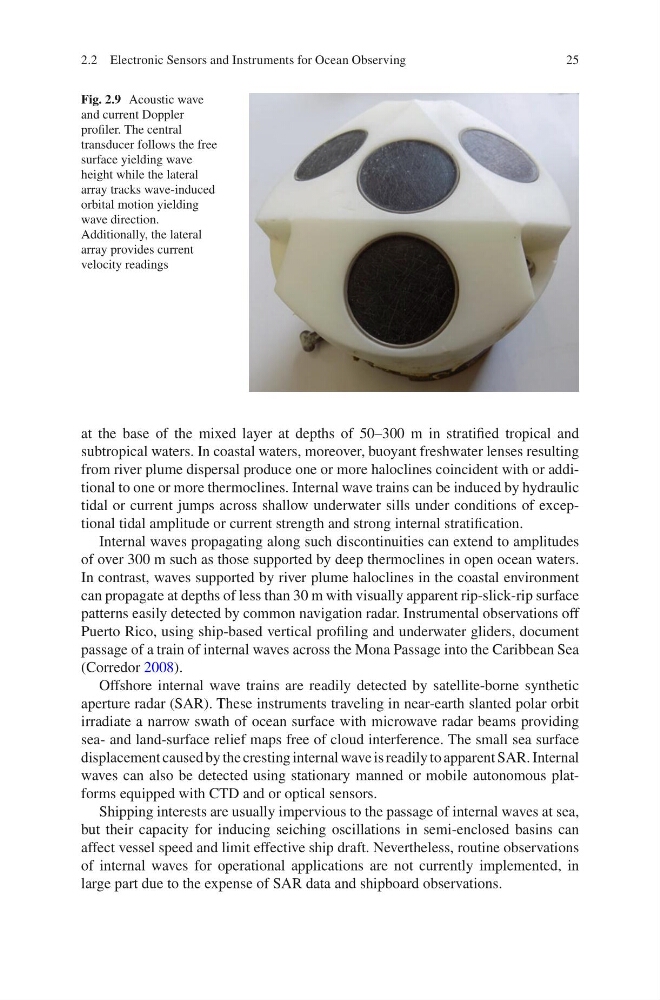
Fig. 2.9 Acoustic wave
and current Doppler
profiler. The central
transducer follows the free
surface yielding wave
height while the lateral
array tracks wave-induced
orbital motion yielding
wave direction.
Additionally, the lateral
array provides current
velocity readings
2.2 Electronic Sensors and Instruments for Ocean Observing
at the base of the mixed layer at depths of 50–300 m in stratified tropical and
subtropical waters. In coastal waters, moreover, buoyant freshwater lenses resulting
from river plume dispersal produce one or more haloclines coincident with or additional to one or more thermoclines. Internal wave trains can be induced by hydraulic
tidal or current jumps across shallow underwater sills under conditions of exceptional tidal amplitude or current strength and strong internal stratification.
Internal waves propagating along such discontinuities can extend to amplitudes
of over 300 m such as those supported by deep thermoclines in open ocean waters.
In contrast, waves supported by river plume haloclines in the coastal environment
can propagate at depths of less than 30 m with visually apparent rip-slick-rip surface
patterns easily detected by common navigation radar. Instrumental observations off
Puerto Rico, using ship-based vertical profiling and underwater gliders, document
passage of a train of internal waves across the Mona Passage into the Caribbean Sea
(Corredor 2008).
Offshore internal wave trains are readily detected by satellite-borne synthetic
aperture radar (SAR). These instruments traveling in near-earth slanted polar orbit
irradiate a narrow swath of ocean surface with microwave radar beams providing
sea- and land-surface relief maps free of cloud interference. The small sea surface
displacement caused by the cresting internal wave is readily to apparent SAR. Internal
waves can also be detected using stationary manned or mobile autonomous platforms equipped with CTD and or optical sensors.
Shipping interests are usually impervious to the passage of internal waves at sea,
but their capacity for inducing seiching oscillations in semi-enclosed basins can
affect vessel speed and limit effective ship draft. Nevertheless, routine observations
of internal waves for operational applications are not currently implemented, in
large part due to the expense of SAR data and shipboard observations.
Fig. 2.9 Acoustic wave
and current Doppler
profiler. The central
transducer follows the free
surface yielding wave
height while the lateral
array tracks wave-induced
orbital motion yielding
wave direction.
Additionally, the lateral
array provides current
velocity readings
2.2 Electronic Sensors and Instruments for Ocean Observing