

22
orifice mid-point along a cylindrical housing pressure open at the bottom. Early
operational models (the Ott gauge) achieved pressure equalization between the orifice at depth and a surface reference measure (calibrated to the benchmark) with a
steel balance beam and a moveable weight operated by an electrical motor. The
balance beam served to toggle the motor on and off. Current models incorporate
piezoelectric sensors that determine the pneumatic pressure difference between the
submerged portion and reference points (NOAA 1991). Although some models
used compressed gases in high pressure tanks, current models use ambient air which
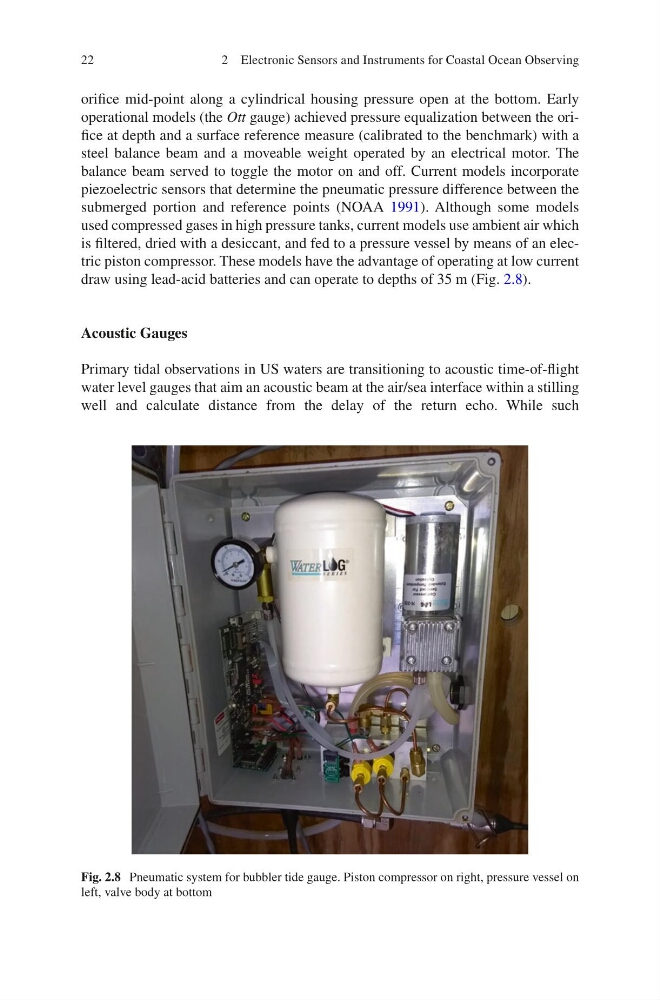
is filtered, dried with a desiccant, and fed to a pressure vessel by means of an electric piston compressor. These models have the advantage of operating at low current
draw using lead-acid batteries and can operate to depths of 35 m (Fig. 2.8).
Acoustic Gauges
Primary tidal observations in US waters are transitioning to acoustic time-of-flight
water level gauges that aim an acoustic beam at the air/sea interface within a stilling
well and calculate distance from the delay of the return echo. While such
Fig. 2.8 Pneumatic system for bubbler tide gauge. Piston compressor on right, pressure vessel on
left, valve body at bottom
2 Electronic Sensors and Instruments for Coastal Ocean Observing
orifice mid-point along a cylindrical housing pressure open at the bottom. Early
operational models (the Ott gauge) achieved pressure equalization between the orifice at depth and a surface reference measure (calibrated to the benchmark) with a
steel balance beam and a moveable weight operated by an electrical motor. The
balance beam served to toggle the motor on and off. Current models incorporate
piezoelectric sensors that determine the pneumatic pressure difference between the
submerged portion and reference points (NOAA 1991). Although some models
used compressed gases in high pressure tanks, current models use ambient air which
is filtered, dried with a desiccant, and fed to a pressure vessel by means of an electric piston compressor. These models have the advantage of operating at low current
draw using lead-acid batteries and can operate to depths of 35 m (Fig. 2.8).
Acoustic Gauges
Primary tidal observations in US waters are transitioning to acoustic time-of-flight
water level gauges that aim an acoustic beam at the air/sea interface within a stilling
well and calculate distance from the delay of the return echo. While such
Fig. 2.8 Pneumatic system for bubbler tide gauge. Piston compressor on right, pressure vessel on
left, valve body at bottom
2 Electronic Sensors and Instruments for Coastal Ocean Observing