

145
securely in anticipation of stormy weather when wind and lightning may pose
hazards to the equipment although, in the latter case, antennae may be provided
with lighting protection devices.
8.3.3 Glider Deployment and Recovery
Glider preparation for deployment requires knowledge of seawater density structure
in the deployment area in order to adjust vehicle buoyancy to dive to the programmed depth and ascend again to the surface. Deployment can be effected from
a small boat by two operators. The glider, mounted on its carrier dolly, can be lifted
to the gunwales and slipped off the dolly with minimum effort. Recovery aboard a
small, low freeboard vessel can be easily performed by hand. Some gliders are
equipped with faired hand grips for this purpose. Gliders may be deployed from
larger ships by lowering the vehicle into the water with a crane or davit suspended
in fabric slings. Recovery aboard large vessels is complicated because of the hazard
of collision with the larger vessel. Custom designed nets or webbing slings may be
used. A simple often-used alternative, when sea state allows, is to lower a small boat
for glider recovery.
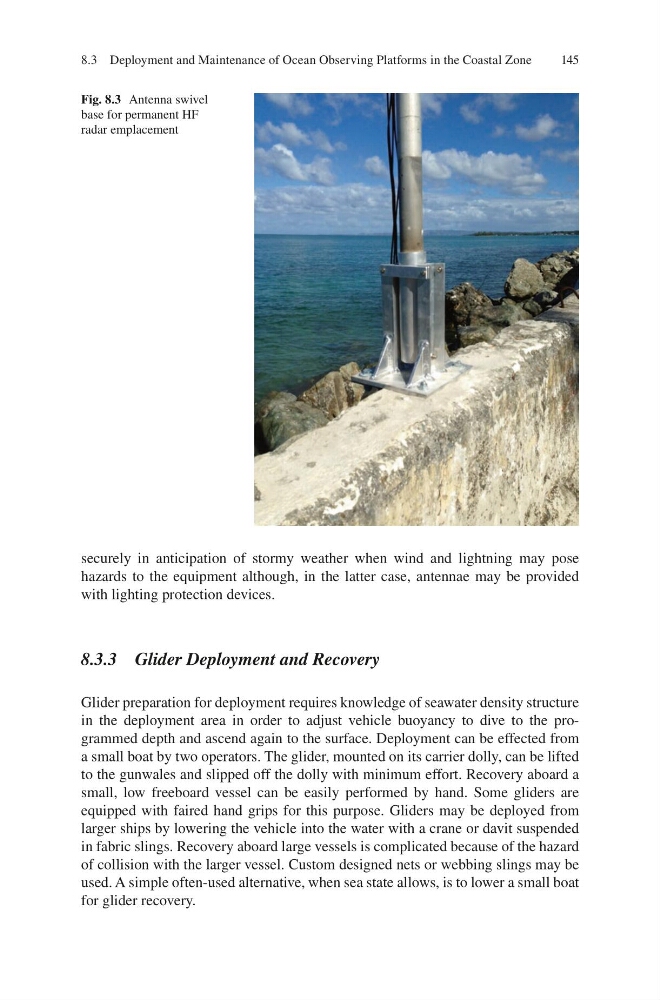
Fig. 8.3 Antenna swivel
base for permanent HF
radar emplacement
8.3 Deployment and Maintenance of Ocean Observing Platforms in the Coastal Zone
securely in anticipation of stormy weather when wind and lightning may pose
hazards to the equipment although, in the latter case, antennae may be provided
with lighting protection devices.
8.3.3 Glider Deployment and Recovery
Glider preparation for deployment requires knowledge of seawater density structure
in the deployment area in order to adjust vehicle buoyancy to dive to the programmed depth and ascend again to the surface. Deployment can be effected from
a small boat by two operators. The glider, mounted on its carrier dolly, can be lifted
to the gunwales and slipped off the dolly with minimum effort. Recovery aboard a
small, low freeboard vessel can be easily performed by hand. Some gliders are
equipped with faired hand grips for this purpose. Gliders may be deployed from
larger ships by lowering the vehicle into the water with a crane or davit suspended
in fabric slings. Recovery aboard large vessels is complicated because of the hazard
of collision with the larger vessel. Custom designed nets or webbing slings may be
used. A simple often-used alternative, when sea state allows, is to lower a small boat
for glider recovery.
Fig. 8.3 Antenna swivel
base for permanent HF
radar emplacement
8.3 Deployment and Maintenance of Ocean Observing Platforms in the Coastal Zone