

143
ODAS buoy retrieval for instrument and platform maintenance may entail
recovery of the entire mooring, essentially the reverse of the deployment operation.
However, under favorable conditions of depth, visibility, and bottom nature, divers
may have access to the anchor end-tackle, making anchor retrieval unnecessary thus
facilitating the operation. Maintenance of coastal buoys equipped with chain moorings is commonly performed at yearly intervals to allow for chain and instrument
replacement or refurbishing. Maintenance may be more frequent in waters of high
biological activity due to loss of instrument performance attendant to biofouling. In
all cases, instruments are dismounted for biofouling removal (if submerged), cleaning inspection and on-site maintenance or shipment to manufacturers for recalibration and refurbishing (if necessary). As mentioned above, best practice is to replace
the old instrument with a freshly calibrated unit. Immediately upon recovery, the
buoy hull, stand, and other submerged surfaces must be freed of biofouling by
mechanical means in anticipation of the onset of putrefaction (especially rapid in
tropical climates). All buoy-specific equipment is inspected and repaired or replaced.
Electrical bulkhead fittings are decoupled, cleaned, lubricated if required, and reinstalled. Structural repairs are performed as required, batteries are replaced (if past
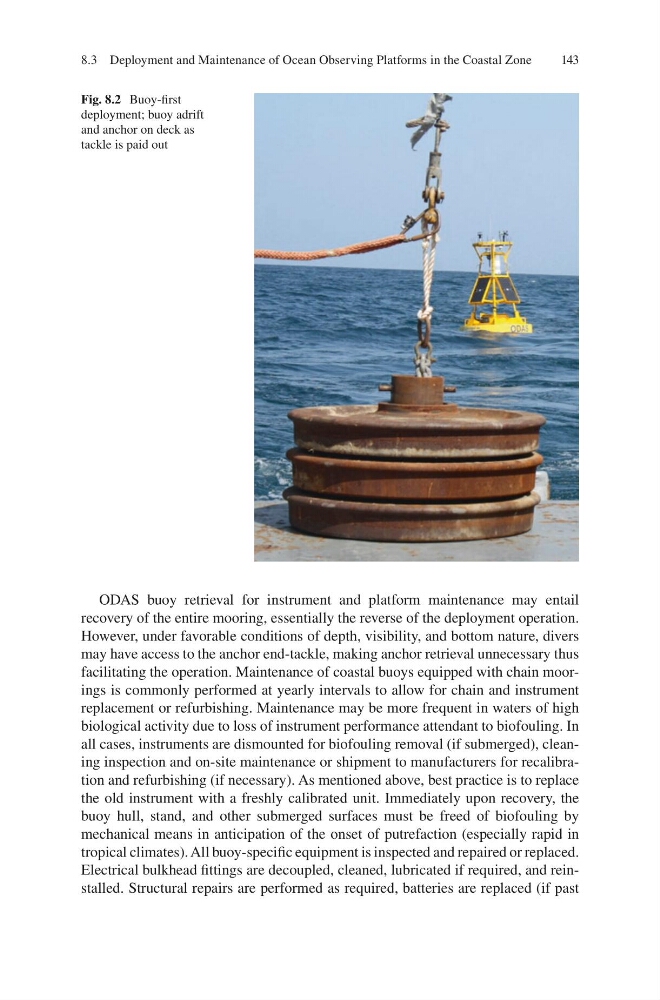
Fig. 8.2 Buoy-first
deployment; buoy adrift
and anchor on deck as
tackle is paid out
8.3 Deployment and Maintenance of Ocean Observing Platforms in the Coastal Zone
ODAS buoy retrieval for instrument and platform maintenance may entail
recovery of the entire mooring, essentially the reverse of the deployment operation.
However, under favorable conditions of depth, visibility, and bottom nature, divers
may have access to the anchor end-tackle, making anchor retrieval unnecessary thus
facilitating the operation. Maintenance of coastal buoys equipped with chain moorings is commonly performed at yearly intervals to allow for chain and instrument
replacement or refurbishing. Maintenance may be more frequent in waters of high
biological activity due to loss of instrument performance attendant to biofouling. In
all cases, instruments are dismounted for biofouling removal (if submerged), cleaning inspection and on-site maintenance or shipment to manufacturers for recalibration and refurbishing (if necessary). As mentioned above, best practice is to replace
the old instrument with a freshly calibrated unit. Immediately upon recovery, the
buoy hull, stand, and other submerged surfaces must be freed of biofouling by
mechanical means in anticipation of the onset of putrefaction (especially rapid in
tropical climates). All buoy-specific equipment is inspected and repaired or replaced.
Electrical bulkhead fittings are decoupled, cleaned, lubricated if required, and reinstalled. Structural repairs are performed as required, batteries are replaced (if past
Fig. 8.2 Buoy-first
deployment; buoy adrift
and anchor on deck as
tackle is paid out
8.3 Deployment and Maintenance of Ocean Observing Platforms in the Coastal Zone