

129
from satellite-borne radiometers. Once deployed, performance of instruments
aboard these craft degrades requiring a sustained calibration effort throughout the
useful instrument life. Brown et al. (2007) describe a buoy system dedicated exclusively to vicarious calibration of satellite ocean color measurements.
Surface ocean current measurements using HFR depend in large part on established physics of deep ocean wave propagation requiring little calibration.
Nevertheless, two factors contribute to degrade signal quality: decreasing wave
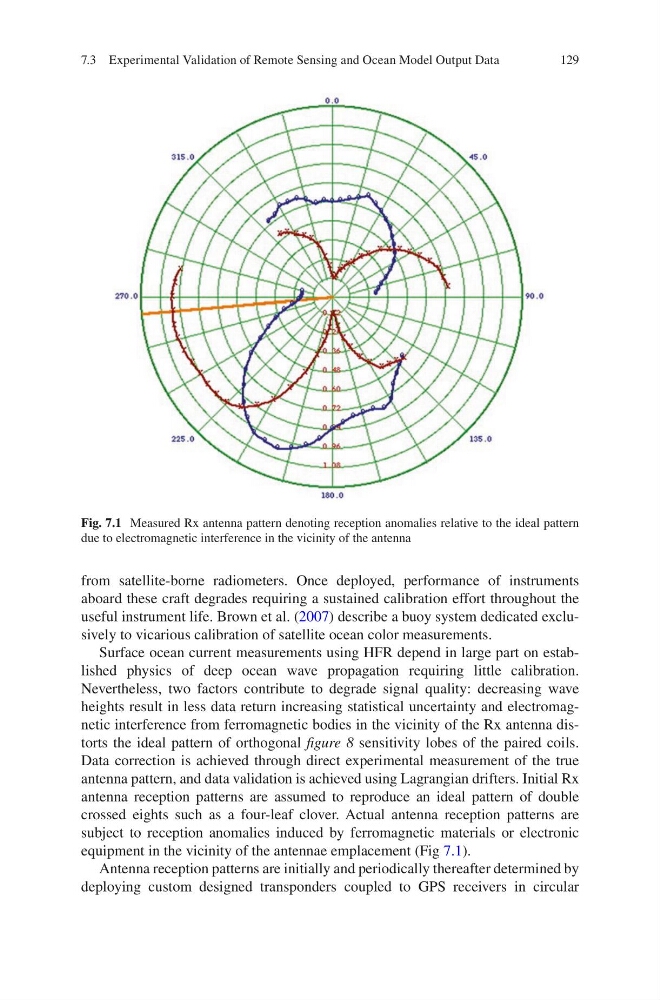
heights result in less data return increasing statistical uncertainty and electromagnetic interference from ferromagnetic bodies in the vicinity of the Rx antenna distorts the ideal pattern of orthogonal figure 8 sensitivity lobes of the paired coils.
Data correction is achieved through direct experimental measurement of the true
antenna pattern, and data validation is achieved using Lagrangian drifters. Initial Rx
antenna reception patterns are assumed to reproduce an ideal pattern of double
crossed eights such as a four-leaf clover. Actual antenna reception patterns are
subject to reception anomalies induced by ferromagnetic materials or electronic
equipment in the vicinity of the antennae emplacement (Fig 7.1).
Antenna reception patterns are initially and periodically thereafter determined by
deploying custom designed transponders coupled to GPS receivers in circular
Fig. 7.1 Measured Rx antenna pattern denoting reception anomalies relative to the ideal pattern
due to electromagnetic interference in the vicinity of the antenna
7.3 Experimental Validation of Remote Sensing and Ocean Model Output Data
from satellite-borne radiometers. Once deployed, performance of instruments
aboard these craft degrades requiring a sustained calibration effort throughout the
useful instrument life. Brown et al. (2007) describe a buoy system dedicated exclusively to vicarious calibration of satellite ocean color measurements.
Surface ocean current measurements using HFR depend in large part on established physics of deep ocean wave propagation requiring little calibration.
Nevertheless, two factors contribute to degrade signal quality: decreasing wave
heights result in less data return increasing statistical uncertainty and electromagnetic interference from ferromagnetic bodies in the vicinity of the Rx antenna distorts the ideal pattern of orthogonal figure 8 sensitivity lobes of the paired coils.
Data correction is achieved through direct experimental measurement of the true
antenna pattern, and data validation is achieved using Lagrangian drifters. Initial Rx
antenna reception patterns are assumed to reproduce an ideal pattern of double
crossed eights such as a four-leaf clover. Actual antenna reception patterns are
subject to reception anomalies induced by ferromagnetic materials or electronic
equipment in the vicinity of the antennae emplacement (Fig 7.1).
Antenna reception patterns are initially and periodically thereafter determined by
deploying custom designed transponders coupled to GPS receivers in circular
Fig. 7.1 Measured Rx antenna pattern denoting reception anomalies relative to the ideal pattern
due to electromagnetic interference in the vicinity of the antenna
7.3 Experimental Validation of Remote Sensing and Ocean Model Output Data