

92
After chloride, sulfate is the most abundant ion in solution in oxic waters. Nitrate,
the preferred electron acceptor for facultative anaerobes in the absence of oxygen
due to its high energy yield (nitroglycerine and trinitrotoluene explosives attest to
this remarkable yield), is present in much lower concentrations and is rapidly
exhausted as are the manganous and ferrous ions leaving sulfate, as a low-yield but
abundant electron acceptor. Accepted knowledge has been that sulfate-reducing
bacteria participate in iron corrosion indirectly through the generation of reducing
sulfur compounds such as thiol, mercaptan, and hydrogen sulfide which directly
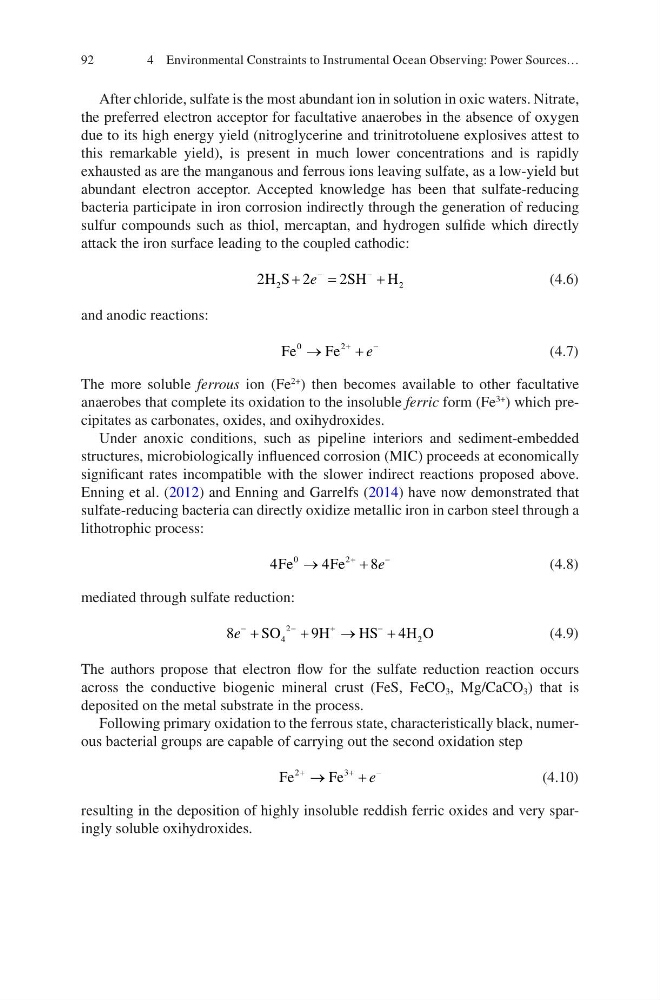
attack the iron surface leading to the coupled cathodic:
2
2
2
2
2
H S
SH H
+
=
+
−
−
e
(4.6)
and anodic reactions:
Fe
Fe
0
2
→
+
+
−
e
(4.7)
The more soluble ferrous ion (Fe
2+
) then becomes available to other facultative
anaerobes that complete its oxidation to the insoluble ferric form (Fe
3+
) which precipitates as carbonates, oxides, and oxihydroxides.
Under anoxic conditions, such as pipeline interiors and sediment-embedded
structures, microbiologically influenced corrosion (MIC) proceeds at economically
significant rates incompatible with the slower indirect reactions proposed above.
Enning et al. (2012) and Enning and Garrelfs (2014) have now demonstrated that
sulfate-reducing bacteria can directly oxidize metallic iron in carbon steel through a
lithotrophic process:
4
4
8
0
2
Fe
Fe
→
+
+
−
e
(4.8)
mediated through sulfate reduction:
8
9
4
4
2
2
e
−
−
+
−
+
+
→
+
SO
H
HS
H O
(4.9)
The authors propose that electron flow for the sulfate reduction reaction occurs
across the conductive biogenic mineral crust (FeS, FeCO 3 , Mg/CaCO 3 ) that is
deposited on the metal substrate in the process.
Following primary oxidation to the ferrous state, characteristically black, numerous bacterial groups are capable of carrying out the second oxidation step
Fe
Fe
2
3
+
+
−
→
+e
(4.10)
resulting in the deposition of highly insoluble reddish ferric oxides and very sparingly soluble oxihydroxides.
4 Environmental Constraints to Instrumental Ocean Observing: Power Sources…
After chloride, sulfate is the most abundant ion in solution in oxic waters. Nitrate,
the preferred electron acceptor for facultative anaerobes in the absence of oxygen
due to its high energy yield (nitroglycerine and trinitrotoluene explosives attest to
this remarkable yield), is present in much lower concentrations and is rapidly
exhausted as are the manganous and ferrous ions leaving sulfate, as a low-yield but
abundant electron acceptor. Accepted knowledge has been that sulfate-reducing
bacteria participate in iron corrosion indirectly through the generation of reducing
sulfur compounds such as thiol, mercaptan, and hydrogen sulfide which directly
attack the iron surface leading to the coupled cathodic:
2
2
2
2
2
H S
SH H
+
=
+
−
−
e
(4.6)
and anodic reactions:
Fe
Fe
0
2
→
+
+
−
e
(4.7)
The more soluble ferrous ion (Fe
2+
) then becomes available to other facultative
anaerobes that complete its oxidation to the insoluble ferric form (Fe
3+
) which precipitates as carbonates, oxides, and oxihydroxides.
Under anoxic conditions, such as pipeline interiors and sediment-embedded
structures, microbiologically influenced corrosion (MIC) proceeds at economically
significant rates incompatible with the slower indirect reactions proposed above.
Enning et al. (2012) and Enning and Garrelfs (2014) have now demonstrated that
sulfate-reducing bacteria can directly oxidize metallic iron in carbon steel through a
lithotrophic process:
4
4
8
0
2
Fe
Fe
→
+
+
−
e
(4.8)
mediated through sulfate reduction:
8
9
4
4
2
2
e
−
−
+
−
+
+
→
+
SO
H
HS
H O
(4.9)
The authors propose that electron flow for the sulfate reduction reaction occurs
across the conductive biogenic mineral crust (FeS, FeCO 3 , Mg/CaCO 3 ) that is
deposited on the metal substrate in the process.
Following primary oxidation to the ferrous state, characteristically black, numerous bacterial groups are capable of carrying out the second oxidation step
Fe
Fe
2
3
+
+
−
→
+e
(4.10)
resulting in the deposition of highly insoluble reddish ferric oxides and very sparingly soluble oxihydroxides.
4 Environmental Constraints to Instrumental Ocean Observing: Power Sources…