

89
4.3.2 Electrochemistry of Metals in Seawater
The prevailing redox potential of oxic seawater, the so-called Eh, can be determined
by reading off a voltmeter, the potential generated by an electrode pair consisting of
a bare platinum indicator electrode (an electrode that acts as a substrate but does not
participate in the reaction) and a secondary reference electrode of known potential.
Seawater, an electrolyte, closes the cell circuit by allowing ion flow to cathode and
anode.
Reference Electrodes for Field Use Given the necessity of using cumbersome
hydrogen tanks and highly corrosive hydrochloric acid, the standard hydrogen electrode is only used for high precision work in the laboratory and seldom in the field.
The sliver/silver chloride and mercury calomel half cells are used instead. These
electrodes are self-contained half cells exploiting the low solubility of the chlorides
of transition metal. Equilibrium is maintained between the sparse oxidized metal ion
and the excess precipitated chloride salt keeping the metal ion concentration stable
and, hence, the electrode potential, regardless of the direction of the reaction.
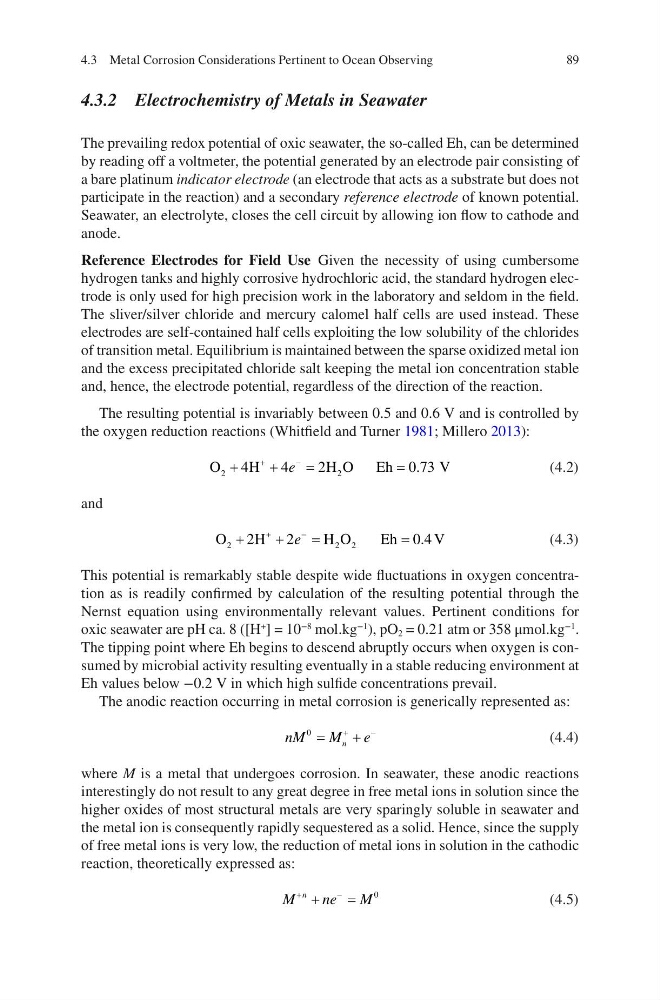
The resulting potential is invariably between 0.5 and 0.6 V and is controlled by
the oxygen reduction reactions (Whitfield and Turner 1981; Millero 2013):
O
H
H O
Eh
V
2
2
4
4
2
0 73
+
+
=
=
+
−
e
.
(4.2)
and
O
H
H O
Eh
V
2
2 2
2
2
0 4
+
+
=
=
+
−
e
.
(4.3)
This potential is remarkably stable despite wide fluctuations in oxygen concentration as is readily confirmed by calculation of the resulting potential through the
Nernst equation using environmentally relevant values. Pertinent conditions for
oxic seawater are pH ca. 8 ([H
+
] = 10
−8
mol.kg
−1
), pO 2 = 0.21 atm or 358 μmol.kg
−1
.
The tipping point where Eh begins to descend abruptly occurs when oxygen is consumed by microbial activity resulting eventually in a stable reducing environment at
Eh values below −0.2 V in which high sulfide concentrations prevail.
The anodic reaction occurring in metal corrosion is generically represented as:
nM
M e
n
0
=
+
+
−
(4.4)
where M is a metal that undergoes corrosion. In seawater, these anodic reactions
interestingly do not result to any great degree in free metal ions in solution since the
higher oxides of most structural metals are very sparingly soluble in seawater and
the metal ion is consequently rapidly sequestered as a solid. Hence, since the supply
of free metal ions is very low, the reduction of metal ions in solution in the cathodic
reaction, theoretically expressed as:
M
ne
M
n
+
−
+
=
0
(4.5)
4.3 Metal Corrosion Considerations Pertinent to Ocean Observing
4.3.2 Electrochemistry of Metals in Seawater
The prevailing redox potential of oxic seawater, the so-called Eh, can be determined
by reading off a voltmeter, the potential generated by an electrode pair consisting of
a bare platinum indicator electrode (an electrode that acts as a substrate but does not
participate in the reaction) and a secondary reference electrode of known potential.
Seawater, an electrolyte, closes the cell circuit by allowing ion flow to cathode and
anode.
Reference Electrodes for Field Use Given the necessity of using cumbersome
hydrogen tanks and highly corrosive hydrochloric acid, the standard hydrogen electrode is only used for high precision work in the laboratory and seldom in the field.
The sliver/silver chloride and mercury calomel half cells are used instead. These
electrodes are self-contained half cells exploiting the low solubility of the chlorides
of transition metal. Equilibrium is maintained between the sparse oxidized metal ion
and the excess precipitated chloride salt keeping the metal ion concentration stable
and, hence, the electrode potential, regardless of the direction of the reaction.
The resulting potential is invariably between 0.5 and 0.6 V and is controlled by
the oxygen reduction reactions (Whitfield and Turner 1981; Millero 2013):
O
H
H O
Eh
V
2
2
4
4
2
0 73
+
+
=
=
+
−
e
.
(4.2)
and
O
H
H O
Eh
V
2
2 2
2
2
0 4
+
+
=
=
+
−
e
.
(4.3)
This potential is remarkably stable despite wide fluctuations in oxygen concentration as is readily confirmed by calculation of the resulting potential through the
Nernst equation using environmentally relevant values. Pertinent conditions for
oxic seawater are pH ca. 8 ([H
+
] = 10
−8
mol.kg
−1
), pO 2 = 0.21 atm or 358 μmol.kg
−1
.
The tipping point where Eh begins to descend abruptly occurs when oxygen is consumed by microbial activity resulting eventually in a stable reducing environment at
Eh values below −0.2 V in which high sulfide concentrations prevail.
The anodic reaction occurring in metal corrosion is generically represented as:
nM
M e
n
0
=
+
+
−
(4.4)
where M is a metal that undergoes corrosion. In seawater, these anodic reactions
interestingly do not result to any great degree in free metal ions in solution since the
higher oxides of most structural metals are very sparingly soluble in seawater and
the metal ion is consequently rapidly sequestered as a solid. Hence, since the supply
of free metal ions is very low, the reduction of metal ions in solution in the cathodic
reaction, theoretically expressed as:
M
ne
M
n
+
−
+
=
0
(4.5)
4.3 Metal Corrosion Considerations Pertinent to Ocean Observing