

428
Multiscale Hydrologic Remote Sensing: Perspectives and Applications
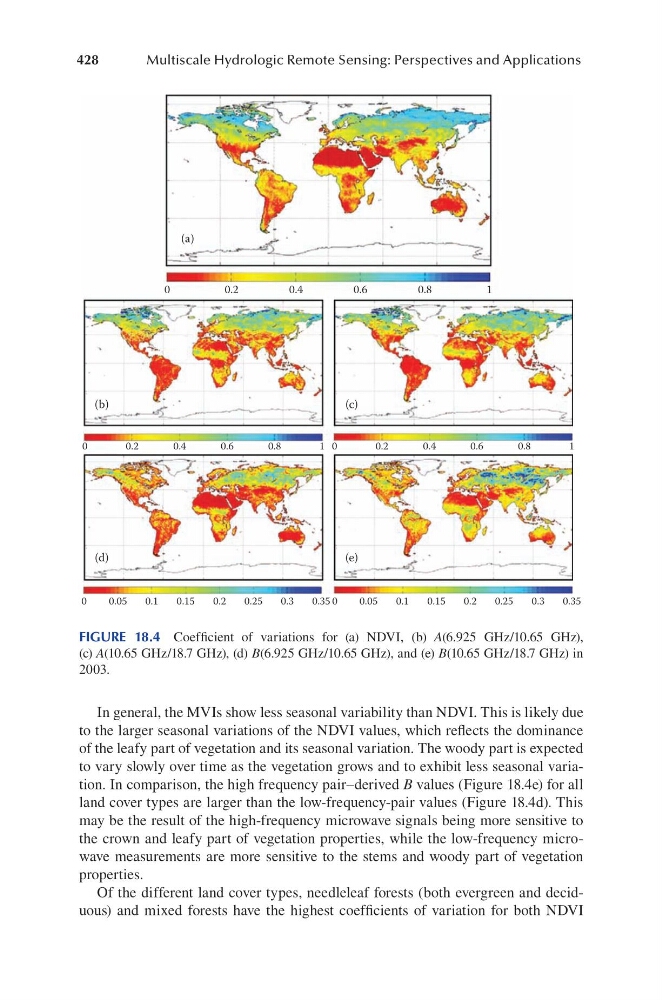
In general, the MVIs show less seasonal variability than NDVI. This is likely due
to the larger seasonal variations of the NDVI values, which reflects the dominance
of the leafy part of vegetation and its seasonal variation. The woody part is expected
to vary slowly over time as the vegetation grows and to exhibit less seasonal variation. In comparison, the high frequency pair–derived B values (Figure 18.4e) for all
land cover types are larger than the low-frequency-pair values (Figure 18.4d). This
may be the result of the high-frequency microwave signals being more sensitive to
the crown and leafy part of vegetation properties, while the low-frequency microwave measurements are more sensitive to the stems and woody part of vegetation
properties.
Of the different land cover types, needleleaf forests (both evergreen and deciduous) and mixed forests have the highest coefficients of variation for both NDVI
(a)
(b)
(c)
(d)
(e)
0.2
0.4
0.6
0.8
1
0
0
0.2
0.4
0.6
0.8
1 0
0.2
0.4
0.6
0.8
1
0
0.05
0.1
0.15
0.25
0.3
0.2
0.35 0
0.05
0.1
0.15
0.25
0.3
0.2
0.35
FIGURE 18.4 Coefficient of variations for (a) NDVI, (b) A(6.925 GHz/10.65 GHz),
(c) A(10.65 GHz/18.7 GHz), (d) B(6.925 GHz/10.65 GHz), and (e) B(10.65 GHz/18.7 GHz) in
2003.
Multiscale Hydrologic Remote Sensing: Perspectives and Applications
In general, the MVIs show less seasonal variability than NDVI. This is likely due
to the larger seasonal variations of the NDVI values, which reflects the dominance
of the leafy part of vegetation and its seasonal variation. The woody part is expected
to vary slowly over time as the vegetation grows and to exhibit less seasonal variation. In comparison, the high frequency pair–derived B values (Figure 18.4e) for all
land cover types are larger than the low-frequency-pair values (Figure 18.4d). This
may be the result of the high-frequency microwave signals being more sensitive to
the crown and leafy part of vegetation properties, while the low-frequency microwave measurements are more sensitive to the stems and woody part of vegetation
properties.
Of the different land cover types, needleleaf forests (both evergreen and deciduous) and mixed forests have the highest coefficients of variation for both NDVI
(a)
(b)
(c)
(d)
(e)
0.2
0.4
0.6
0.8
1
0
0
0.2
0.4
0.6
0.8
1 0
0.2
0.4
0.6
0.8
1
0
0.05
0.1
0.15
0.25
0.3
0.2
0.35 0
0.05
0.1
0.15
0.25
0.3
0.2
0.35
FIGURE 18.4 Coefficient of variations for (a) NDVI, (b) A(6.925 GHz/10.65 GHz),
(c) A(10.65 GHz/18.7 GHz), (d) B(6.925 GHz/10.65 GHz), and (e) B(10.65 GHz/18.7 GHz) in
2003.