

377
Global Precipitation Estimation and Applications
geometries, spatial resolutions, or noise characteristics. Ultimately, such robust algorithms can attribute the differences between sensors to physical differences between
observed scenes rather than artifacts of the algorithm.
15.3 GLOBAL SATELLITE PRECIPITATION PRODUCTS
15.3.1 MultiSenSoR Blended gloBal PReciPitation PRoductS oveRview
In an attempt to improve the accuracy, coverage, and resolution of global precipitation
products, researchers have increasingly moved toward using combinations of GEO
VIS/IR and LEO MW sensors. The first such blending algorithm was performed at
a relatively coarse scale to ensure reasonable error characteristics. For example, the
GPCP multisensor combination is computed on a monthly 2.5° latitude–longitude
grid (Adler et al. 2003) and at 1° daily (Huffman et al. 2001). In the past several years,
a number of fine-scale estimates were in quasioperational production, including the
University of California Irvine PERSIANN (Hsu et al. 1997; Sorooshian et al. 2000),
Climate Prediction Center morphing algorithm (CMORPH) (Joyce et al. 2004), the
Naval Research Laboratory Global Blended–Statistical Precipitation Analysis (Turk
and Miller 2005), the TRMM-based Multisatellite Precipitation Analysis (TMPA)
(Huffman et al. 2007), and PERSIANN Cloud Classification System (PERSIANNCCS) (Hong et al. 2004, 2005). Due to page limits, we can only briefly describe the
GPCP, TMPA, and PERSIANN-CCS operational algorithms, generating global precipitation products at grid resolutions of monthly 2.5°, 3-hourly 0.25°, and 1-hourly
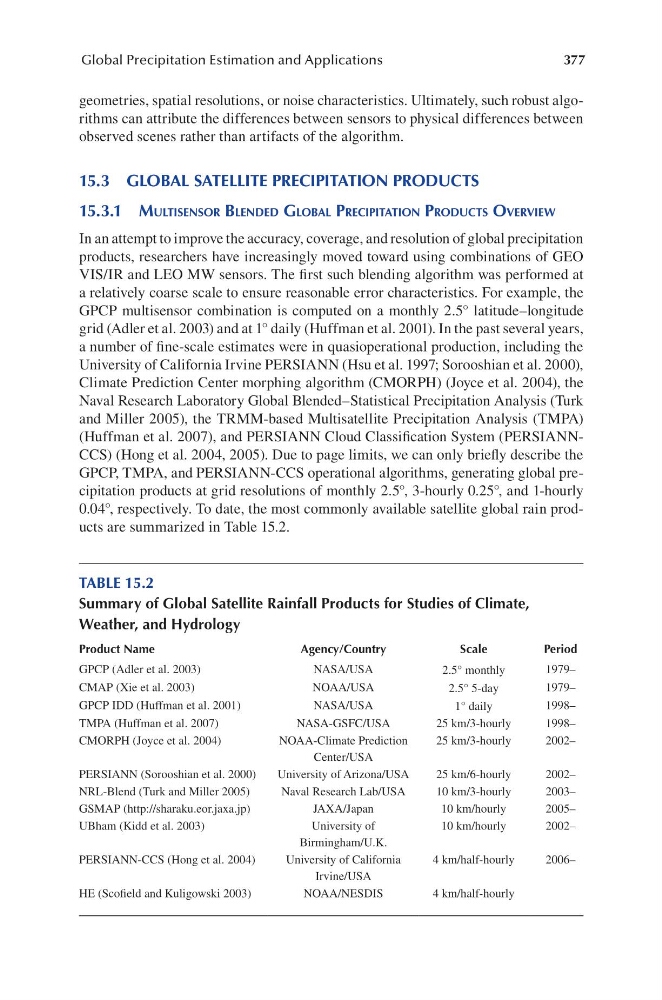
0.04°, respectively. To date, the most commonly available satellite global rain products are summarized in Table 15.2.
TABLE 15.2
Summary of Global Satellite Rainfall Products for Studies of Climate,
Weather, and Hydrology
Product Name
Agency/Country
Scale
Period
GPCP (Adler et al. 2003)
NASA/USA
2.5° monthly
1979–
CMAP (Xie et al. 2003)
NOAA/USA
2.5° 5-day
1979–
GPCP IDD (Huffman et al. 2001)
NASA/USA
1° daily
1998–
TMPA (Huffman et al. 2007)
NASA-GSFC/USA
25 km/3-hourly
1998–
CMORPH (Joyce et al. 2004)
NOAA-Climate Prediction
Center/USA
25 km/3-hourly
2002–
PERSIANN (Sorooshian et al. 2000)
University of Arizona/USA
25 km/6-hourly
2002–
NRL-Blend (Turk and Miller 2005)
Naval Research Lab/USA
10 km/3-hourly
2003–
GSMAP (http://sharaku.eor.jaxa.jp)
JAXA/Japan
10 km/hourly
2005–
UBham (Kidd et al. 2003)
University of
Birmingham/U.K.
10 km/hourly
2002–
PERSIANN-CCS (Hong et al. 2004)
University of California
Irvine/USA
4 km/half-hourly
2006–
HE (Scofield and Kuligowski 2003)
NOAA/NESDIS
4 km/half-hourly
Global Precipitation Estimation and Applications
geometries, spatial resolutions, or noise characteristics. Ultimately, such robust algorithms can attribute the differences between sensors to physical differences between
observed scenes rather than artifacts of the algorithm.
15.3 GLOBAL SATELLITE PRECIPITATION PRODUCTS
15.3.1 MultiSenSoR Blended gloBal PReciPitation PRoductS oveRview
In an attempt to improve the accuracy, coverage, and resolution of global precipitation
products, researchers have increasingly moved toward using combinations of GEO
VIS/IR and LEO MW sensors. The first such blending algorithm was performed at
a relatively coarse scale to ensure reasonable error characteristics. For example, the
GPCP multisensor combination is computed on a monthly 2.5° latitude–longitude
grid (Adler et al. 2003) and at 1° daily (Huffman et al. 2001). In the past several years,
a number of fine-scale estimates were in quasioperational production, including the
University of California Irvine PERSIANN (Hsu et al. 1997; Sorooshian et al. 2000),
Climate Prediction Center morphing algorithm (CMORPH) (Joyce et al. 2004), the
Naval Research Laboratory Global Blended–Statistical Precipitation Analysis (Turk
and Miller 2005), the TRMM-based Multisatellite Precipitation Analysis (TMPA)
(Huffman et al. 2007), and PERSIANN Cloud Classification System (PERSIANNCCS) (Hong et al. 2004, 2005). Due to page limits, we can only briefly describe the
GPCP, TMPA, and PERSIANN-CCS operational algorithms, generating global precipitation products at grid resolutions of monthly 2.5°, 3-hourly 0.25°, and 1-hourly
0.04°, respectively. To date, the most commonly available satellite global rain products are summarized in Table 15.2.
TABLE 15.2
Summary of Global Satellite Rainfall Products for Studies of Climate,
Weather, and Hydrology
Product Name
Agency/Country
Scale
Period
GPCP (Adler et al. 2003)
NASA/USA
2.5° monthly
1979–
CMAP (Xie et al. 2003)
NOAA/USA
2.5° 5-day
1979–
GPCP IDD (Huffman et al. 2001)
NASA/USA
1° daily
1998–
TMPA (Huffman et al. 2007)
NASA-GSFC/USA
25 km/3-hourly
1998–
CMORPH (Joyce et al. 2004)
NOAA-Climate Prediction
Center/USA
25 km/3-hourly
2002–
PERSIANN (Sorooshian et al. 2000)
University of Arizona/USA
25 km/6-hourly
2002–
NRL-Blend (Turk and Miller 2005)
Naval Research Lab/USA
10 km/3-hourly
2003–
GSMAP (http://sharaku.eor.jaxa.jp)
JAXA/Japan
10 km/hourly
2005–
UBham (Kidd et al. 2003)
University of
Birmingham/U.K.
10 km/hourly
2002–
PERSIANN-CCS (Hong et al. 2004)
University of California
Irvine/USA
4 km/half-hourly
2006–
HE (Scofield and Kuligowski 2003)
NOAA/NESDIS
4 km/half-hourly