

341
Airborne Water Vapor Differential Absorption Lidar
Except for the effects on the line shape, pressure and temperature can also induce
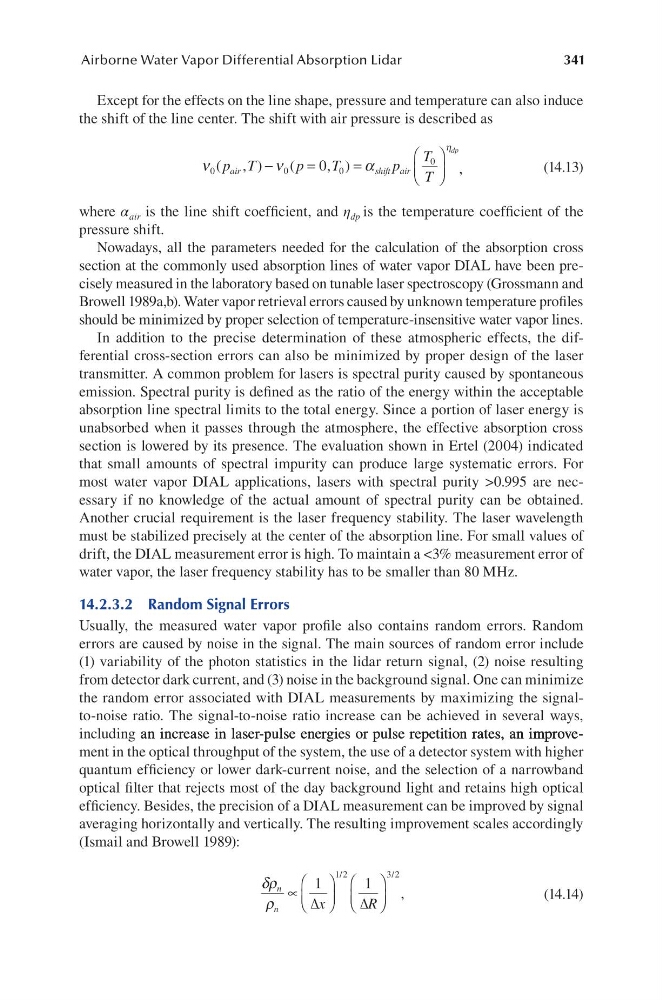
the shift of the line center. The shift with air pressure is described as
ν
ν
α
η
0
0
0
0
0
( , )
(
, )
p T
p
T
p
T
T
air
shift air
dp
−
=
=
,
(14.13)
where α air is the line shift coefficient, and η dp is the temperature coefficient of the
pressure shift.
Nowadays, all the parameters needed for the calculation of the absorption cross
section at the commonly used absorption lines of water vapor DIAL have been precisely measured in the laboratory based on tunable laser spectroscopy (Grossmann and
Browell 1989a,b). Water vapor retrieval errors caused by unknown temperature profiles
should be minimized by proper selection of temperature-insensitive water vapor lines.
In addition to the precise determination of these atmospheric effects, the differential cross-section errors can also be minimized by proper design of the laser
transmitter. A common problem for lasers is spectral purity caused by spontaneous
emission. Spectral purity is defined as the ratio of the energy within the acceptable
absorption line spectral limits to the total energy. Since a portion of laser energy is
unabsorbed when it passes through the atmosphere, the effective absorption cross
section is lowered by its presence. The evaluation shown in Ertel (2004) indicated
that small amounts of spectral impurity can produce large systematic errors. For
most water vapor DIAL applications, lasers with spectral purity >0.995 are necessary if no knowledge of the actual amount of spectral purity can be obtained.
Another crucial requirement is the laser frequency stability. The laser wavelength
must be stabilized precisely at the center of the absorption line. For small values of
drift, the DIAL measurement error is high. To maintain a <3% measurement error of
water vapor, the laser frequency stability has to be smaller than 80 MHz.
14.2.3.2 Random Signal Errors
Usually, the measured water vapor profile also contains random errors. Random
errors are caused by noise in the signal. The main sources of random error include
(1) variability of the photon statistics in the lidar return signal, (2) noise resulting
from detector dark current, and (3) noise in the background signal. One can minimize
the random error associated with DIAL measurements by maximizing the signalto-noise ratio. The signal-to-noise ratio increase can be achieved in several ways,
including an increase in laser-pulse energies or pulse repetition rates, an improvean increase in laser-pulse energies or pulse repetition rates, an improvean increase in laser-pulse energies or pulse repetition rates, an improverates, an improverates, an improvement in the optical throughput of the system, the use of a detector system with higher
quantum efficiency or lower dark-current noise, and the selection of a narrowband
optical filter that rejects most of the day background light and retains high optical
efficiency. Besides, the precision of a DIAL measurement can be improved by signal
averaging horizontally and vertically. The resulting improvement scales accordingly
(Ismail and Browell 1989):
δρ
ρ
n
n
x
R
∝
1
1
1 2
3 2
∆
∆
/
/
,
(14.14)
Airborne Water Vapor Differential Absorption Lidar
Except for the effects on the line shape, pressure and temperature can also induce
the shift of the line center. The shift with air pressure is described as
ν
ν
α
η
0
0
0
0
0
( , )
(
, )
p T
p
T
p
T
T
air
shift air
dp
−
=
=
,
(14.13)
where α air is the line shift coefficient, and η dp is the temperature coefficient of the
pressure shift.
Nowadays, all the parameters needed for the calculation of the absorption cross
section at the commonly used absorption lines of water vapor DIAL have been precisely measured in the laboratory based on tunable laser spectroscopy (Grossmann and
Browell 1989a,b). Water vapor retrieval errors caused by unknown temperature profiles
should be minimized by proper selection of temperature-insensitive water vapor lines.
In addition to the precise determination of these atmospheric effects, the differential cross-section errors can also be minimized by proper design of the laser
transmitter. A common problem for lasers is spectral purity caused by spontaneous
emission. Spectral purity is defined as the ratio of the energy within the acceptable
absorption line spectral limits to the total energy. Since a portion of laser energy is
unabsorbed when it passes through the atmosphere, the effective absorption cross
section is lowered by its presence. The evaluation shown in Ertel (2004) indicated
that small amounts of spectral impurity can produce large systematic errors. For
most water vapor DIAL applications, lasers with spectral purity >0.995 are necessary if no knowledge of the actual amount of spectral purity can be obtained.
Another crucial requirement is the laser frequency stability. The laser wavelength
must be stabilized precisely at the center of the absorption line. For small values of
drift, the DIAL measurement error is high. To maintain a <3% measurement error of
water vapor, the laser frequency stability has to be smaller than 80 MHz.
14.2.3.2 Random Signal Errors
Usually, the measured water vapor profile also contains random errors. Random
errors are caused by noise in the signal. The main sources of random error include
(1) variability of the photon statistics in the lidar return signal, (2) noise resulting
from detector dark current, and (3) noise in the background signal. One can minimize
the random error associated with DIAL measurements by maximizing the signalto-noise ratio. The signal-to-noise ratio increase can be achieved in several ways,
including an increase in laser-pulse energies or pulse repetition rates, an improvean increase in laser-pulse energies or pulse repetition rates, an improvean increase in laser-pulse energies or pulse repetition rates, an improverates, an improverates, an improvement in the optical throughput of the system, the use of a detector system with higher
quantum efficiency or lower dark-current noise, and the selection of a narrowband
optical filter that rejects most of the day background light and retains high optical
efficiency. Besides, the precision of a DIAL measurement can be improved by signal
averaging horizontally and vertically. The resulting improvement scales accordingly
(Ismail and Browell 1989):
δρ
ρ
n
n
x
R
∝
1
1
1 2
3 2
∆
∆
/
/
,
(14.14)