

320
Multiscale Hydrologic Remote Sensing: Perspectives and Applications
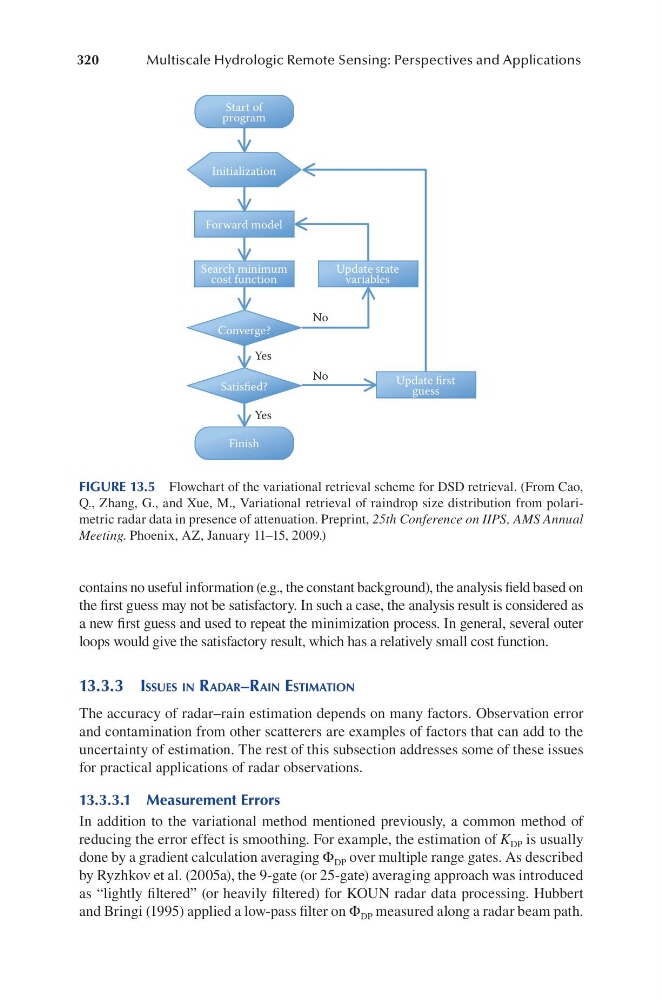
contains no useful information (e.g., the constant background), the analysis field based on
the first guess may not be satisfactory. In such a case, the analysis result is considered as
a new first guess and used to repeat the minimization process. In general, several outer
loops would give the satisfactory result, which has a relatively small cost function.
13.3.3 iSSueS in RadaR–Rain eStiMation
The accuracy of radar–rain estimation depends on many factors. Observation error
and contamination from other scatterers are examples of factors that can add to the
uncertainty of estimation. The rest of this subsection addresses some of these issues
for practical applications of radar observations.
13.3.3.1 Measurement Errors
In addition to the variational method mentioned previously, a common method of
reducing the error effect is smoothing. For example, the estimation of K DP is usually
done by a gradient calculation averaging Φ DP over multiple range gates. As described
by Ryzhkov et al. (2005a), the 9-gate (or 25-gate) averaging approach was introduced
as “lightly filtered” (or heavily filtered) for KOUN radar data processing. Hubbert
and Bringi (1995) applied a low-pass filter on Φ DP measured along a radar beam path.
Start of
program
Initialization
Forward model
Search minimum
cost function
Update state
variables
Update first
guess
Converge?
Satisfied?
Finish
Yes
Yes
No
No
FIGURE 13.5 Flowchart of the variational retrieval scheme for DSD retrieval. (From Cao,
Q., Zhang, G., and Xue, M., Variational retrieval of raindrop size distribution from polarimetric radar data in presence of attenuation. Preprint, 25th Conference on IIPS, AMS Annual
Meeting. Phoenix, AZ, January 11–15, 2009.)
Multiscale Hydrologic Remote Sensing: Perspectives and Applications
contains no useful information (e.g., the constant background), the analysis field based on
the first guess may not be satisfactory. In such a case, the analysis result is considered as
a new first guess and used to repeat the minimization process. In general, several outer
loops would give the satisfactory result, which has a relatively small cost function.
13.3.3 iSSueS in RadaR–Rain eStiMation
The accuracy of radar–rain estimation depends on many factors. Observation error
and contamination from other scatterers are examples of factors that can add to the
uncertainty of estimation. The rest of this subsection addresses some of these issues
for practical applications of radar observations.
13.3.3.1 Measurement Errors
In addition to the variational method mentioned previously, a common method of
reducing the error effect is smoothing. For example, the estimation of K DP is usually
done by a gradient calculation averaging Φ DP over multiple range gates. As described
by Ryzhkov et al. (2005a), the 9-gate (or 25-gate) averaging approach was introduced
as “lightly filtered” (or heavily filtered) for KOUN radar data processing. Hubbert
and Bringi (1995) applied a low-pass filter on Φ DP measured along a radar beam path.
Start of
program
Initialization
Forward model
Search minimum
cost function
Update state
variables
Update first
guess
Converge?
Satisfied?
Finish
Yes
Yes
No
No
FIGURE 13.5 Flowchart of the variational retrieval scheme for DSD retrieval. (From Cao,
Q., Zhang, G., and Xue, M., Variational retrieval of raindrop size distribution from polarimetric radar data in presence of attenuation. Preprint, 25th Conference on IIPS, AMS Annual
Meeting. Phoenix, AZ, January 11–15, 2009.)