

13
Advanced Ground-Penetrating Radar for Soil Moisture Retrieval
are retrieved using an inversion of the filtered GPR waveform. Phase and amplitude information of the large-frequency-bandwidth GPR signal is inherently used for
model inversion, thereby maximizing information retrieval from the available radar
data, both in terms of quantity and quality. The technique was validated in a series
of hydrogeophysical applications (Lambot et al. 2004a,b, 2006, 2008, 2009; Jadoon
et al. 2008, 2010; Minet et al. 2010, 2011; Jonard et al. 2011).
2.3.1 Modeling of the gPR SySteM
The GPR signal to be modeled consists of the frequency-dependent complex ratio
S 11 (ω) between the returned signal and the emitted signal, with ω being the angular frequency. It relies on the linearity of Maxwell’s equations and assumes that
the spatial distribution of the backscattered electromagnetic field measured by the
antenna does not depend on the subsurface, that is, only the amplitude and phase
change. This is expected to be a valid assumption if the antenna is not too close to the
ground, given that the soil can be described by a planar layered medium. The model
consists of a linear system composed of elementary model components in series and
parallel, all characterized by their own frequency response function accounting for
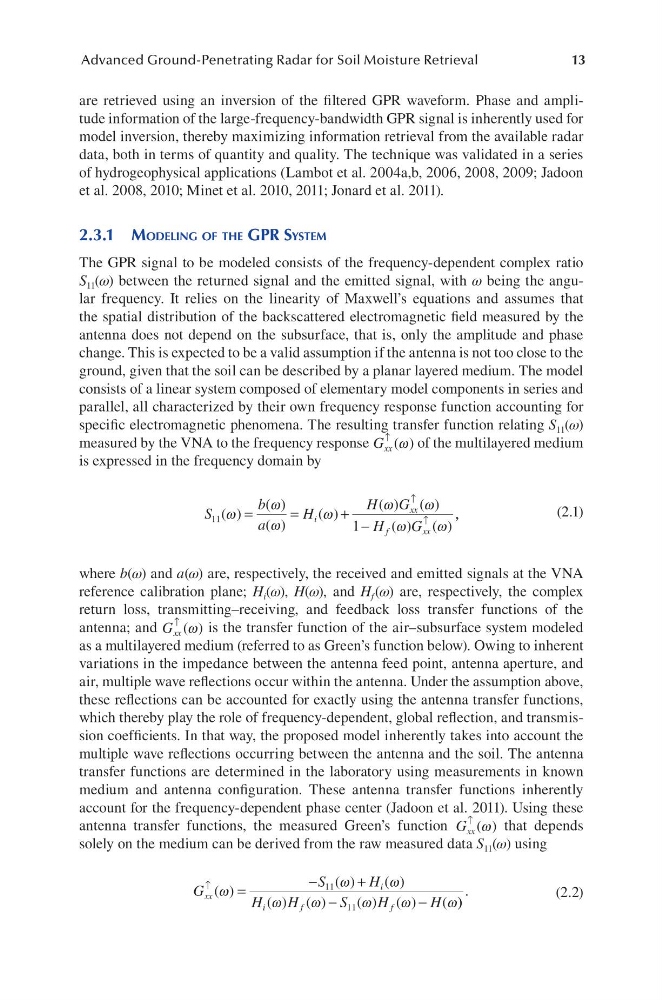
specific electromagnetic phenomena. The resulting transfer function relating S 11 (ω)
measured by the VNA to the frequency response G xx
↑ ( )
ω of the multilayered medium
is expressed in the frequency domain by
S
b
a
H
H G
H
G
i
xx
f
xx
11
1
( )
( )
( )
( )
( ) ( )
( ) ( )
ω
ω
ω
ω
ω
ω
ω
ω
=
=
+ −
↑
↑
, ,
(2.1)
where b(ω) and a(ω) are, respectively, the received and emitted signals at the VNA
reference calibration plane; H i (ω), H(ω), and H f (ω) are, respectively, the complex
return loss, transmitting–receiving, and feedback loss transfer functions of the
antenna; and G xx
↑ ( )
ω is the transfer function of the air–subsurface system modeled
as a multilayered medium (referred to as Green’s function below). Owing to inherent
variations in the impedance between the antenna feed point, antenna aperture, and
air, multiple wave reflections occur within the antenna. Under the assumption above,
these reflections can be accounted for exactly using the antenna transfer functions,
which thereby play the role of frequency-dependent, global reflection, and transmission coefficients. In that way, the proposed model inherently takes into account the
multiple wave reflections occurring between the antenna and the soil. The antenna
transfer functions are determined in the laboratory using measurements in known
medium and antenna configuration. These antenna transfer functions inherently
account for the frequency-dependent phase center (Jadoon et al. 2011). Using these
antenna transfer functions, the measured Green’s function G xx
↑ ( )
ω that depends
solely on the medium can be derived from the raw measured data S 11 (ω) using
G
S
H
H
H
S
H
H
xx
i
i
f
f
↑
=
−
+
−
−
( )
( )
( )
( ) ( )
( ) ( )
(
ω
ω
ω
ω
ω
ω
ω
ω
11
11
) )
.
(2.2)
Advanced Ground-Penetrating Radar for Soil Moisture Retrieval
are retrieved using an inversion of the filtered GPR waveform. Phase and amplitude information of the large-frequency-bandwidth GPR signal is inherently used for
model inversion, thereby maximizing information retrieval from the available radar
data, both in terms of quantity and quality. The technique was validated in a series
of hydrogeophysical applications (Lambot et al. 2004a,b, 2006, 2008, 2009; Jadoon
et al. 2008, 2010; Minet et al. 2010, 2011; Jonard et al. 2011).
2.3.1 Modeling of the gPR SySteM
The GPR signal to be modeled consists of the frequency-dependent complex ratio
S 11 (ω) between the returned signal and the emitted signal, with ω being the angular frequency. It relies on the linearity of Maxwell’s equations and assumes that
the spatial distribution of the backscattered electromagnetic field measured by the
antenna does not depend on the subsurface, that is, only the amplitude and phase
change. This is expected to be a valid assumption if the antenna is not too close to the
ground, given that the soil can be described by a planar layered medium. The model
consists of a linear system composed of elementary model components in series and
parallel, all characterized by their own frequency response function accounting for
specific electromagnetic phenomena. The resulting transfer function relating S 11 (ω)
measured by the VNA to the frequency response G xx
↑ ( )
ω of the multilayered medium
is expressed in the frequency domain by
S
b
a
H
H G
H
G
i
xx
f
xx
11
1
( )
( )
( )
( )
( ) ( )
( ) ( )
ω
ω
ω
ω
ω
ω
ω
ω
=
=
+ −
↑
↑
, ,
(2.1)
where b(ω) and a(ω) are, respectively, the received and emitted signals at the VNA
reference calibration plane; H i (ω), H(ω), and H f (ω) are, respectively, the complex
return loss, transmitting–receiving, and feedback loss transfer functions of the
antenna; and G xx
↑ ( )
ω is the transfer function of the air–subsurface system modeled
as a multilayered medium (referred to as Green’s function below). Owing to inherent
variations in the impedance between the antenna feed point, antenna aperture, and
air, multiple wave reflections occur within the antenna. Under the assumption above,
these reflections can be accounted for exactly using the antenna transfer functions,
which thereby play the role of frequency-dependent, global reflection, and transmission coefficients. In that way, the proposed model inherently takes into account the
multiple wave reflections occurring between the antenna and the soil. The antenna
transfer functions are determined in the laboratory using measurements in known
medium and antenna configuration. These antenna transfer functions inherently
account for the frequency-dependent phase center (Jadoon et al. 2011). Using these
antenna transfer functions, the measured Green’s function G xx
↑ ( )
ω that depends
solely on the medium can be derived from the raw measured data S 11 (ω) using
G
S
H
H
H
S
H
H
xx
i
i
f
f
↑
=
−
+
−
−
( )
( )
( )
( ) ( )
( ) ( )
(
ω
ω
ω
ω
ω
ω
ω
ω
11
11
) )
.
(2.2)