

223
Modeling Snowmelt Runoff under Climate Change Scenarios
ranged from 5.4 to 56 km, thus providing finer spatial resolution imagery with better retrieval accuracy compared to SSMR and SSM/I (Pulliainen 2006). Second,
AMSR-E provides measurement at approximately 1:30 a.m. and 1:30 p.m., an observing local time that is not covered by the existing measurement of SSM/I (Kawanishi
et al. 2003). Also, the better vegetation penetration abilities make AMSR-E’s 6.925GHz channels very useful compared to the frequency bands of SSM/I and SMMR
(Jackson and Hsu 2001). Despite various advantages of AMSR-E over the other passive microwave instruments, it is important to note that AMSR-E and other advanced
microwave instruments still use the dual-frequency approach of identifying snow
cover used in the older radiometers (Grody and Basist 1996). Snow cover produces
a positive difference between low- and high-frequency channels, called a scattering
signal that is detectable by the dual-frequency approach (Grody and Basist 1996).
Apart from identifying snow cover by its volume-scattering signature, researchers
have also used passive microwave radiometers to conduct several studies on SD and
its water equivalent in different parts of the world. The scattering signal, that is, the
brightness temperature difference between vertically polarized AMSR-E (SSM/I)
channels of 18.7 (19.0) and 36.5 (37.0) GHz, is the most commonly used index to
derive SWE or SD (Chang et al. 1987; Pulliainen 2006). According to Kelly et al.
(2003), a surface scattering signal can be detected using the expression developed by
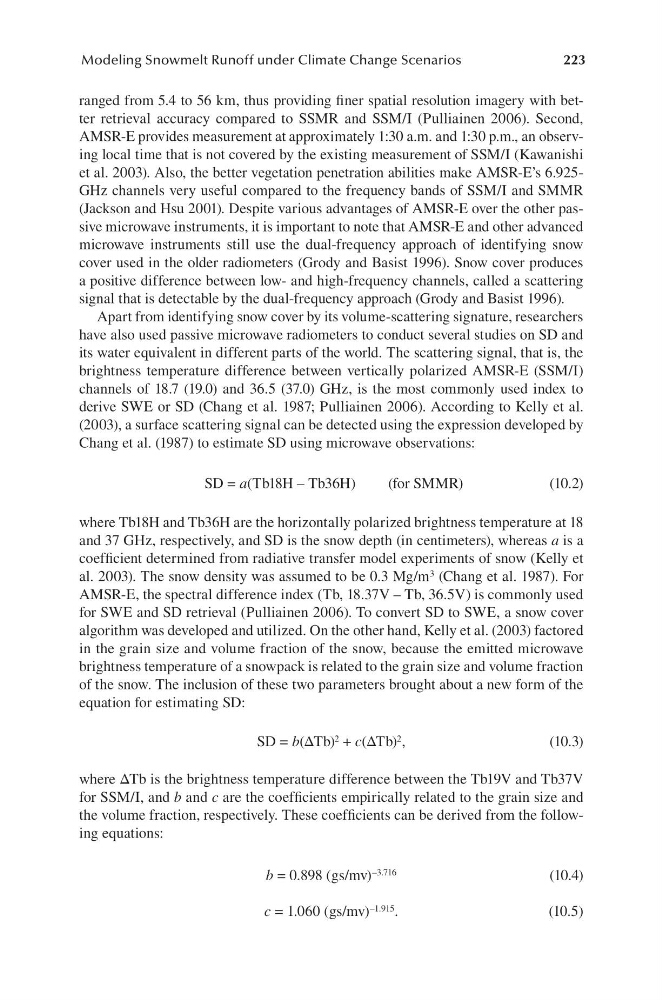
Chang et al. (1987) to estimate SD using microwave observations:
SD = a(Tb18H – Tb36H)
(for SMMR)
(10.2)
where Tb18H and Tb36H are the horizontally polarized brightness temperature at 18
and 37 GHz, respectively, and SD is the snow depth (in centimeters), whereas a is a
coefficient determined from radiative transfer model experiments of snow (Kelly et
al. 2003). The snow density was assumed to be 0.3 Mg/m 3 (Chang et al. 1987). For
AMSR-E, the spectral difference index (Tb, 18.37V – Tb, 36.5V) is commonly used
for SWE and SD retrieval (Pulliainen 2006). To convert SD to SWE, a snow cover
algorithm was developed and utilized. On the other hand, Kelly et al. (2003) factored
in the grain size and volume fraction of the snow, because the emitted microwave
brightness temperature of a snowpack is related to the grain size and volume fraction
of the snow. The inclusion of these two parameters brought about a new form of the
equation for estimating SD:
SD = b(ΔTb) 2 + c(ΔTb) 2 ,
(10.3)
where ΔTb is the brightness temperature difference between the Tb19V and Tb37V
for SSM/I, and b and c are the coefficients empirically related to the grain size and
the volume fraction, respectively. These coefficients can be derived from the following equations:
b = 0.898 (gs/mv) –3.716
(10.4)
c = 1.060 (gs/mv) –1.915 .
(10.5)
Modeling Snowmelt Runoff under Climate Change Scenarios
ranged from 5.4 to 56 km, thus providing finer spatial resolution imagery with better retrieval accuracy compared to SSMR and SSM/I (Pulliainen 2006). Second,
AMSR-E provides measurement at approximately 1:30 a.m. and 1:30 p.m., an observing local time that is not covered by the existing measurement of SSM/I (Kawanishi
et al. 2003). Also, the better vegetation penetration abilities make AMSR-E’s 6.925GHz channels very useful compared to the frequency bands of SSM/I and SMMR
(Jackson and Hsu 2001). Despite various advantages of AMSR-E over the other passive microwave instruments, it is important to note that AMSR-E and other advanced
microwave instruments still use the dual-frequency approach of identifying snow
cover used in the older radiometers (Grody and Basist 1996). Snow cover produces
a positive difference between low- and high-frequency channels, called a scattering
signal that is detectable by the dual-frequency approach (Grody and Basist 1996).
Apart from identifying snow cover by its volume-scattering signature, researchers
have also used passive microwave radiometers to conduct several studies on SD and
its water equivalent in different parts of the world. The scattering signal, that is, the
brightness temperature difference between vertically polarized AMSR-E (SSM/I)
channels of 18.7 (19.0) and 36.5 (37.0) GHz, is the most commonly used index to
derive SWE or SD (Chang et al. 1987; Pulliainen 2006). According to Kelly et al.
(2003), a surface scattering signal can be detected using the expression developed by
Chang et al. (1987) to estimate SD using microwave observations:
SD = a(Tb18H – Tb36H)
(for SMMR)
(10.2)
where Tb18H and Tb36H are the horizontally polarized brightness temperature at 18
and 37 GHz, respectively, and SD is the snow depth (in centimeters), whereas a is a
coefficient determined from radiative transfer model experiments of snow (Kelly et
al. 2003). The snow density was assumed to be 0.3 Mg/m 3 (Chang et al. 1987). For
AMSR-E, the spectral difference index (Tb, 18.37V – Tb, 36.5V) is commonly used
for SWE and SD retrieval (Pulliainen 2006). To convert SD to SWE, a snow cover
algorithm was developed and utilized. On the other hand, Kelly et al. (2003) factored
in the grain size and volume fraction of the snow, because the emitted microwave
brightness temperature of a snowpack is related to the grain size and volume fraction
of the snow. The inclusion of these two parameters brought about a new form of the
equation for estimating SD:
SD = b(ΔTb) 2 + c(ΔTb) 2 ,
(10.3)
where ΔTb is the brightness temperature difference between the Tb19V and Tb37V
for SSM/I, and b and c are the coefficients empirically related to the grain size and
the volume fraction, respectively. These coefficients can be derived from the following equations:
b = 0.898 (gs/mv) –3.716
(10.4)
c = 1.060 (gs/mv) –1.915 .
(10.5)