

220
Multiscale Hydrologic Remote Sensing: Perspectives and Applications
should be based on input from a wide range of historical snowmelt conditions to
determine the repeatable or invariant characteristics of snowmelt depletion.
10.3 REMOTE SENSING OF SNOW
SCA obtained from satellite images plays a crucial role in modeling snowmelt
runoff processes (Brubaker et al. 1996) associated with climate change scenarios.
According to Wang et al. (2010), SCA is the key feature for describing the snow
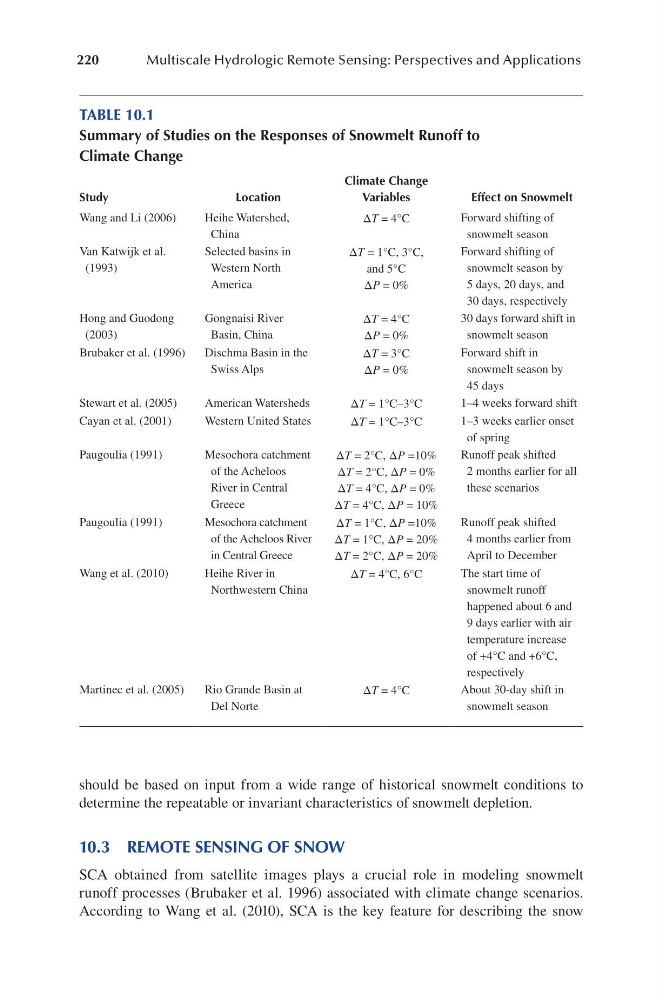
TABLE 10.1
Summary of Studies on the Responses of Snowmelt Runoff to
Climate Change
Study
Location
Climate Change
Variables
Effect on Snowmelt
Wang and Li (2006)
Heihe Watershed,
China
ΔT = 4°C
Forward shifting of
snowmelt season
Van Katwijk et al.
(1993)
Selected basins in
Western North
America
ΔT = 1°C, 3°C,
and 5°C
ΔP = 0%
Forward shifting of
snowmelt season by
5 days, 20 days, and
30 days, respectively
Hong and Guodong
(2003)
Gongnaisi River
Basin, China
ΔT = 4°C
ΔP = 0%
30 days forward shift in
snowmelt season
Brubaker et al. (1996)
Dischma Basin in the
Swiss Alps
ΔT = 3°C
ΔP = 0%
Forward shift in
snowmelt season by
45 days
Stewart et al. (2005)
American Watersheds
ΔT = 1°C–3°C
1–4 weeks forward shift
Cayan et al. (2001)
Western United States
ΔT = 1°C–3°C
1–3 weeks earlier onset
of spring
Paugoulia (1991)
Mesochora catchment
of the Acheloos
River in Central
Greece
ΔT = 2°C, ΔP =10%
ΔT = 2°C, ΔP = 0%
ΔT = 4°C, ΔP = 0%
ΔT = 4°C, ΔP = 10%
Runoff peak shifted
2 months earlier for all
these scenarios
Paugoulia (1991)
Mesochora catchment
of the Acheloos River
in Central Greece
ΔT = 1°C, ΔP =10%
ΔT = 1°C, ΔP = 20%
ΔT = 2°C, ΔP = 20%
Runoff peak shifted
4 months earlier from
April to December
Wang et al. (2010)
Heihe River in
Northwestern China
ΔT = 4°C, 6°C
The start time of
snowmelt runoff
happened about 6 and
9 days earlier with air
temperature increase
of +4°C and +6°C,
respectively
Martinec et al. (2005)
Rio Grande Basin at
Del Norte
ΔT = 4°C
About 30-day shift in
snowmelt season
Multiscale Hydrologic Remote Sensing: Perspectives and Applications
should be based on input from a wide range of historical snowmelt conditions to
determine the repeatable or invariant characteristics of snowmelt depletion.
10.3 REMOTE SENSING OF SNOW
SCA obtained from satellite images plays a crucial role in modeling snowmelt
runoff processes (Brubaker et al. 1996) associated with climate change scenarios.
According to Wang et al. (2010), SCA is the key feature for describing the snow
TABLE 10.1
Summary of Studies on the Responses of Snowmelt Runoff to
Climate Change
Study
Location
Climate Change
Variables
Effect on Snowmelt
Wang and Li (2006)
Heihe Watershed,
China
ΔT = 4°C
Forward shifting of
snowmelt season
Van Katwijk et al.
(1993)
Selected basins in
Western North
America
ΔT = 1°C, 3°C,
and 5°C
ΔP = 0%
Forward shifting of
snowmelt season by
5 days, 20 days, and
30 days, respectively
Hong and Guodong
(2003)
Gongnaisi River
Basin, China
ΔT = 4°C
ΔP = 0%
30 days forward shift in
snowmelt season
Brubaker et al. (1996)
Dischma Basin in the
Swiss Alps
ΔT = 3°C
ΔP = 0%
Forward shift in
snowmelt season by
45 days
Stewart et al. (2005)
American Watersheds
ΔT = 1°C–3°C
1–4 weeks forward shift
Cayan et al. (2001)
Western United States
ΔT = 1°C–3°C
1–3 weeks earlier onset
of spring
Paugoulia (1991)
Mesochora catchment
of the Acheloos
River in Central
Greece
ΔT = 2°C, ΔP =10%
ΔT = 2°C, ΔP = 0%
ΔT = 4°C, ΔP = 0%
ΔT = 4°C, ΔP = 10%
Runoff peak shifted
2 months earlier for all
these scenarios
Paugoulia (1991)
Mesochora catchment
of the Acheloos River
in Central Greece
ΔT = 1°C, ΔP =10%
ΔT = 1°C, ΔP = 20%
ΔT = 2°C, ΔP = 20%
Runoff peak shifted
4 months earlier from
April to December
Wang et al. (2010)
Heihe River in
Northwestern China
ΔT = 4°C, 6°C
The start time of
snowmelt runoff
happened about 6 and
9 days earlier with air
temperature increase
of +4°C and +6°C,
respectively
Martinec et al. (2005)
Rio Grande Basin at
Del Norte
ΔT = 4°C
About 30-day shift in
snowmelt season