

218
Multiscale Hydrologic Remote Sensing: Perspectives and Applications
from remotely sensed observations and satellite monitoring (Martinec and Rango
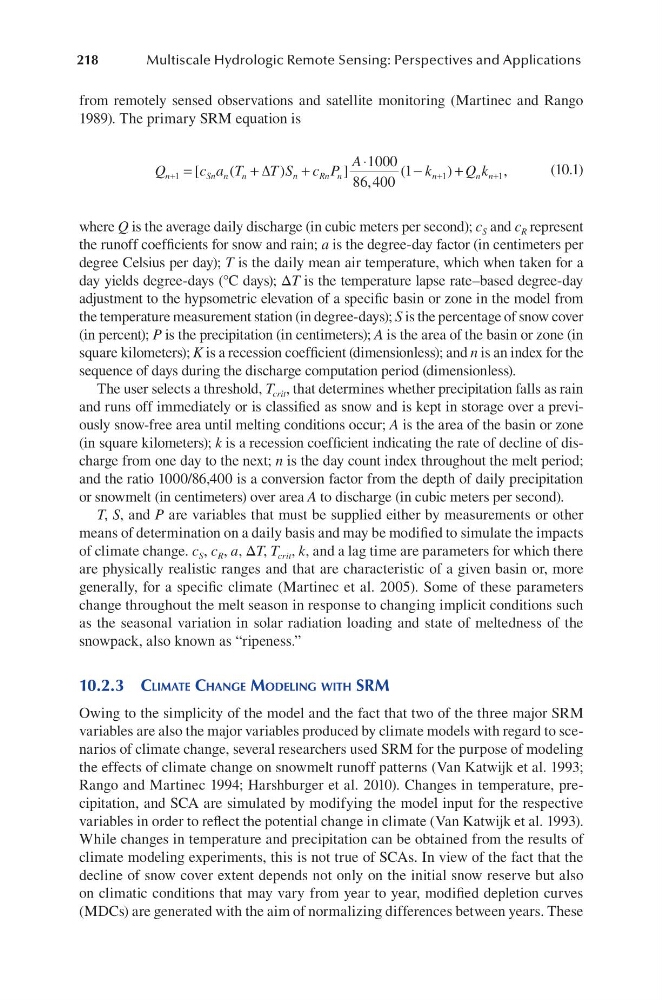
1989). The primary SRM equation is
Q
c a T
T S c P
A
k
n
Sn n n
n
Rn n
n
+
+
=
+
+
⋅
−
1
1
1000
86 400
1
[
(
)
] ,
(
)
∆
+ +
+
Q k
n n 1 ,
(10.1)
where Q is the average daily discharge (in cubic meters per second); c S and c R represent
the runoff coefficients for snow and rain; a is the degree-day factor (in centimeters per
degree Celsius per day); T is the daily mean air temperature, which when taken for a
day yields degree-days (°C days); ΔT is the temperature lapse rate–based degree-day
adjustment to the hypsometric elevation of a specific basin or zone in the model from
the temperature measurement station (in degree-days); S is the percentage of snow cover
(in percent); P is the precipitation (in centimeters); A is the area of the basin or zone (in
square kilometers); K is a recession coefficient (dimensionless); and n is an index for the
sequence of days during the discharge computation period (dimensionless).
The user selects a threshold, T crit , that determines whether precipitation falls as rain
and runs off immediately or is classified as snow and is kept in storage over a previously snow-free area until melting conditions occur; A is the area of the basin or zone
(in square kilometers); k is a recession coefficient indicating the rate of decline of discharge from one day to the next; n is the day count index throughout the melt period;
and the ratio 1000/86,400 is a conversion factor from the depth of daily precipitation
or snowmelt (in centimeters) over area A to discharge (in cubic meters per second).
T, S, and P are variables that must be supplied either by measurements or other
means of determination on a daily basis and may be modified to simulate the impacts
of climate change. c S , c R , a, ΔT, T crit , k, and a lag time are parameters for which there
are physically realistic ranges and that are characteristic of a given basin or, more
generally, for a specific climate (Martinec et al. 2005). Some of these parameters
change throughout the melt season in response to changing implicit conditions such
as the seasonal variation in solar radiation loading and state of meltedness of the
snowpack, also known as “ripeness.”
10.2.3 cliMate change Modeling with SRM
Owing to the simplicity of the model and the fact that two of the three major SRM
variables are also the major variables produced by climate models with regard to scenarios of climate change, several researchers used SRM for the purpose of modeling
the effects of climate change on snowmelt runoff patterns (Van Katwijk et al. 1993;
Rango and Martinec 1994; Harshburger et al. 2010). Changes in temperature, precipitation, and SCA are simulated by modifying the model input for the respective
variables in order to reflect the potential change in climate (Van Katwijk et al. 1993).
While changes in temperature and precipitation can be obtained from the results of
climate modeling experiments, this is not true of SCAs. In view of the fact that the
decline of snow cover extent depends not only on the initial snow reserve but also
on climatic conditions that may vary from year to year, modified depletion curves
(MDCs) are generated with the aim of normalizing differences between years. These
Multiscale Hydrologic Remote Sensing: Perspectives and Applications
from remotely sensed observations and satellite monitoring (Martinec and Rango
1989). The primary SRM equation is
Q
c a T
T S c P
A
k
n
Sn n n
n
Rn n
n
+
+
=
+
+
⋅
−
1
1
1000
86 400
1
[
(
)
] ,
(
)
∆
+ +
+
Q k
n n 1 ,
(10.1)
where Q is the average daily discharge (in cubic meters per second); c S and c R represent
the runoff coefficients for snow and rain; a is the degree-day factor (in centimeters per
degree Celsius per day); T is the daily mean air temperature, which when taken for a
day yields degree-days (°C days); ΔT is the temperature lapse rate–based degree-day
adjustment to the hypsometric elevation of a specific basin or zone in the model from
the temperature measurement station (in degree-days); S is the percentage of snow cover
(in percent); P is the precipitation (in centimeters); A is the area of the basin or zone (in
square kilometers); K is a recession coefficient (dimensionless); and n is an index for the
sequence of days during the discharge computation period (dimensionless).
The user selects a threshold, T crit , that determines whether precipitation falls as rain
and runs off immediately or is classified as snow and is kept in storage over a previously snow-free area until melting conditions occur; A is the area of the basin or zone
(in square kilometers); k is a recession coefficient indicating the rate of decline of discharge from one day to the next; n is the day count index throughout the melt period;
and the ratio 1000/86,400 is a conversion factor from the depth of daily precipitation
or snowmelt (in centimeters) over area A to discharge (in cubic meters per second).
T, S, and P are variables that must be supplied either by measurements or other
means of determination on a daily basis and may be modified to simulate the impacts
of climate change. c S , c R , a, ΔT, T crit , k, and a lag time are parameters for which there
are physically realistic ranges and that are characteristic of a given basin or, more
generally, for a specific climate (Martinec et al. 2005). Some of these parameters
change throughout the melt season in response to changing implicit conditions such
as the seasonal variation in solar radiation loading and state of meltedness of the
snowpack, also known as “ripeness.”
10.2.3 cliMate change Modeling with SRM
Owing to the simplicity of the model and the fact that two of the three major SRM
variables are also the major variables produced by climate models with regard to scenarios of climate change, several researchers used SRM for the purpose of modeling
the effects of climate change on snowmelt runoff patterns (Van Katwijk et al. 1993;
Rango and Martinec 1994; Harshburger et al. 2010). Changes in temperature, precipitation, and SCA are simulated by modifying the model input for the respective
variables in order to reflect the potential change in climate (Van Katwijk et al. 1993).
While changes in temperature and precipitation can be obtained from the results of
climate modeling experiments, this is not true of SCAs. In view of the fact that the
decline of snow cover extent depends not only on the initial snow reserve but also
on climatic conditions that may vary from year to year, modified depletion curves
(MDCs) are generated with the aim of normalizing differences between years. These