

216
Multiscale Hydrologic Remote Sensing: Perspectives and Applications
available to run energy balance models (Kustas et al. 1994; Singh et al. 2000), which
has prevented them from gaining dominance over the temperature index approach.
Although energy balance models have been used successfully in some studies like
the work of Garen and Marks (2005), it is noteworthy to point out that many of the
required input data, including radiation/incoming thermal radiation, net radiation,
cloudiness, wind speed, and humidity, are not readily available. Despite their support and use of energy balance models, Garen and Marks (2005) emphasized that
the process involved in data preparation is not only time consuming but also subject
to a lot of human errors due to the extensive manual editing and manipulation that
may be difficult to automate. Adding to the list of challenges, Day (2009) indicated
that several problems arise concerning the use of this approach in the field owing to
the technicalities of the procedure. These difficulties might pose a challenge to the
universal acceptability of the model. Rango and Martinec (1995) “felt the theoretical
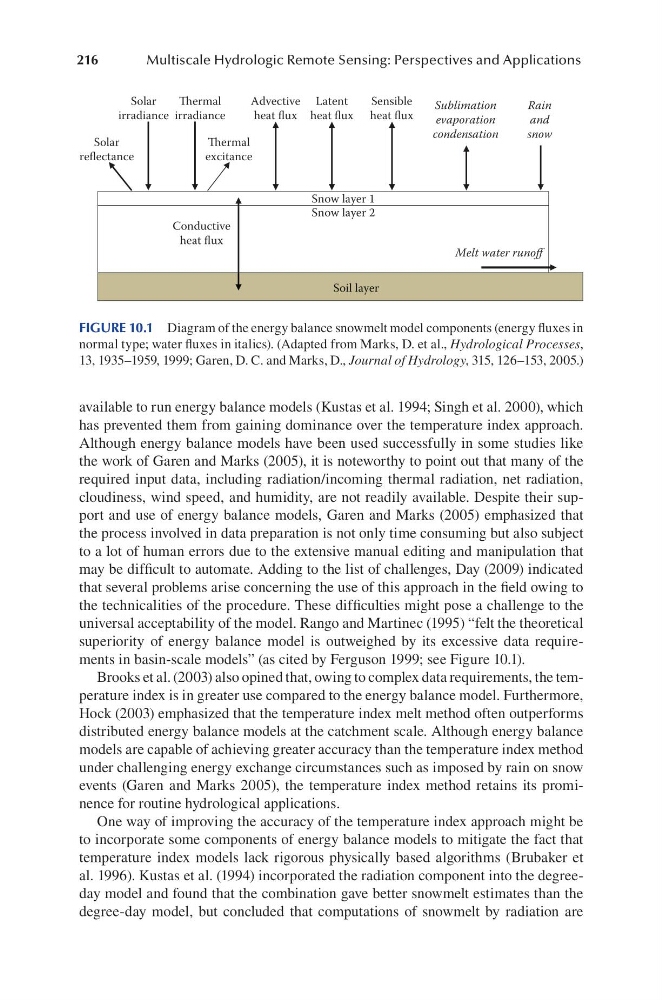
superiority of energy balance model is outweighed by its excessive data requirements in basin-scale models” (as cited by Ferguson 1999; see Figure 10.1).
Brooks et al. (2003) also opined that, owing to complex data requirements, the temperature index is in greater use compared to the energy balance model. Furthermore,
Hock (2003) emphasized that the temperature index melt method often outperforms
distributed energy balance models at the catchment scale. Although energy balance
models are capable of achieving greater accuracy than the temperature index method
under challenging energy exchange circumstances such as imposed by rain on snow
events (Garen and Marks 2005), the temperature index method retains its prominence for routine hydrological applications.
One way of improving the accuracy of the temperature index approach might be
to incorporate some components of energy balance models to mitigate the fact that
temperature index models lack rigorous physically based algorithms (Brubaker et
al. 1996). Kustas et al. (1994) incorporated the radiation component into the degreeday model and found that the combination gave better snowmelt estimates than the
degree-day model, but concluded that computations of snowmelt by radiation are
Solar
irradiance
ermal
irradiance
Sublimation
evaporation
condensation
Rain
and
snow
Advective
heat flux
Latent
heat flux
Sensible
heat flux
Solar
reflectance
ermal
excitance
Snow layer 1
Snow layer 2
Conductive
heat flux
Melt water runoff
Soil layer
FIGURE 10.1 Diagram of the energy balance snowmelt model components (energy fluxes in
normal type; water fluxes in italics). (Adapted from Marks, D. et al., Hydrological Processes,
13, 1935–1959, 1999; Garen, D. C. and Marks, D., Journal of Hydrology, 315, 126–153, 2005.)
Multiscale Hydrologic Remote Sensing: Perspectives and Applications
available to run energy balance models (Kustas et al. 1994; Singh et al. 2000), which
has prevented them from gaining dominance over the temperature index approach.
Although energy balance models have been used successfully in some studies like
the work of Garen and Marks (2005), it is noteworthy to point out that many of the
required input data, including radiation/incoming thermal radiation, net radiation,
cloudiness, wind speed, and humidity, are not readily available. Despite their support and use of energy balance models, Garen and Marks (2005) emphasized that
the process involved in data preparation is not only time consuming but also subject
to a lot of human errors due to the extensive manual editing and manipulation that
may be difficult to automate. Adding to the list of challenges, Day (2009) indicated
that several problems arise concerning the use of this approach in the field owing to
the technicalities of the procedure. These difficulties might pose a challenge to the
universal acceptability of the model. Rango and Martinec (1995) “felt the theoretical
superiority of energy balance model is outweighed by its excessive data requirements in basin-scale models” (as cited by Ferguson 1999; see Figure 10.1).
Brooks et al. (2003) also opined that, owing to complex data requirements, the temperature index is in greater use compared to the energy balance model. Furthermore,
Hock (2003) emphasized that the temperature index melt method often outperforms
distributed energy balance models at the catchment scale. Although energy balance
models are capable of achieving greater accuracy than the temperature index method
under challenging energy exchange circumstances such as imposed by rain on snow
events (Garen and Marks 2005), the temperature index method retains its prominence for routine hydrological applications.
One way of improving the accuracy of the temperature index approach might be
to incorporate some components of energy balance models to mitigate the fact that
temperature index models lack rigorous physically based algorithms (Brubaker et
al. 1996). Kustas et al. (1994) incorporated the radiation component into the degreeday model and found that the combination gave better snowmelt estimates than the
degree-day model, but concluded that computations of snowmelt by radiation are
Solar
irradiance
ermal
irradiance
Sublimation
evaporation
condensation
Rain
and
snow
Advective
heat flux
Latent
heat flux
Sensible
heat flux
Solar
reflectance
ermal
excitance
Snow layer 1
Snow layer 2
Conductive
heat flux
Melt water runoff
Soil layer
FIGURE 10.1 Diagram of the energy balance snowmelt model components (energy fluxes in
normal type; water fluxes in italics). (Adapted from Marks, D. et al., Hydrological Processes,
13, 1935–1959, 1999; Garen, D. C. and Marks, D., Journal of Hydrology, 315, 126–153, 2005.)