

season imposes a period of rest on the winter
vegetation, just as winter imposes a similar
period on the forests of the middle latitudes.
Many, although not all, of the trees lose their
leaves. On the dry margins, the semideciduous
forest merges into woodlands.
Where both the rainforest and semideciduous
forest border the ocean along low, coastal plains,
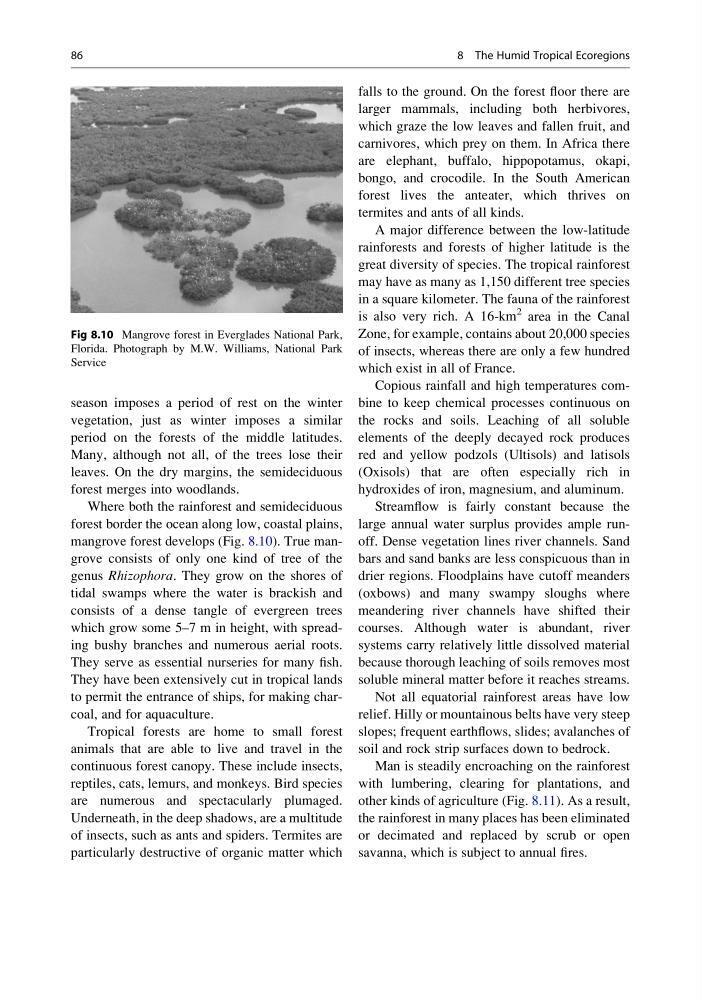
mangrove forest develops (Fig. 8.10). True mangrove consists of only one kind of tree of the
genus Rhizophora. They grow on the shores of
tidal swamps where the water is brackish and
consists of a dense tangle of evergreen trees
which grow some 5–7 m in height, with spreading bushy branches and numerous aerial roots.
They serve as essential nurseries for many fish.
They have been extensively cut in tropical lands
to permit the entrance of ships, for making charcoal, and for aquaculture.
Tropical forests are home to small forest
animals that are able to live and travel in the
continuous forest canopy. These include insects,
reptiles, cats, lemurs, and monkeys. Bird species
are numerous and spectacularly plumaged.
Underneath, in the deep shadows, are a multitude
of insects, such as ants and spiders. Termites are
particularly destructive of organic matter which
falls to the ground. On the forest floor there are
larger mammals, including both herbivores,
which graze the low leaves and fallen fruit, and
carnivores, which prey on them. In Africa there
are elephant, buffalo, hippopotamus, okapi,
bongo, and crocodile. In the South American
forest lives the anteater, which thrives on
termites and ants of all kinds.
A major difference between the low-latitude
rainforests and forests of higher latitude is the
great diversity of species. The tropical rainforest
may have as many as 1,150 different tree species
in a square kilometer. The fauna of the rainforest
is also very rich. A 16-km
2 area in the Canal
Zone, for example, contains about 20,000 species
of insects, whereas there are only a few hundred
which exist in all of France.
Copious rainfall and high temperatures combine to keep chemical processes continuous on
the rocks and soils. Leaching of all soluble
elements of the deeply decayed rock produces
red and yellow podzols (Ultisols) and latisols
(Oxisols) that are often especially rich in
hydroxides of iron, magnesium, and aluminum.
Streamflow is fairly constant because the
large annual water surplus provides ample runoff. Dense vegetation lines river channels. Sand
bars and sand banks are less conspicuous than in
drier regions. Floodplains have cutoff meanders
(oxbows) and many swampy sloughs where
meandering river channels have shifted their
courses. Although water is abundant, river
systems carry relatively little dissolved material
because thorough leaching of soils removes most
soluble mineral matter before it reaches streams.
Not all equatorial rainforest areas have low
relief. Hilly or mountainous belts have very steep
slopes; frequent earthflows, slides; avalanches of
soil and rock strip surfaces down to bedrock.
Man is steadily encroaching on the rainforest
with lumbering, clearing for plantations, and
other kinds of agriculture (Fig. 8.11). As a result,
the rainforest in many places has been eliminated
or decimated and replaced by scrub or open
savanna, which is subject to annual fires.
Fig 8.10 Mangrove forest in Everglades National Park,
Florida. Photograph by M.W. Williams, National Park
Service
86
8 The Humid Tropical Ecoregions
vegetation, just as winter imposes a similar
period on the forests of the middle latitudes.
Many, although not all, of the trees lose their
leaves. On the dry margins, the semideciduous
forest merges into woodlands.
Where both the rainforest and semideciduous
forest border the ocean along low, coastal plains,
mangrove forest develops (Fig. 8.10). True mangrove consists of only one kind of tree of the
genus Rhizophora. They grow on the shores of
tidal swamps where the water is brackish and
consists of a dense tangle of evergreen trees
which grow some 5–7 m in height, with spreading bushy branches and numerous aerial roots.
They serve as essential nurseries for many fish.
They have been extensively cut in tropical lands
to permit the entrance of ships, for making charcoal, and for aquaculture.
Tropical forests are home to small forest
animals that are able to live and travel in the
continuous forest canopy. These include insects,
reptiles, cats, lemurs, and monkeys. Bird species
are numerous and spectacularly plumaged.
Underneath, in the deep shadows, are a multitude
of insects, such as ants and spiders. Termites are
particularly destructive of organic matter which
falls to the ground. On the forest floor there are
larger mammals, including both herbivores,
which graze the low leaves and fallen fruit, and
carnivores, which prey on them. In Africa there
are elephant, buffalo, hippopotamus, okapi,
bongo, and crocodile. In the South American
forest lives the anteater, which thrives on
termites and ants of all kinds.
A major difference between the low-latitude
rainforests and forests of higher latitude is the
great diversity of species. The tropical rainforest
may have as many as 1,150 different tree species
in a square kilometer. The fauna of the rainforest
is also very rich. A 16-km
2 area in the Canal
Zone, for example, contains about 20,000 species
of insects, whereas there are only a few hundred
which exist in all of France.
Copious rainfall and high temperatures combine to keep chemical processes continuous on
the rocks and soils. Leaching of all soluble
elements of the deeply decayed rock produces
red and yellow podzols (Ultisols) and latisols
(Oxisols) that are often especially rich in
hydroxides of iron, magnesium, and aluminum.
Streamflow is fairly constant because the
large annual water surplus provides ample runoff. Dense vegetation lines river channels. Sand
bars and sand banks are less conspicuous than in
drier regions. Floodplains have cutoff meanders
(oxbows) and many swampy sloughs where
meandering river channels have shifted their
courses. Although water is abundant, river
systems carry relatively little dissolved material
because thorough leaching of soils removes most
soluble mineral matter before it reaches streams.
Not all equatorial rainforest areas have low
relief. Hilly or mountainous belts have very steep
slopes; frequent earthflows, slides; avalanches of
soil and rock strip surfaces down to bedrock.
Man is steadily encroaching on the rainforest
with lumbering, clearing for plantations, and
other kinds of agriculture (Fig. 8.11). As a result,
the rainforest in many places has been eliminated
or decimated and replaced by scrub or open
savanna, which is subject to annual fires.
Fig 8.10 Mangrove forest in Everglades National Park,
Florida. Photograph by M.W. Williams, National Park
Service
86
8 The Humid Tropical Ecoregions