

The regions of the humid temperate domain
occur within climatic conditions where there is a
winter cold season when plant growth ceases,
and rain in summer is sufficient to support forest
vegetation of broadleaf deciduous and needleleaf
evergreen trees. On the equatorward side of these
regions where this group borders the tropical
regions, the differences in the forest are not
sharply contrasted. Gradually the species that
cannot survive frost drop out. On the poleward
side of these regions in the Northern Hemisphere,
there is a relatively sharp line of demarcation.
The boreal forest occurs where there are severe
winters and only short, cool summers. Here the
spruce, fir, and larch are the more widespread
conifers. Toward the continental interiors, on
the dry side of these regions, grasslands usually
border the forests.
Animals in these climates need to survive cold
winters and seasonal variations in their food supply. Some vary their diet. Many birds and
mammals migrate to warmer climates. Most
amphibians and reptiles, as well as some large
mammals, hibernate or become dormant.
The variable importance of winter frost
determines six divisions: warm continental, hot
continental, subtropical, marine, prairie, and
mediterranean. Figure 6.2 shows the distribution
of these divisions. Climate diagrams for these
divisions are presented in Fig. 6.3.
6.2
210 Warm Continental Division
South of the eastern area of the subarctic climate,
between latitudes 40
and 55
N and from the
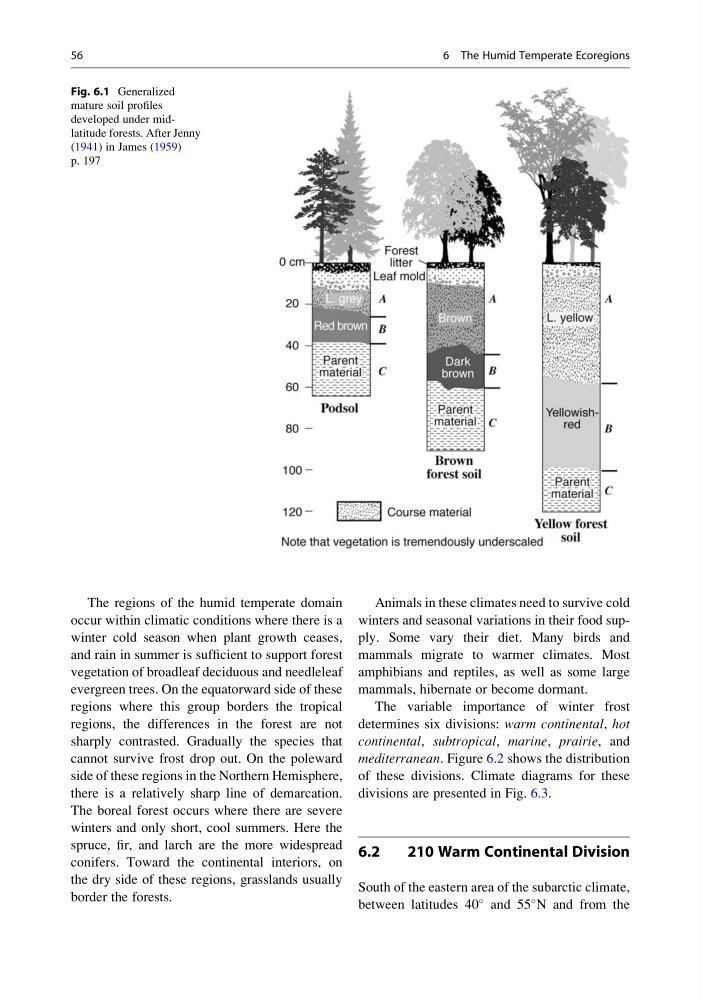
Fig. 6.1 Generalized
mature soil profiles
developed under midlatitude forests. After Jenny
(1941) in James (1959)
p. 197
56
6 The Humid Temperate Ecoregions
occur within climatic conditions where there is a
winter cold season when plant growth ceases,
and rain in summer is sufficient to support forest
vegetation of broadleaf deciduous and needleleaf
evergreen trees. On the equatorward side of these
regions where this group borders the tropical
regions, the differences in the forest are not
sharply contrasted. Gradually the species that
cannot survive frost drop out. On the poleward
side of these regions in the Northern Hemisphere,
there is a relatively sharp line of demarcation.
The boreal forest occurs where there are severe
winters and only short, cool summers. Here the
spruce, fir, and larch are the more widespread
conifers. Toward the continental interiors, on
the dry side of these regions, grasslands usually
border the forests.
Animals in these climates need to survive cold
winters and seasonal variations in their food supply. Some vary their diet. Many birds and
mammals migrate to warmer climates. Most
amphibians and reptiles, as well as some large
mammals, hibernate or become dormant.
The variable importance of winter frost
determines six divisions: warm continental, hot
continental, subtropical, marine, prairie, and
mediterranean. Figure 6.2 shows the distribution
of these divisions. Climate diagrams for these
divisions are presented in Fig. 6.3.
6.2
210 Warm Continental Division
South of the eastern area of the subarctic climate,
between latitudes 40
and 55
N and from the
Fig. 6.1 Generalized
mature soil profiles
developed under midlatitude forests. After Jenny
(1941) in James (1959)
p. 197
56
6 The Humid Temperate Ecoregions