

3.3.6 760 Equatorial Countercurrent
Division
The equatorial currents are separated by an equatorial countercurrent and are designated A by
Dietrich. This condition is well developed in
the three oceans. This region, lying roughly 5
S
and 5
N lat., coincides with a trough of low
pressure, the intertropical convergence zone
(see also Chap. 4, p. 27 and Chap. 8, p. 81).
The northeast and southeast trade winds come
together toward this trough. It is a zone of variable winds and calms, or the doldrums. The zone
contains large amounts of moisture, and cloudiness and frequent precipitation are common. The
heavy precipitation lowers the salinity of the sea
surface considerably.
Upwelling at the poleward side of the countercurrent results in ascending water masses rich
in nutrients. As it reaches the surface, an
abundant plankton population develops (see
Fig. 2.4, p. 12). Like the areas of upwelling in
the eastern region of the trade wind currents, the
equatorial countercurrent zones are characterized
by greenish color and an abundance of fish.
3.4
Shelf
All shallow-shelf areas with depths of 0–200 m
are interpreted as shallow variations of the hydrologic zone concerned. A further ecoregional
breakdown of coastal and shelf areas of the
world is presented by Spalding et al. (2007).
A controlling factor approach to classification
(see Chap. 2) of estuaries in New Zealand is
described by Hume et al. (2007). The classification is based on the principle that particular
factors are responsible for environmental processes and patterns that are observed at various
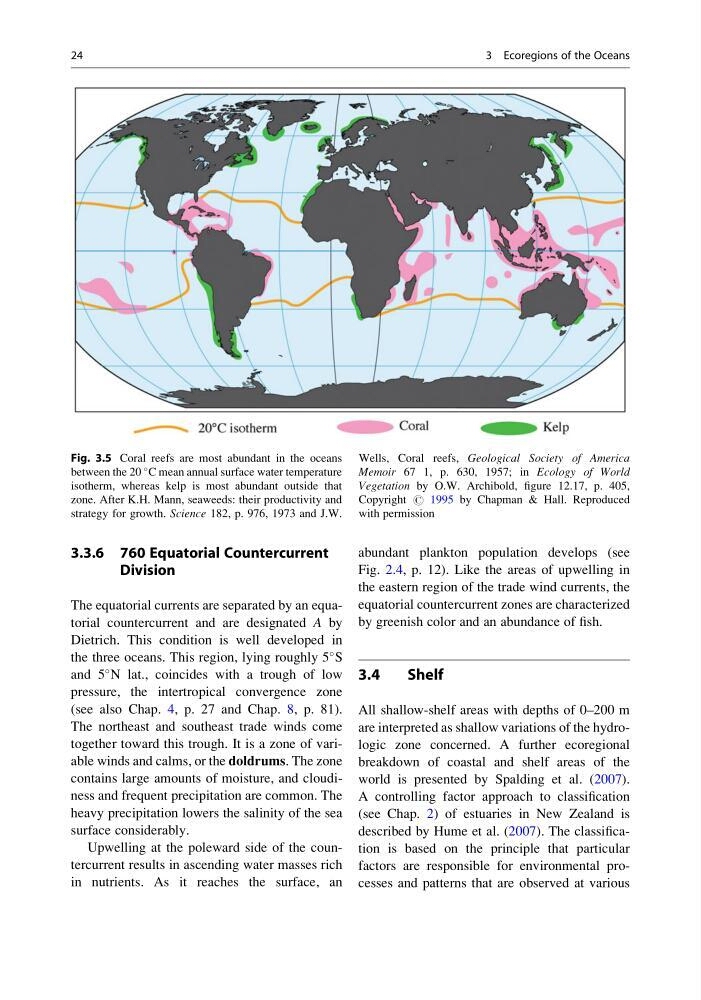
Fig. 3.5 Coral reefs are most abundant in the oceans
between the 20
C mean annual surface water temperature
isotherm, whereas kelp is most abundant outside that
zone. After K.H. Mann, seaweeds: their productivity and
strategy for growth. Science 182, p. 976, 1973 and J.W.
Wells, Coral reefs, Geological Society of America
Memoir 67 1, p. 630, 1957; in Ecology of World
Vegetation by O.W. Archibold, figure 12.17, p. 405,
Copyright # 1995 by Chapman & Hall. Reproduced
with permission
24
3 Ecoregions of the Oceans
Division
The equatorial currents are separated by an equatorial countercurrent and are designated A by
Dietrich. This condition is well developed in
the three oceans. This region, lying roughly 5
S
and 5
N lat., coincides with a trough of low
pressure, the intertropical convergence zone
(see also Chap. 4, p. 27 and Chap. 8, p. 81).
The northeast and southeast trade winds come
together toward this trough. It is a zone of variable winds and calms, or the doldrums. The zone
contains large amounts of moisture, and cloudiness and frequent precipitation are common. The
heavy precipitation lowers the salinity of the sea
surface considerably.
Upwelling at the poleward side of the countercurrent results in ascending water masses rich
in nutrients. As it reaches the surface, an
abundant plankton population develops (see
Fig. 2.4, p. 12). Like the areas of upwelling in
the eastern region of the trade wind currents, the
equatorial countercurrent zones are characterized
by greenish color and an abundance of fish.
3.4
Shelf
All shallow-shelf areas with depths of 0–200 m
are interpreted as shallow variations of the hydrologic zone concerned. A further ecoregional
breakdown of coastal and shelf areas of the
world is presented by Spalding et al. (2007).
A controlling factor approach to classification
(see Chap. 2) of estuaries in New Zealand is
described by Hume et al. (2007). The classification is based on the principle that particular
factors are responsible for environmental processes and patterns that are observed at various
Fig. 3.5 Coral reefs are most abundant in the oceans
between the 20
C mean annual surface water temperature
isotherm, whereas kelp is most abundant outside that
zone. After K.H. Mann, seaweeds: their productivity and
strategy for growth. Science 182, p. 976, 1973 and J.W.
Wells, Coral reefs, Geological Society of America
Memoir 67 1, p. 630, 1957; in Ecology of World
Vegetation by O.W. Archibold, figure 12.17, p. 405,
Copyright # 1995 by Chapman & Hall. Reproduced
with permission
24
3 Ecoregions of the Oceans