

(division) characterized by excess evaporation
over precipitation; (e) a jet-stream zone (division) characterized by strong, narrow currents
which exist during the entire year as the result
of discharge from trade wind regions; and (f) a
poleward monsoon zone (division) of high
latitudes with the reversal of current (connected
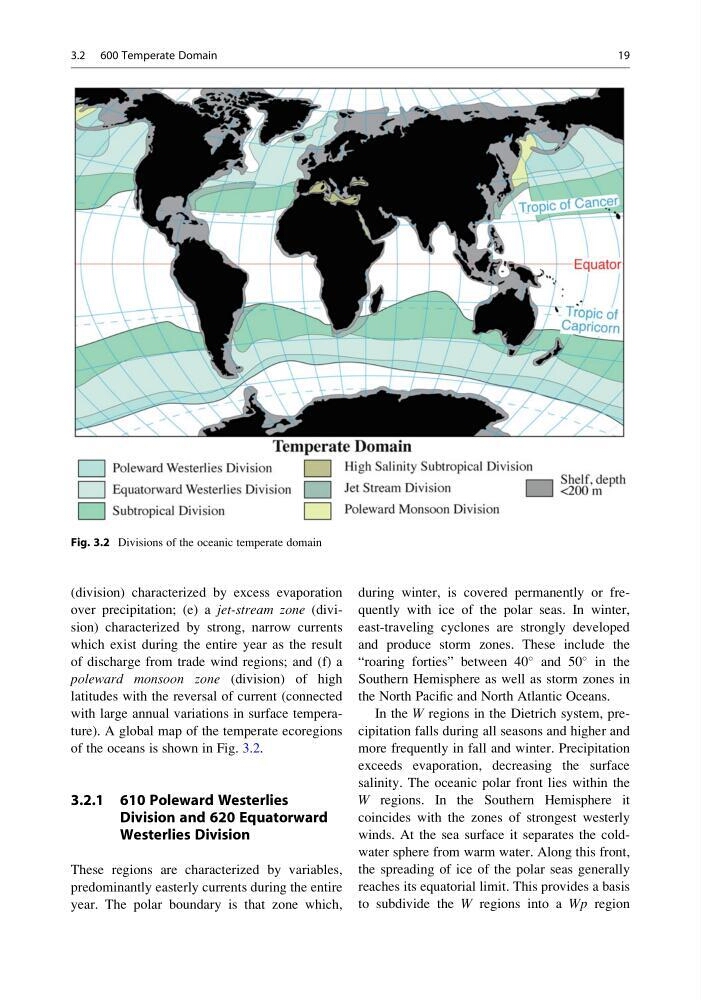
with large annual variations in surface temperature). A global map of the temperate ecoregions
of the oceans is shown in Fig. 3.2.
3.2.1 610 Poleward Westerlies
Division and 620 Equatorward
Westerlies Division
These regions are characterized by variables,
predominantly easterly currents during the entire
year. The polar boundary is that zone which,
during winter, is covered permanently or frequently with ice of the polar seas. In winter,
east-traveling cyclones are strongly developed
and produce storm zones. These include the
“roaring forties” between 40
and 50
in the
Southern Hemisphere as well as storm zones in
the North Pacific and North Atlantic Oceans.
In the W regions in the Dietrich system, precipitation falls during all seasons and higher and
more frequently in fall and winter. Precipitation
exceeds evaporation, decreasing the surface
salinity. The oceanic polar front lies within the
W regions. In the Southern Hemisphere it
coincides with the zones of strongest westerly
winds. At the sea surface it separates the coldwater sphere from warm water. Along this front,
the spreading of ice of the polar seas generally
reaches its equatorial limit. This provides a basis
to subdivide the W regions into a Wp region
Fig. 3.2 Divisions of the oceanic temperate domain
3.2 600 Temperate Domain
19
over precipitation; (e) a jet-stream zone (division) characterized by strong, narrow currents
which exist during the entire year as the result
of discharge from trade wind regions; and (f) a
poleward monsoon zone (division) of high
latitudes with the reversal of current (connected
with large annual variations in surface temperature). A global map of the temperate ecoregions
of the oceans is shown in Fig. 3.2.
3.2.1 610 Poleward Westerlies
Division and 620 Equatorward
Westerlies Division
These regions are characterized by variables,
predominantly easterly currents during the entire
year. The polar boundary is that zone which,
during winter, is covered permanently or frequently with ice of the polar seas. In winter,
east-traveling cyclones are strongly developed
and produce storm zones. These include the
“roaring forties” between 40
and 50
in the
Southern Hemisphere as well as storm zones in
the North Pacific and North Atlantic Oceans.
In the W regions in the Dietrich system, precipitation falls during all seasons and higher and
more frequently in fall and winter. Precipitation
exceeds evaporation, decreasing the surface
salinity. The oceanic polar front lies within the
W regions. In the Southern Hemisphere it
coincides with the zones of strongest westerly
winds. At the sea surface it separates the coldwater sphere from warm water. Along this front,
the spreading of ice of the polar seas generally
reaches its equatorial limit. This provides a basis
to subdivide the W regions into a Wp region
Fig. 3.2 Divisions of the oceanic temperate domain
3.2 600 Temperate Domain
19