

evaporation. Marine organisms are usually more
abundant in cold waters, which makes the water
appear more green.
There are seven main groups of hydrologic
zones. Six are based on ocean currents, while
the polar group is not. Four of these are
subdivided into types based on current direction,
latitude, and duration of pack ice. All together
there are 12 regional divisions.
Dietrich (1963) describes them briefly. In the
equatorial region is a belt with currents directed
toward the east. These are the currents of the
equatorial region, or the A group. On the lowlatitude margins of the equatorial region are the
currents of the trade wind regions, or the P group,
where persistent currents move in a westerly
direction. It is subdivided into three types, with
a poleward current (Pp), a westerly current (Pw),
or an equatorward component (Pa¨). Poleward
from the trade winds is the horse wind region,
or R group, where weak currents of variable
direction exist. Still farther poleward is the
region of west wind drift, or W group, where
variable easterly currents prevail. Here, two
subdivisions are recognized: poleward of the
oceanic front (Wp) and equatorward of polar
front (Wa¨). In the very high latitudes are the
polar regions, or the B group, which are covered
by ice. The duration of ice determines the subdivision: outer polar (Ba¨) in winter and spring
which is covered with pack ice, and inner polar
(Bi) which is covered with ice the entire year.
The monsoon regions, group M, are subdivided
into poleward monsoon (Mp) and a tropical monsoon (Mt). A final subdivision is the jet stream
region, or F group, where strong, narrow currents
exist as a result of discharge from trade wind
regions.
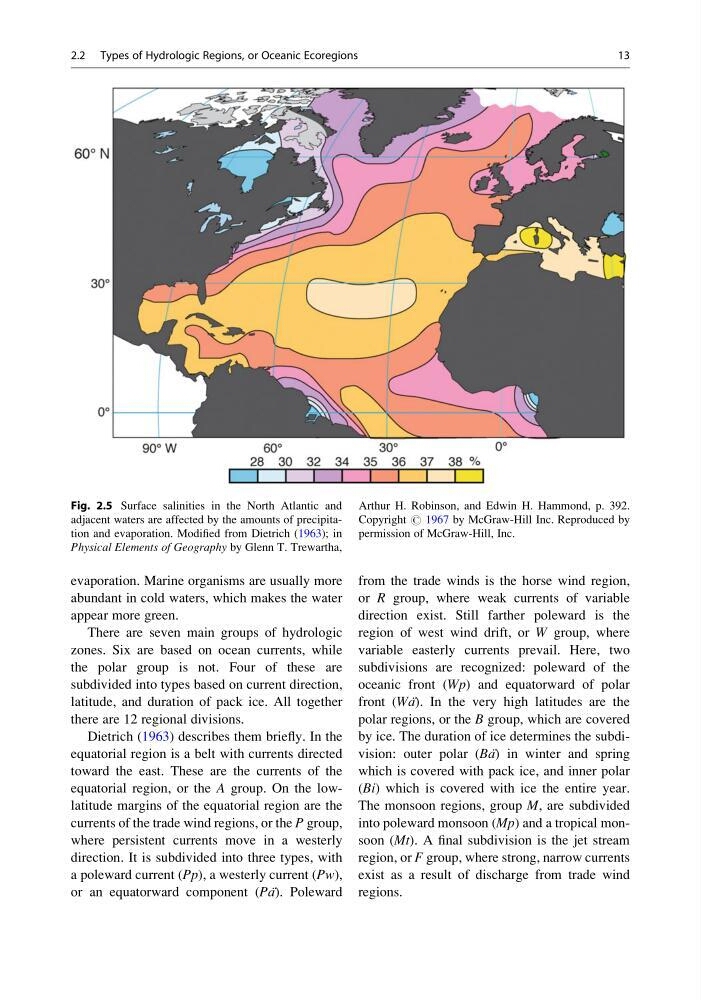
Fig. 2.5 Surface salinities in the North Atlantic and
adjacent waters are affected by the amounts of precipitation and evaporation. Modified from Dietrich (1963); in
Physical Elements of Geography by Glenn T. Trewartha,
Arthur H. Robinson, and Edwin H. Hammond, p. 392.
Copyright # 1967 by McGraw-Hill Inc. Reproduced by
permission of McGraw-Hill, Inc.
2.2 Types of Hydrologic Regions, or Oceanic Ecoregions
13
abundant in cold waters, which makes the water
appear more green.
There are seven main groups of hydrologic
zones. Six are based on ocean currents, while
the polar group is not. Four of these are
subdivided into types based on current direction,
latitude, and duration of pack ice. All together
there are 12 regional divisions.
Dietrich (1963) describes them briefly. In the
equatorial region is a belt with currents directed
toward the east. These are the currents of the
equatorial region, or the A group. On the lowlatitude margins of the equatorial region are the
currents of the trade wind regions, or the P group,
where persistent currents move in a westerly
direction. It is subdivided into three types, with
a poleward current (Pp), a westerly current (Pw),
or an equatorward component (Pa¨). Poleward
from the trade winds is the horse wind region,
or R group, where weak currents of variable
direction exist. Still farther poleward is the
region of west wind drift, or W group, where
variable easterly currents prevail. Here, two
subdivisions are recognized: poleward of the
oceanic front (Wp) and equatorward of polar
front (Wa¨). In the very high latitudes are the
polar regions, or the B group, which are covered
by ice. The duration of ice determines the subdivision: outer polar (Ba¨) in winter and spring
which is covered with pack ice, and inner polar
(Bi) which is covered with ice the entire year.
The monsoon regions, group M, are subdivided
into poleward monsoon (Mp) and a tropical monsoon (Mt). A final subdivision is the jet stream
region, or F group, where strong, narrow currents
exist as a result of discharge from trade wind
regions.
Fig. 2.5 Surface salinities in the North Atlantic and
adjacent waters are affected by the amounts of precipitation and evaporation. Modified from Dietrich (1963); in
Physical Elements of Geography by Glenn T. Trewartha,
Arthur H. Robinson, and Edwin H. Hammond, p. 392.
Copyright # 1967 by McGraw-Hill Inc. Reproduced by
permission of McGraw-Hill, Inc.
2.2 Types of Hydrologic Regions, or Oceanic Ecoregions
13