

arrangement of thermal zones. The most important of these winds, centered over the ocean
basins at about 30
in both hemispheres, are
known as oceanic whirls (Fig. 2.2). They circulate around the subtropical high-pressure cells,
created by subsiding air masses (see Fig. 4.4, p.
30). Lying between the subtropical belts and the
equator are easterly winds, known as trade
winds. Near the equator the trade winds of both
hemispheres converge to form a low-pressure
trough, often referred to as the intertropical
convergence zone, or ITC. On the poleward
side of the subtropical highs is a belt of westerly
winds, or westerlies. Generally, wind-driven
ocean currents move warm water toward the
poles and cold water toward the tropics, in a
clockwise direction in the Northern Hemisphere
and a counterclockwise direction in the Southern
Hemisphere (Fig. 2.3).
The effects of these movements may be seen
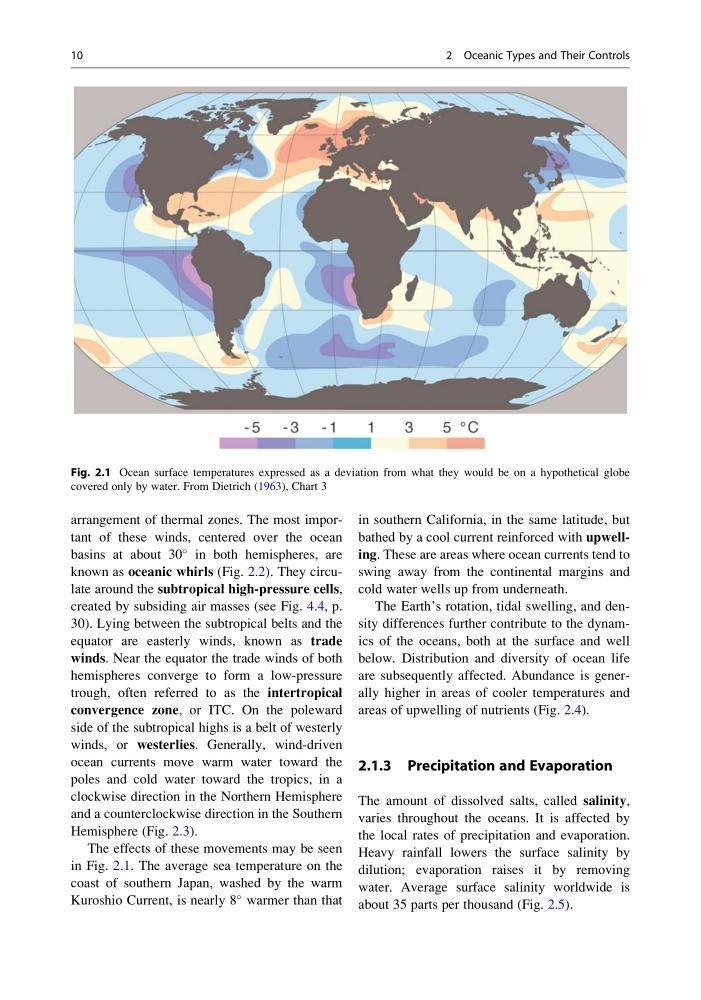
in Fig. 2.1. The average sea temperature on the
coast of southern Japan, washed by the warm
Kuroshio Current, is nearly 8
warmer than that
in southern California, in the same latitude, but
bathed by a cool current reinforced with upwelling. These are areas where ocean currents tend to
swing away from the continental margins and
cold water wells up from underneath.
The Earth’s rotation, tidal swelling, and density differences further contribute to the dynamics of the oceans, both at the surface and well
below. Distribution and diversity of ocean life
are subsequently affected. Abundance is generally higher in areas of cooler temperatures and
areas of upwelling of nutrients (Fig. 2.4).
2.1.3 Precipitation and Evaporation
The amount of dissolved salts, called salinity,
varies throughout the oceans. It is affected by
the local rates of precipitation and evaporation.
Heavy rainfall lowers the surface salinity by
dilution; evaporation raises it by removing
water. Average surface salinity worldwide is
about 35 parts per thousand (Fig. 2.5).
Fig. 2.1 Ocean surface temperatures expressed as a deviation from what they would be on a hypothetical globe
covered only by water. From Dietrich (1963), Chart 3
10
2 Oceanic Types and Their Controls
basins at about 30
in both hemispheres, are
known as oceanic whirls (Fig. 2.2). They circulate around the subtropical high-pressure cells,
created by subsiding air masses (see Fig. 4.4, p.
30). Lying between the subtropical belts and the
equator are easterly winds, known as trade
winds. Near the equator the trade winds of both
hemispheres converge to form a low-pressure
trough, often referred to as the intertropical
convergence zone, or ITC. On the poleward
side of the subtropical highs is a belt of westerly
winds, or westerlies. Generally, wind-driven
ocean currents move warm water toward the
poles and cold water toward the tropics, in a
clockwise direction in the Northern Hemisphere
and a counterclockwise direction in the Southern
Hemisphere (Fig. 2.3).
The effects of these movements may be seen
in Fig. 2.1. The average sea temperature on the
coast of southern Japan, washed by the warm
Kuroshio Current, is nearly 8
warmer than that
in southern California, in the same latitude, but
bathed by a cool current reinforced with upwelling. These are areas where ocean currents tend to
swing away from the continental margins and
cold water wells up from underneath.
The Earth’s rotation, tidal swelling, and density differences further contribute to the dynamics of the oceans, both at the surface and well
below. Distribution and diversity of ocean life
are subsequently affected. Abundance is generally higher in areas of cooler temperatures and
areas of upwelling of nutrients (Fig. 2.4).
2.1.3 Precipitation and Evaporation
The amount of dissolved salts, called salinity,
varies throughout the oceans. It is affected by
the local rates of precipitation and evaporation.
Heavy rainfall lowers the surface salinity by
dilution; evaporation raises it by removing
water. Average surface salinity worldwide is
about 35 parts per thousand (Fig. 2.5).
Fig. 2.1 Ocean surface temperatures expressed as a deviation from what they would be on a hypothetical globe
covered only by water. From Dietrich (1963), Chart 3
10
2 Oceanic Types and Their Controls