

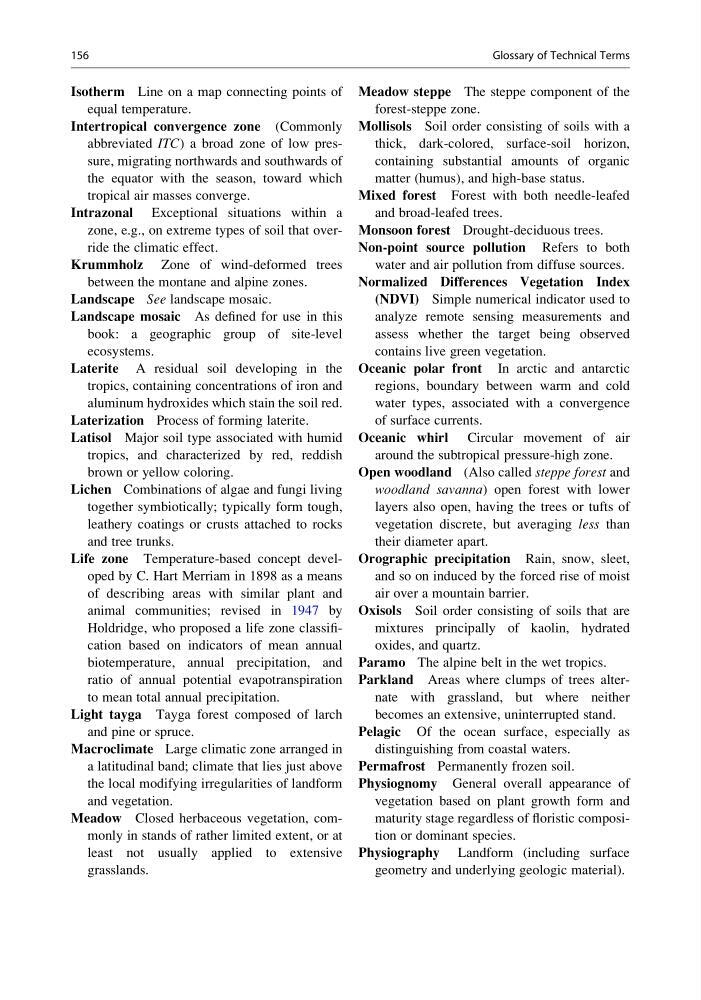
Isotherm Line on a map connecting points of
equal temperature.
Intertropical convergence zone (Commonly
abbreviated ITC) a broad zone of low pressure, migrating northwards and southwards of
the equator with the season, toward which
tropical air masses converge.
Intrazonal Exceptional situations within a
zone, e.g., on extreme types of soil that override the climatic effect.
Krummholz Zone of wind-deformed trees
between the montane and alpine zones.
Landscape See landscape mosaic.
Landscape mosaic As defined for use in this
book: a geographic group of site-level
ecosystems.
Laterite A residual soil developing in the
tropics, containing concentrations of iron and
aluminum hydroxides which stain the soil red.
Laterization Process of forming laterite.
Latisol Major soil type associated with humid
tropics, and characterized by red, reddish
brown or yellow coloring.
Lichen Combinations of algae and fungi living
together symbiotically; typically form tough,
leathery coatings or crusts attached to rocks
and tree trunks.
Life zone Temperature-based concept developed by C. Hart Merriam in 1898 as a means
of describing areas with similar plant and
animal communities; revised in 1947 by
Holdridge, who proposed a life zone classification based on indicators of mean annual
biotemperature, annual precipitation, and
ratio of annual potential evapotranspiration
to mean total annual precipitation.
Light tayga Tayga forest composed of larch
and pine or spruce.
Macroclimate Large climatic zone arranged in
a latitudinal band; climate that lies just above
the local modifying irregularities of landform
and vegetation.
Meadow Closed herbaceous vegetation, commonly in stands of rather limited extent, or at
least not usually applied to extensive
grasslands.
Meadow steppe The steppe component of the
forest-steppe zone.
Mollisols Soil order consisting of soils with a
thick, dark-colored, surface-soil horizon,
containing substantial amounts of organic
matter (humus), and high-base status.
Mixed forest Forest with both needle-leafed
and broad-leafed trees.
Monsoon forest Drought-deciduous trees.
Non-point source pollution Refers to both
water and air pollution from diffuse sources.
Normalized Differences Vegetation Index
(NDVI) Simple numerical indicator used to
analyze remote sensing measurements and
assess whether the target being observed
contains live green vegetation.
Oceanic polar front In arctic and antarctic
regions, boundary between warm and cold
water types, associated with a convergence
of surface currents.
Oceanic whirl Circular movement of air
around the subtropical pressure-high zone.
Open woodland (Also called steppe forest and
woodland savanna) open forest with lower
layers also open, having the trees or tufts of
vegetation discrete, but averaging less than
their diameter apart.
Orographic precipitation Rain, snow, sleet,
and so on induced by the forced rise of moist
air over a mountain barrier.
Oxisols Soil order consisting of soils that are
mixtures principally of kaolin, hydrated
oxides, and quartz.
Paramo The alpine belt in the wet tropics.
Parkland Areas where clumps of trees alternate with grassland, but where neither
becomes an extensive, uninterrupted stand.
Pelagic Of the ocean surface, especially as
distinguishing from coastal waters.
Permafrost Permanently frozen soil.
Physiognomy General overall appearance of
vegetation based on plant growth form and
maturity stage regardless of floristic composition or dominant species.
Physiography Landform (including surface
geometry and underlying geologic material).
156
Glossary of Technical Terms
equal temperature.
Intertropical convergence zone (Commonly
abbreviated ITC) a broad zone of low pressure, migrating northwards and southwards of
the equator with the season, toward which
tropical air masses converge.
Intrazonal Exceptional situations within a
zone, e.g., on extreme types of soil that override the climatic effect.
Krummholz Zone of wind-deformed trees
between the montane and alpine zones.
Landscape See landscape mosaic.
Landscape mosaic As defined for use in this
book: a geographic group of site-level
ecosystems.
Laterite A residual soil developing in the
tropics, containing concentrations of iron and
aluminum hydroxides which stain the soil red.
Laterization Process of forming laterite.
Latisol Major soil type associated with humid
tropics, and characterized by red, reddish
brown or yellow coloring.
Lichen Combinations of algae and fungi living
together symbiotically; typically form tough,
leathery coatings or crusts attached to rocks
and tree trunks.
Life zone Temperature-based concept developed by C. Hart Merriam in 1898 as a means
of describing areas with similar plant and
animal communities; revised in 1947 by
Holdridge, who proposed a life zone classification based on indicators of mean annual
biotemperature, annual precipitation, and
ratio of annual potential evapotranspiration
to mean total annual precipitation.
Light tayga Tayga forest composed of larch
and pine or spruce.
Macroclimate Large climatic zone arranged in
a latitudinal band; climate that lies just above
the local modifying irregularities of landform
and vegetation.
Meadow Closed herbaceous vegetation, commonly in stands of rather limited extent, or at
least not usually applied to extensive
grasslands.
Meadow steppe The steppe component of the
forest-steppe zone.
Mollisols Soil order consisting of soils with a
thick, dark-colored, surface-soil horizon,
containing substantial amounts of organic
matter (humus), and high-base status.
Mixed forest Forest with both needle-leafed
and broad-leafed trees.
Monsoon forest Drought-deciduous trees.
Non-point source pollution Refers to both
water and air pollution from diffuse sources.
Normalized Differences Vegetation Index
(NDVI) Simple numerical indicator used to
analyze remote sensing measurements and
assess whether the target being observed
contains live green vegetation.
Oceanic polar front In arctic and antarctic
regions, boundary between warm and cold
water types, associated with a convergence
of surface currents.
Oceanic whirl Circular movement of air
around the subtropical pressure-high zone.
Open woodland (Also called steppe forest and
woodland savanna) open forest with lower
layers also open, having the trees or tufts of
vegetation discrete, but averaging less than
their diameter apart.
Orographic precipitation Rain, snow, sleet,
and so on induced by the forced rise of moist
air over a mountain barrier.
Oxisols Soil order consisting of soils that are
mixtures principally of kaolin, hydrated
oxides, and quartz.
Paramo The alpine belt in the wet tropics.
Parkland Areas where clumps of trees alternate with grassland, but where neither
becomes an extensive, uninterrupted stand.
Pelagic Of the ocean surface, especially as
distinguishing from coastal waters.
Permafrost Permanently frozen soil.
Physiognomy General overall appearance of
vegetation based on plant growth form and
maturity stage regardless of floristic composition or dominant species.
Physiography Landform (including surface
geometry and underlying geologic material).
156
Glossary of Technical Terms