

examples are found in the Himalayas, the
Philippines, and the Andes.
In middle latitudes, with marked seasonal
change and fewer vertical zones, mountain people tend to establish their homes at the lower
altitude and to ascend each summer with their
domestic animals. The movements up and down
the mountains in response to seasonal rhythm are
called transhumance. It occurs on nearly all the
lower middle-latitude mountains of the world,
except in Japan.
The incidence of forest fires has increased,
despite forest-fire protection services restricting
the once wide-ranging ground fires to relatively
small areas. Exclusion of fires may cause
changes in the composition and density of
the vegetation, sometimes with disastrous
consequences when fuels build up. Many subalpine areas in the Rocky Mountains are now
occupied by successional lodgepole pine forest,
which covers old burned areas in the spruce-fir
zone. Our suppression of wildfires has extended
the intervals between major fire events. These
efforts have resulted in fires such as the infamous
Yellowstone National Park fire in 1988. This fire
not only had a different character from past natural fires but also burned a far larger area.
The majority of American forest and grassland ecosystems are adapted to fire of varying
frequencies and magnitude. Fire is critical in
maintaining ecological processes and biodiversity. Fire-excluded systems are susceptible to
catastrophic fire and invasion by nonnative species. The cause of the problem in many areas
includes more than a century of fire prevention
and suppression along with increased human
development in the wildland-urban interface.
To correct this problem, planning for fire and
land management must incorporate an improved
understanding of fire regimes. The various kinds
of fire regimes and how understanding fire
regimes can abate the threat of fire exclusion
and restore fire-adapted ecosystem, are discussed
in Chap. 13.
Fig 9.7 Elevational zonation in the Ruby Mountains in
Nevada, with sagebrush semi-desert in the foreground,
coniferous forest on the lower mountain slopes, and alpine
tundra toward the top. Photograph by Robert G. Bailey
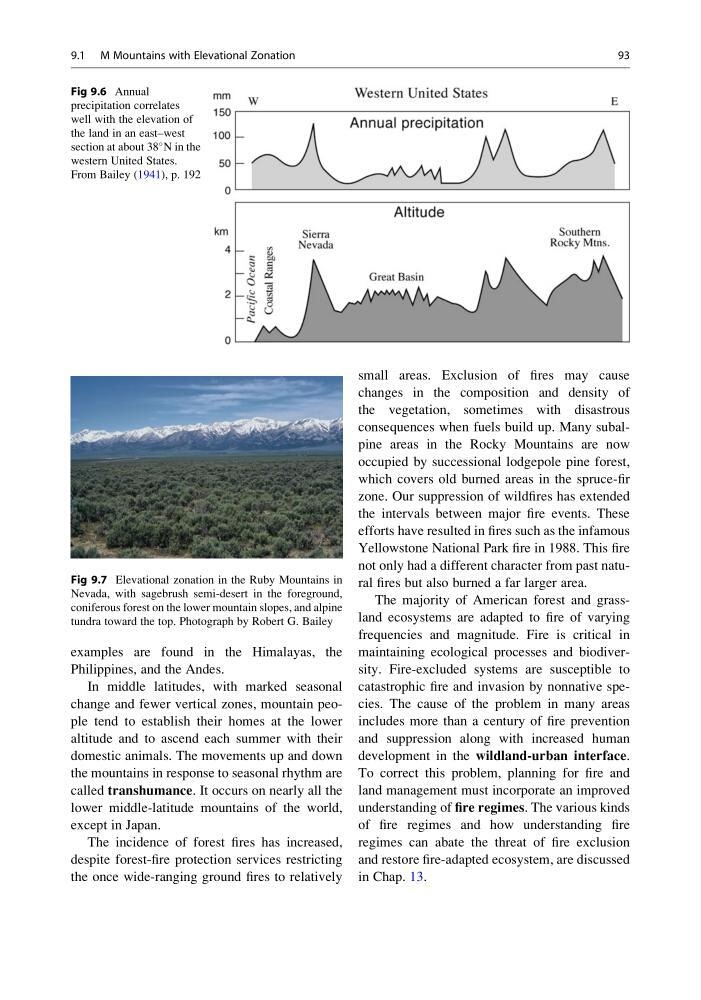
Fig 9.6 Annual
precipitation correlates
well with the elevation of
the land in an east–west
section at about 38
N in the
western United States.
From Bailey (1941), p. 192
9.1 M Mountains with Elevational Zonation
93
Philippines, and the Andes.
In middle latitudes, with marked seasonal
change and fewer vertical zones, mountain people tend to establish their homes at the lower
altitude and to ascend each summer with their
domestic animals. The movements up and down
the mountains in response to seasonal rhythm are
called transhumance. It occurs on nearly all the
lower middle-latitude mountains of the world,
except in Japan.
The incidence of forest fires has increased,
despite forest-fire protection services restricting
the once wide-ranging ground fires to relatively
small areas. Exclusion of fires may cause
changes in the composition and density of
the vegetation, sometimes with disastrous
consequences when fuels build up. Many subalpine areas in the Rocky Mountains are now
occupied by successional lodgepole pine forest,
which covers old burned areas in the spruce-fir
zone. Our suppression of wildfires has extended
the intervals between major fire events. These
efforts have resulted in fires such as the infamous
Yellowstone National Park fire in 1988. This fire
not only had a different character from past natural fires but also burned a far larger area.
The majority of American forest and grassland ecosystems are adapted to fire of varying
frequencies and magnitude. Fire is critical in
maintaining ecological processes and biodiversity. Fire-excluded systems are susceptible to
catastrophic fire and invasion by nonnative species. The cause of the problem in many areas
includes more than a century of fire prevention
and suppression along with increased human
development in the wildland-urban interface.
To correct this problem, planning for fire and
land management must incorporate an improved
understanding of fire regimes. The various kinds
of fire regimes and how understanding fire
regimes can abate the threat of fire exclusion
and restore fire-adapted ecosystem, are discussed
in Chap. 13.
Fig 9.7 Elevational zonation in the Ruby Mountains in
Nevada, with sagebrush semi-desert in the foreground,
coniferous forest on the lower mountain slopes, and alpine
tundra toward the top. Photograph by Robert G. Bailey
Fig 9.6 Annual
precipitation correlates
well with the elevation of
the land in an east–west
section at about 38
N in the
western United States.
From Bailey (1941), p. 192
9.1 M Mountains with Elevational Zonation
93