

Biogenous Sediments
83
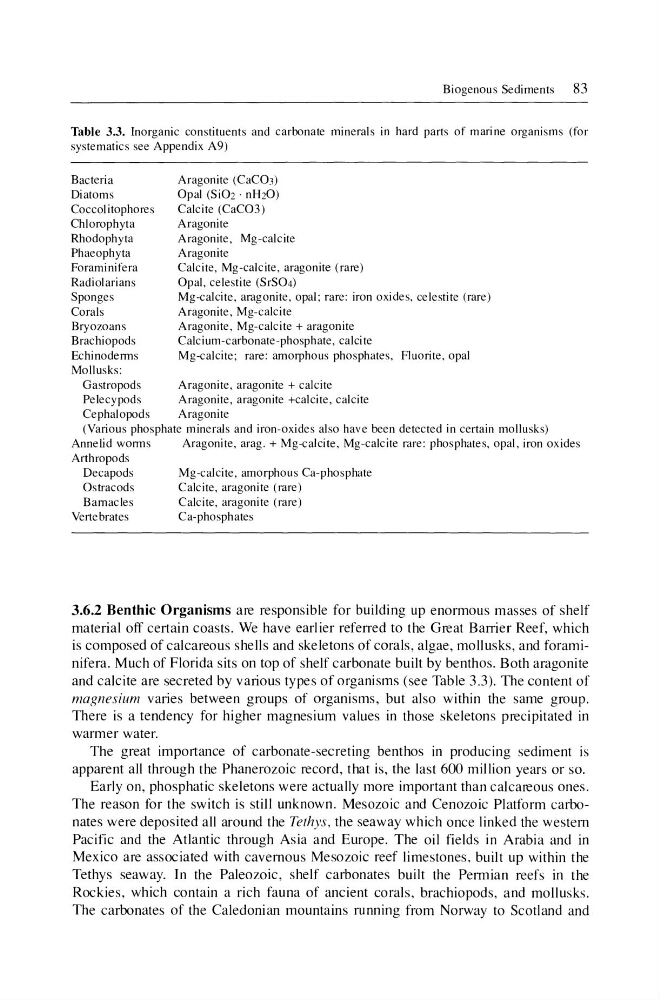
Table 3.3. Inorganic constituents and carbonate minerals in hard parts of marine organisms (for
systematics see Appendix A9)
Bacteria
Diatoms
Coccolitophores
Chlorophyta
Rhodophyta
Phaeophyta
Foraminifera
Radiolarians
Sponges
Corals
Bryowans
Brachiopods
Echinoderms
Mollusks:
Aragonite (CaC03)
Opal (Si02 . nH20)
Calcite (CaC03)
Aragonite
Aragonite, Mg-calcite
Aragonite
Calcite, Mg-calcite, aragonite (rare)
Opal, celestite (SrS04)
Mg-calcite, aragonite, opal; rare: iron oxides, celestite (rare)
Aragonite, Mg-calcite
Aragonite, Mg-calcite + aragonite
Calcium-carbonate-phosphate, calcite
Mg-calcite; rare: amorphous phosphates, Fluorite. opal
Gastropods
Aragonite, aragonite + calcite
Pelecypods
Aragonite, aragonite +calcite, calcite
Cephalopods
Aragonite
(Various phosphate minerals and iron-oxides also have been detected in certain mollusks)
Annelid worms
Aragonite, arag. + Mg-calcite, Mg-calcite rare: phosphates, opal, iron oxides
Arthropods
Decapods
Ostracods
Barnacles
Verte brates
Mg-calcite, amorphous Ca-phosphate
Calcite, aragonite (rare)
Calcite, aragonite (rare)
Ca-phosphates
3.6.2 Benthic Organisms are responsible for building up enormous masses of shelf
material off certain coasts. We have earlier referred to the Great Barrier Reef, which
is composed of calcareous shells and skeletons of corals, algae, mollusks, and foraminifera. Much of Florida sits on top of shelf carbonate built by benthos. Both aragonite
and calcite are secreted by various types of organisms (see Table 3.3). The content of
magnesium varies between groups of organisms, but also within the same group.
There is a tendency for higher magnesium values in those skeletons precipitated in
warmer water.
The great importance of carbonate-secreting benthos in producing sediment is
apparent all through the Phanerozoic record, that is, the last 600 million years or so.
Early on, phosphatic skeletons were actually more important than calcareous ones.
The reason for the switch is still unknown. Mesozoic and Cenozoic Platform carbonates were deposited all around the Tethys. the seaway which once linked the western
Pacific and the Atlantic through Asia and Europe. The oil fields in Arabia and in
Mexico are associated with cavernous Mesozoic reef limestones. built up within the
Tethys seaway. In the Paleozoic, shelf carbonates built the Permian reefs in the
Rockies, which contain a rich fauna of ancient corals, brachiopods, and mollusks.
The carbonates of the Caledonian mountains running from Norway to Scotland and
83
Table 3.3. Inorganic constituents and carbonate minerals in hard parts of marine organisms (for
systematics see Appendix A9)
Bacteria
Diatoms
Coccolitophores
Chlorophyta
Rhodophyta
Phaeophyta
Foraminifera
Radiolarians
Sponges
Corals
Bryowans
Brachiopods
Echinoderms
Mollusks:
Aragonite (CaC03)
Opal (Si02 . nH20)
Calcite (CaC03)
Aragonite
Aragonite, Mg-calcite
Aragonite
Calcite, Mg-calcite, aragonite (rare)
Opal, celestite (SrS04)
Mg-calcite, aragonite, opal; rare: iron oxides, celestite (rare)
Aragonite, Mg-calcite
Aragonite, Mg-calcite + aragonite
Calcium-carbonate-phosphate, calcite
Mg-calcite; rare: amorphous phosphates, Fluorite. opal
Gastropods
Aragonite, aragonite + calcite
Pelecypods
Aragonite, aragonite +calcite, calcite
Cephalopods
Aragonite
(Various phosphate minerals and iron-oxides also have been detected in certain mollusks)
Annelid worms
Aragonite, arag. + Mg-calcite, Mg-calcite rare: phosphates, opal, iron oxides
Arthropods
Decapods
Ostracods
Barnacles
Verte brates
Mg-calcite, amorphous Ca-phosphate
Calcite, aragonite (rare)
Calcite, aragonite (rare)
Ca-phosphates
3.6.2 Benthic Organisms are responsible for building up enormous masses of shelf
material off certain coasts. We have earlier referred to the Great Barrier Reef, which
is composed of calcareous shells and skeletons of corals, algae, mollusks, and foraminifera. Much of Florida sits on top of shelf carbonate built by benthos. Both aragonite
and calcite are secreted by various types of organisms (see Table 3.3). The content of
magnesium varies between groups of organisms, but also within the same group.
There is a tendency for higher magnesium values in those skeletons precipitated in
warmer water.
The great importance of carbonate-secreting benthos in producing sediment is
apparent all through the Phanerozoic record, that is, the last 600 million years or so.
Early on, phosphatic skeletons were actually more important than calcareous ones.
The reason for the switch is still unknown. Mesozoic and Cenozoic Platform carbonates were deposited all around the Tethys. the seaway which once linked the western
Pacific and the Atlantic through Asia and Europe. The oil fields in Arabia and in
Mexico are associated with cavernous Mesozoic reef limestones. built up within the
Tethys seaway. In the Paleozoic, shelf carbonates built the Permian reefs in the
Rockies, which contain a rich fauna of ancient corals, brachiopods, and mollusks.
The carbonates of the Caledonian mountains running from Norway to Scotland and