

78
Sources and Composition of Marine Sediments
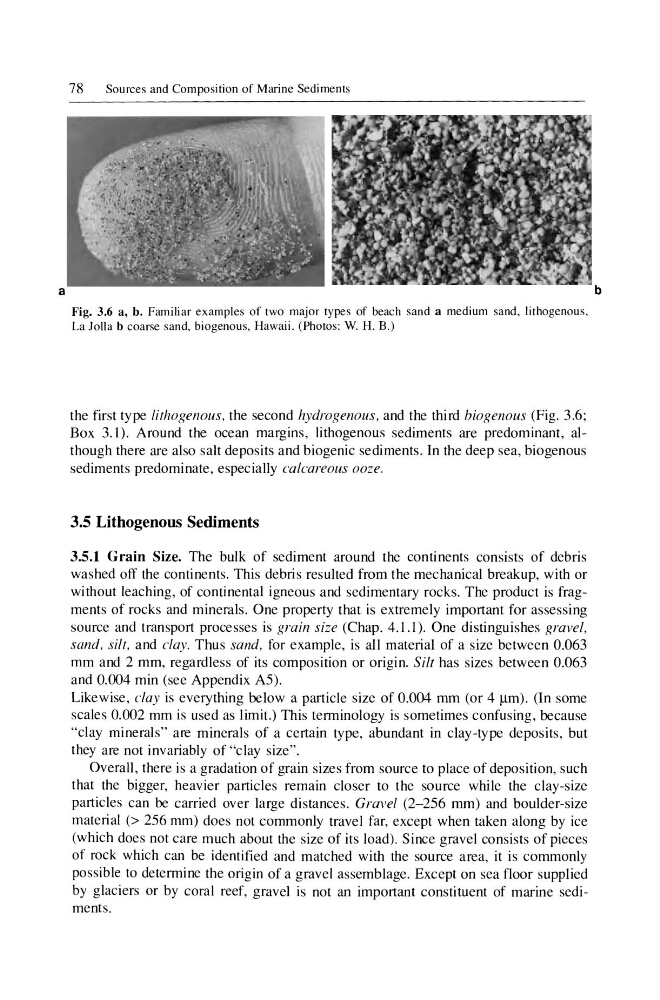
Fig. 3.6 a, b. Familiar examples of two major types of beach sand a medium sand, lithogenous,
La 10lla b coarse sand, biogenous, Hawaii. (Photos: W. H. B.)
the first type lithogenous, the second hydrogenous, and the third biogenous (Fig. 3.6;
Box 3.1) . Around the ocean margins, lithogenous sediments are predominant, although there are also salt deposits and biogenic sediments. In the deep sea, biogenous
sediments predominate, especially calcareous ooze.
3.5 Lithogenous Sediments
3.5.1 Grain Size. The bulk of sediment around the continents consists of debris
washed off the continents. This debris resulted from the mechanical breakup, with or
without leaching, of continental igneous and sedimentary rocks. The product is fragments of rocks and minerals. One property that is extremely important for assessing
source and transport processes is grain size (Chap. 4.1.1). One distinguishes gravel,
sand, silt. and clay. Thus sand. for example, is all material of a size between 0.063
mm and 2 mm, regardless of its composition or origin. Silt has sizes between 0.063
and 0.004 min (see Appendix AS).
Likewise, clay is everything below a particle size of 0.004 mm (or 4 11m). (In some
scales 0.002 mm is used as limit.) This terminology is sometimes confusing, because
"clay minerals" are minerals of a certain type, abundant in clay-type deposits, but
they are not invariably of "clay size".
Overall, there is a gradation of grain sizes from source to place of deposition, such
that the bigger, heavier particles remain closer to the source while the clay-size
particles can be carried over large distances. Gravel (2-256 mm) and boulder-size
material (> 256 mm) does not commonly travel far, except when taken along by ice
(which does not care much about the size of its load). Since gravel consists of pieces
of rock which can be identified and matched with the source area, it is commonly
possible to determine the origin of a gravel assemblage. Except on sea floor supplied
by glaciers or by coral reef, gravel is not an important constituent of marine sediments.
Sources and Composition of Marine Sediments
Fig. 3.6 a, b. Familiar examples of two major types of beach sand a medium sand, lithogenous,
La 10lla b coarse sand, biogenous, Hawaii. (Photos: W. H. B.)
the first type lithogenous, the second hydrogenous, and the third biogenous (Fig. 3.6;
Box 3.1) . Around the ocean margins, lithogenous sediments are predominant, although there are also salt deposits and biogenic sediments. In the deep sea, biogenous
sediments predominate, especially calcareous ooze.
3.5 Lithogenous Sediments
3.5.1 Grain Size. The bulk of sediment around the continents consists of debris
washed off the continents. This debris resulted from the mechanical breakup, with or
without leaching, of continental igneous and sedimentary rocks. The product is fragments of rocks and minerals. One property that is extremely important for assessing
source and transport processes is grain size (Chap. 4.1.1). One distinguishes gravel,
sand, silt. and clay. Thus sand. for example, is all material of a size between 0.063
mm and 2 mm, regardless of its composition or origin. Silt has sizes between 0.063
and 0.004 min (see Appendix AS).
Likewise, clay is everything below a particle size of 0.004 mm (or 4 11m). (In some
scales 0.002 mm is used as limit.) This terminology is sometimes confusing, because
"clay minerals" are minerals of a certain type, abundant in clay-type deposits, but
they are not invariably of "clay size".
Overall, there is a gradation of grain sizes from source to place of deposition, such
that the bigger, heavier particles remain closer to the source while the clay-size
particles can be carried over large distances. Gravel (2-256 mm) and boulder-size
material (> 256 mm) does not commonly travel far, except when taken along by ice
(which does not care much about the size of its load). Since gravel consists of pieces
of rock which can be identified and matched with the source area, it is commonly
possible to determine the origin of a gravel assemblage. Except on sea floor supplied
by glaciers or by coral reef, gravel is not an important constituent of marine sediments.