

70 Sources and Composition of Marine Sediments
SOURCES
Weathering and Volcanic Ejecta Hydrothermal
ExtraErosion
and Gases
Reactions.
terrestrlOl
on Land
Ridge Crest
Matter
,
Water
Wind
Ice
TRANSPORT
Dissol ved Matter Suspended Matter
I
I
•
•
PRECIPIT A TE S
CLASTICS (OETRITAL)
Biogenous
Hydrogenous
Lithogenous
Cosmogenous
Ca- Carbonates Evaporites
Silicates
Cosmic
Opal
Ferroman -
(Quartz.
Spherules
Organics
Pyrite genese Feldspars etc)
Zeolites
Rock fragments
Phosphorites
Clay minerals
DEPOSITS
I
~
1
riREDEPOSITk)NrCompaction
Sliding and slumping
Debris flow
Recrystallization
~----. Grain flow
Cementation
Turbidity and other
currents
H ROCKS rHALLOCHTHONS~
Limestones
SlIde- • slumps-.
Shales
etc - deposits
Sandstones
Turbidites
Graywackes etc
Intraclasts
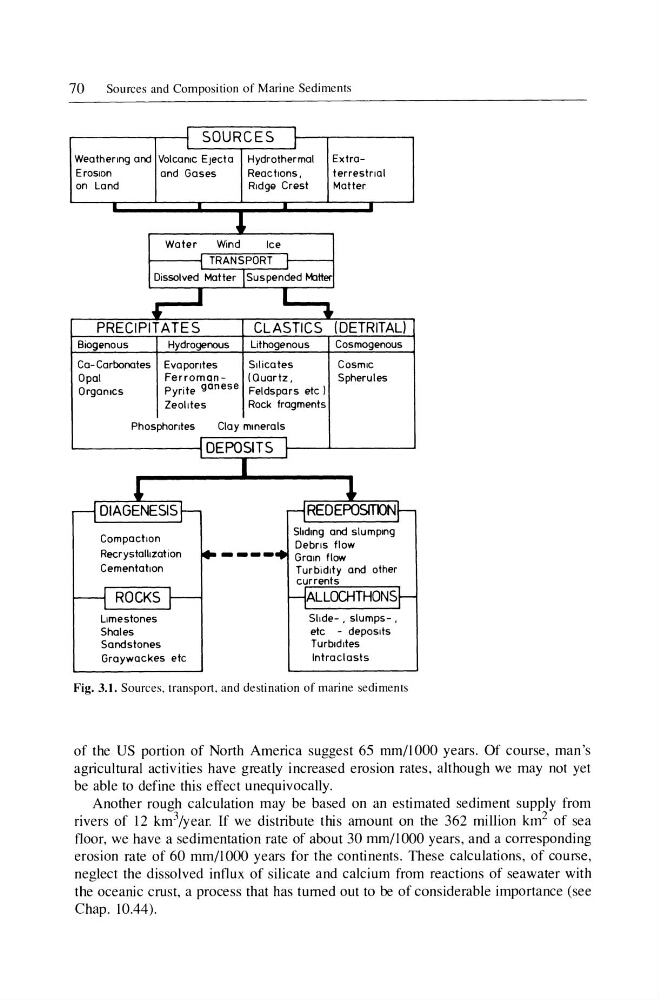
Fig. 3.1. Sources. transport. and destination of marine sediments
of the US portion of North America suggest 65 mm/lOOO years. Of course, man's
agricultural activities have greatly increased erosion rates, although we may not yet
be able to define this effect unequivocally.
Another rough calculation may be based on an estimated sediment supply from
rivers of 12 km 3 /year. If we distribute this amount on the 362 million km 2 of sea
floor, we have a sedimentation rate of about 30 mm/1000 years, and a corresponding
erosion rate of 60 mm/1000 years for the continents. These calculations, of course,
neglect the dissolved influx of silicate and calcium from reactions of seawater with
the oceanic crust, a process that has tumed out to be of considerable importance (see
Chap. 10.44).
SOURCES
Weathering and Volcanic Ejecta Hydrothermal
ExtraErosion
and Gases
Reactions.
terrestrlOl
on Land
Ridge Crest
Matter
,
Water
Wind
Ice
TRANSPORT
Dissol ved Matter Suspended Matter
I
I
•
•
PRECIPIT A TE S
CLASTICS (OETRITAL)
Biogenous
Hydrogenous
Lithogenous
Cosmogenous
Ca- Carbonates Evaporites
Silicates
Cosmic
Opal
Ferroman -
(Quartz.
Spherules
Organics
Pyrite genese Feldspars etc)
Zeolites
Rock fragments
Phosphorites
Clay minerals
DEPOSITS
I
~
1
riREDEPOSITk)NrCompaction
Sliding and slumping
Debris flow
Recrystallization
~----. Grain flow
Cementation
Turbidity and other
currents
H ROCKS rHALLOCHTHONS~
Limestones
SlIde- • slumps-.
Shales
etc - deposits
Sandstones
Turbidites
Graywackes etc
Intraclasts
Fig. 3.1. Sources. transport. and destination of marine sediments
of the US portion of North America suggest 65 mm/lOOO years. Of course, man's
agricultural activities have greatly increased erosion rates, although we may not yet
be able to define this effect unequivocally.
Another rough calculation may be based on an estimated sediment supply from
rivers of 12 km 3 /year. If we distribute this amount on the 362 million km 2 of sea
floor, we have a sedimentation rate of about 30 mm/1000 years, and a corresponding
erosion rate of 60 mm/1000 years for the continents. These calculations, of course,
neglect the dissolved influx of silicate and calcium from reactions of seawater with
the oceanic crust, a process that has tumed out to be of considerable importance (see
Chap. 10.44).