

66 Origin and Morphology of Ocean Margins
time to time, perhaps once in a century or a millenium, a great turbidity current
rushes down-canyon, moving enormous masses of sediment. Additionally, undercutting of canyon walls causes mass wasting similar to land slides. Such currents, with
high velocities and inertia, and carrying sand or even pebbles and boulders, are
certainly able to deepen and widen the canyons by erosion, even in hard rock. As the
power of the current wanes downslope, particles settle out, generally first the coarse
and later the finer ones. These deposits form huge semi-conal sediment bodies, the
deep-sea fans .
2.11 Deep-Sea Fans
Deep-sea fans consist of overlapping tongues of sediment, variously dissected by
channels, which are in turn re-filled when abandoned (Fig. 2.17). Details of the fan
landscape, with its distributary system (including channels, levees formed by spillover, slumps, and slides), have become available through sides-scan surveys. Meanders of several km width have been mapped off the Amazon River, and elsewhere.
Fans are of interest from an economic point of view, as potential reservoirs for
hydrocarbons, with their huge dimensions, and their many meters thick sand bodies
offering high porosity and permeability.
Much or most of the sediment in deep-sea fans consists of turbidites, which is
what the deposits of turbidity currents are called. Turbidites are also common both
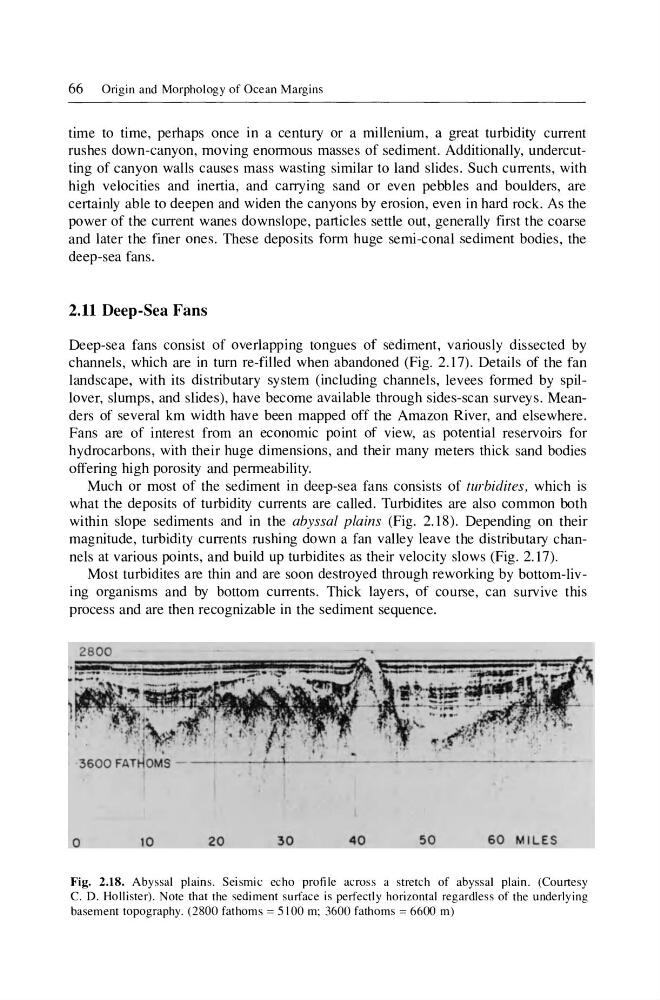
within slope sediments and in the abyssal plains (Fig. 2.18). Depending on their
magnitude, turbidity currents rushing down a fan valley leave the distributary channels at various points, and build up turbidites as their velocity slows (Fig. 2.17).
Most turbidites are thin and are soon destroyed through reworking by bottom-living organisms and by bottom currents. Thick layers, of course, can survive this
process and are then recognizable in the sediment sequence.
O~ ________ ~ IO ~ ________ ~~ ________ ~ 3~ O ____________ ~ 4 ~ O ____________ 5 ~O ~ ________ ~ 6~ O~ M ~I~ L~ E~ S~
Fig. 2.18. Abyssal plains. Seismic echo profile across a stretch of abyssal plain. (Courtesy
C. D. Hollister). Note that the sediment surface is perfectly horizontal regardless of the underlying
basement topography. (2800 fathoms = 5100 m; 3600 fathoms = 6600 m)
time to time, perhaps once in a century or a millenium, a great turbidity current
rushes down-canyon, moving enormous masses of sediment. Additionally, undercutting of canyon walls causes mass wasting similar to land slides. Such currents, with
high velocities and inertia, and carrying sand or even pebbles and boulders, are
certainly able to deepen and widen the canyons by erosion, even in hard rock. As the
power of the current wanes downslope, particles settle out, generally first the coarse
and later the finer ones. These deposits form huge semi-conal sediment bodies, the
deep-sea fans .
2.11 Deep-Sea Fans
Deep-sea fans consist of overlapping tongues of sediment, variously dissected by
channels, which are in turn re-filled when abandoned (Fig. 2.17). Details of the fan
landscape, with its distributary system (including channels, levees formed by spillover, slumps, and slides), have become available through sides-scan surveys. Meanders of several km width have been mapped off the Amazon River, and elsewhere.
Fans are of interest from an economic point of view, as potential reservoirs for
hydrocarbons, with their huge dimensions, and their many meters thick sand bodies
offering high porosity and permeability.
Much or most of the sediment in deep-sea fans consists of turbidites, which is
what the deposits of turbidity currents are called. Turbidites are also common both
within slope sediments and in the abyssal plains (Fig. 2.18). Depending on their
magnitude, turbidity currents rushing down a fan valley leave the distributary channels at various points, and build up turbidites as their velocity slows (Fig. 2.17).
Most turbidites are thin and are soon destroyed through reworking by bottom-living organisms and by bottom currents. Thick layers, of course, can survive this
process and are then recognizable in the sediment sequence.
O~ ________ ~ IO ~ ________ ~~ ________ ~ 3~ O ____________ ~ 4 ~ O ____________ 5 ~O ~ ________ ~ 6~ O~ M ~I~ L~ E~ S~
Fig. 2.18. Abyssal plains. Seismic echo profile across a stretch of abyssal plain. (Courtesy
C. D. Hollister). Note that the sediment surface is perfectly horizontal regardless of the underlying
basement topography. (2800 fathoms = 5100 m; 3600 fathoms = 6600 m)