

64 Origin and Morphology of Ocean Margins
influx of mud-laden bottom-hugging water bodies. These muddy waters, upon decelerating, drop their load within a short time as graded layers. Such layers are found
within the fan deposits of continental slopes and in the sediments building the abyssal
plains (Fig. 2.(7).
Kuenen's work inspired marine geologists to look for direct evidence of the action
of turbidity currents in the present ocean. A well-known example of this search is the
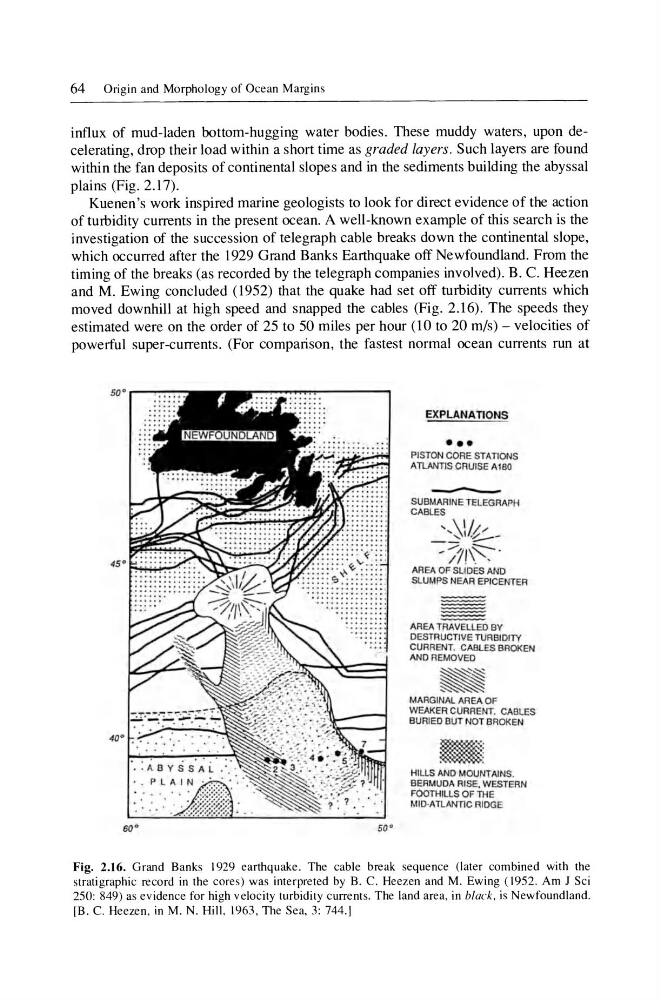
investigation of the succession of telegraph cable breaks down the continental slope,
which occurred after the 1929 Grand Banks Earthquake off Newfoundland. From the
timing of the breaks (as recorded by the telegraph companies involved). B. C. Heezen
and M. Ewing concluded (1952) that the quake had set off turbidity currents which
moved downhill at high speed and snapped the cables (Fig. 2.16). The speeds they
estimated were on the order of 25 to 50 miles per hour (10 to 20 m/s) - velocities of
powerful super-currents. (For comparison, the fastest normal ocean currents run at
60·
50·
EX PLANA nONS
•••
PISTON CORE STATIONS
ATLANTIS CR UISE A180
-
SUBMAR INE TELEGRAPH
CABLES
... \ \ '1'-/
' ~\l/,
_
-- ::;..-~.-'11\~ ·
/ ..
AREA OF SLIDES AND
SLUMPS NEAR EPICENTER
AREA TRAVELLED BY
DESTRUCTIVE TUR81DITY
CURRENT. CABLES BROKEN
AND REMOVED
~ ~
MARGINAl AREA OF
WEAKER CURRENT. CABLES
BURIED BUT NOT BROKEN
HIUS AND MOUNTAINS.
BERMUDA RISE. WESTERN
FOOTHILLS O F THE
MID·ATLANTIC RIDGE
Fig. 2.16. Grand Banks 1929 earthquake. The cable break sequence (later combined with the
stratigraphic record in the cores) was interpreted by B. C. Heezen and M. Ewing (1952. Am J Sci
250: 849) as evidence for high velocity turbidity currents. The land area, in hlack, is Newfoundland.
[B . C. Heezen, in M. N. Hill , 1963 , The Sea, 3: 744.]
influx of mud-laden bottom-hugging water bodies. These muddy waters, upon decelerating, drop their load within a short time as graded layers. Such layers are found
within the fan deposits of continental slopes and in the sediments building the abyssal
plains (Fig. 2.(7).
Kuenen's work inspired marine geologists to look for direct evidence of the action
of turbidity currents in the present ocean. A well-known example of this search is the
investigation of the succession of telegraph cable breaks down the continental slope,
which occurred after the 1929 Grand Banks Earthquake off Newfoundland. From the
timing of the breaks (as recorded by the telegraph companies involved). B. C. Heezen
and M. Ewing concluded (1952) that the quake had set off turbidity currents which
moved downhill at high speed and snapped the cables (Fig. 2.16). The speeds they
estimated were on the order of 25 to 50 miles per hour (10 to 20 m/s) - velocities of
powerful super-currents. (For comparison, the fastest normal ocean currents run at
60·
50·
EX PLANA nONS
•••
PISTON CORE STATIONS
ATLANTIS CR UISE A180
-
SUBMAR INE TELEGRAPH
CABLES
... \ \ '1'-/
' ~\l/,
_
-- ::;..-~.-'11\~ ·
/ ..
AREA OF SLIDES AND
SLUMPS NEAR EPICENTER
AREA TRAVELLED BY
DESTRUCTIVE TUR81DITY
CURRENT. CABLES BROKEN
AND REMOVED
~ ~
MARGINAl AREA OF
WEAKER CURRENT. CABLES
BURIED BUT NOT BROKEN
HIUS AND MOUNTAINS.
BERMUDA RISE. WESTERN
FOOTHILLS O F THE
MID·ATLANTIC RIDGE
Fig. 2.16. Grand Banks 1929 earthquake. The cable break sequence (later combined with the
stratigraphic record in the cores) was interpreted by B. C. Heezen and M. Ewing (1952. Am J Sci
250: 849) as evidence for high velocity turbidity currents. The land area, in hlack, is Newfoundland.
[B . C. Heezen, in M. N. Hill , 1963 , The Sea, 3: 744.]