

Continental Slope and Continental Rise
59
horizons, thus "floating" the overlying sediment stack. Slides can be coherent over
large areas, preserving much of the original stratigraphy, or they can be chaotic
(called slumps), producing a jumbled mess. Earthquakes can trigger slides, especially
in the active margins, but also elsewhere.
Off Cape Hatteras, a tongue-shaped mass of displaced sediment on the Upper
Continental Rise is 60 km wide and over 190 km long, and has a hummocky relief of
up to 300 m in places. During and following slope failure, deformation can span a
number of processes, from rigid-block motion to turbulent flow. Probably most of the
slope failures occurred during Pleistocene low sea level stands (1. S. Schlee and J. M.
Robb, Geol. Soc. Amer. Bull ., 1098, 1991).
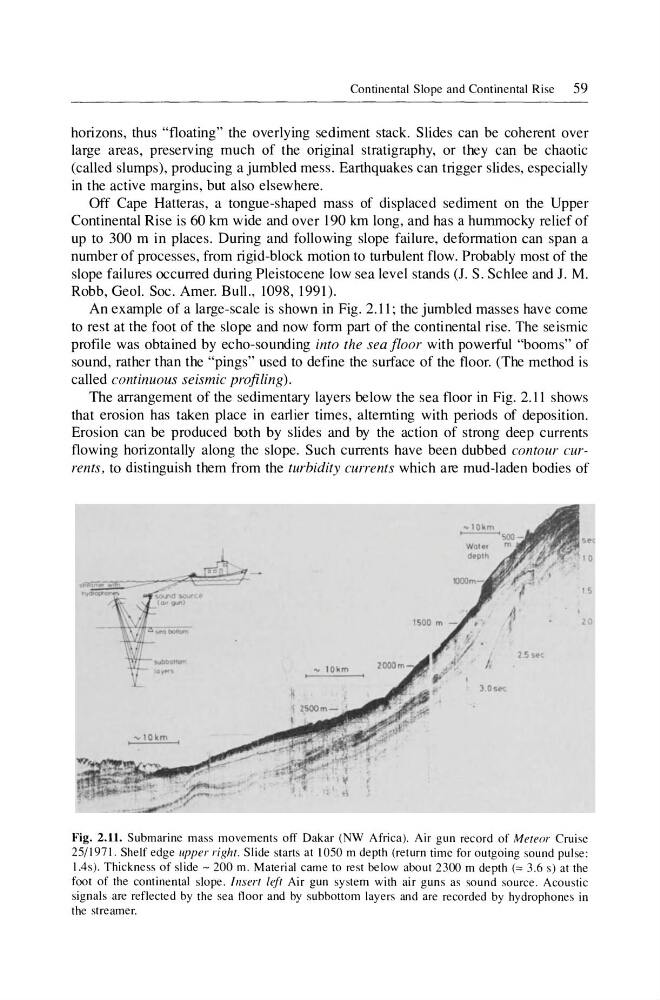
An example of a large-scale is shown in Fig. 2.11; the jumbled masses have come
to rest at the foot of the slope and now form part of the continental rise. The seismic
profile was obtained by echo-sounding into the sea floor with powerful "booms" of
sound, rather than the "pings" used to define the surface of the floor. (The method is
called continuous seismic profiling).
The arrangement of the sedimentary layers below the sea floor in Fig. 2.11 shows
that erosion has taken place in earlier times, altemting with periods of deposition.
Erosion can be produced both by slides and by the action of strong deep currents
flowing horizontally along the slope. Such currents have been dubbed contour currents, to distinguish them from the turbidity currents which are mud-laden bodies of
Fig. 2.11. Submarine mass movements off Dakar (NW Africa). Air gun record of Meteor Cruise
25/1971. Shelf edge upper right. Slide starts at 1050 m depth (return time for outgoing sound pulse:
l.4s). Thickness of slide - 200 m. Material came to rest below about 2300 m depth (= 3.6 s) at the
foot of the continental slope. Insert left Air gun system with air guns as sound source. Acoustic
signals are reflected by the sea floor and by subbottom layers and are recorded by hydrophones in
the stre amer.
59
horizons, thus "floating" the overlying sediment stack. Slides can be coherent over
large areas, preserving much of the original stratigraphy, or they can be chaotic
(called slumps), producing a jumbled mess. Earthquakes can trigger slides, especially
in the active margins, but also elsewhere.
Off Cape Hatteras, a tongue-shaped mass of displaced sediment on the Upper
Continental Rise is 60 km wide and over 190 km long, and has a hummocky relief of
up to 300 m in places. During and following slope failure, deformation can span a
number of processes, from rigid-block motion to turbulent flow. Probably most of the
slope failures occurred during Pleistocene low sea level stands (1. S. Schlee and J. M.
Robb, Geol. Soc. Amer. Bull ., 1098, 1991).
An example of a large-scale is shown in Fig. 2.11; the jumbled masses have come
to rest at the foot of the slope and now form part of the continental rise. The seismic
profile was obtained by echo-sounding into the sea floor with powerful "booms" of
sound, rather than the "pings" used to define the surface of the floor. (The method is
called continuous seismic profiling).
The arrangement of the sedimentary layers below the sea floor in Fig. 2.11 shows
that erosion has taken place in earlier times, altemting with periods of deposition.
Erosion can be produced both by slides and by the action of strong deep currents
flowing horizontally along the slope. Such currents have been dubbed contour currents, to distinguish them from the turbidity currents which are mud-laden bodies of
Fig. 2.11. Submarine mass movements off Dakar (NW Africa). Air gun record of Meteor Cruise
25/1971. Shelf edge upper right. Slide starts at 1050 m depth (return time for outgoing sound pulse:
l.4s). Thickness of slide - 200 m. Material came to rest below about 2300 m depth (= 3.6 s) at the
foot of the continental slope. Insert left Air gun system with air guns as sound source. Acoustic
signals are reflected by the sea floor and by subbottom layers and are recorded by hydrophones in
the stre amer.