

52 Origin and Morphology of Ocean Margins
b L..-. _ _ _ --'-' .......... _ ....
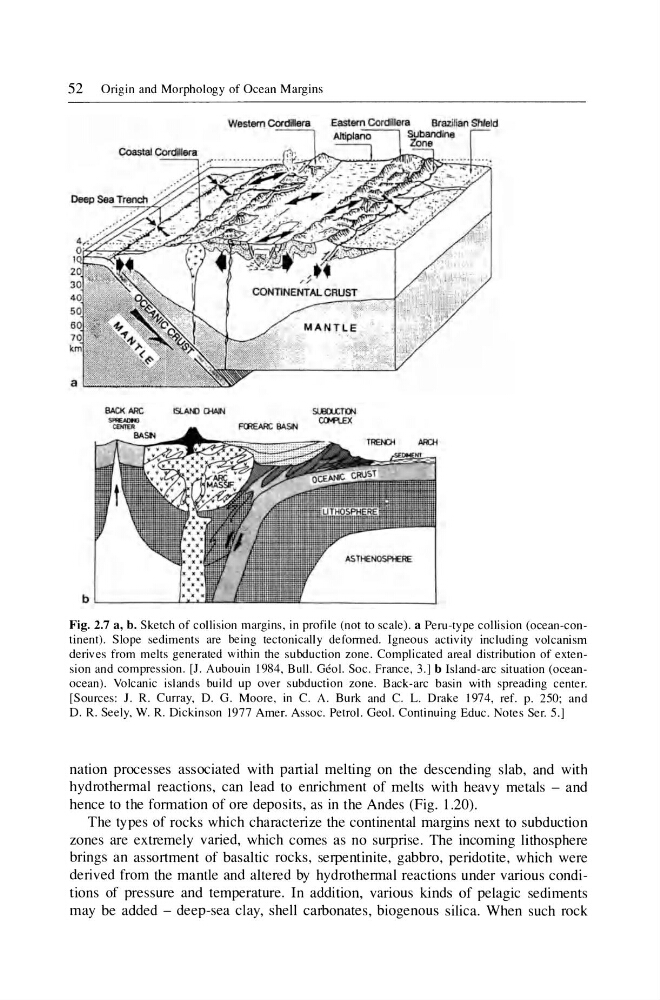
Fig. 2.7 a, b. Sketch of collision margins. in profile (not to scale). a Peru-type collision (ocean-continent). Slope sediments are being tectonically deformed. Igneous activity including volcanism
derives from melts generated within the subduction zone. Complicated areal distribution of extension and compression. [J. Aubouin 1984, Bull. Geol. Soc. France. 3.] b Island-arc situation (oceanocean). Volcanic islands build up over subduction zone. Back-arc basin with spreading center.
[Sources: J. R. Curray. D . G. Moore, in C. A. Burk and C. L. Drake 1974, ref. p. 250; and
D. R. Seely, W. R. Dickinson 1977 Amer. Assoc. Petrol. Geol. Continuing Educ. Notes Ser. 5.]
nation processes associated with partial melting on the descending slab, and with
hydrothermal reactions, can lead to enrichment of melts with heavy metals - and
hence to the formation of ore deposits, as in the Andes (Fig. 1.20).
The types of rocks which characterize the continental margins next to subduction
zones are extremely varied, which comes as no surprise. The incoming lithosphere
brings an assortment of basaltic rocks, serpentinite, gabbro, peridotite, which were
derived from the mantle and altered by hydrothermal reactions under various conditions of pressure and temperature. In addition, various kinds of pelagic sediments
may be added - deep-sea clay, shell carbonates, biogenous silica. When such rock
b L..-. _ _ _ --'-' .......... _ ....
Fig. 2.7 a, b. Sketch of collision margins. in profile (not to scale). a Peru-type collision (ocean-continent). Slope sediments are being tectonically deformed. Igneous activity including volcanism
derives from melts generated within the subduction zone. Complicated areal distribution of extension and compression. [J. Aubouin 1984, Bull. Geol. Soc. France. 3.] b Island-arc situation (oceanocean). Volcanic islands build up over subduction zone. Back-arc basin with spreading center.
[Sources: J. R. Curray. D . G. Moore, in C. A. Burk and C. L. Drake 1974, ref. p. 250; and
D. R. Seely, W. R. Dickinson 1977 Amer. Assoc. Petrol. Geol. Continuing Educ. Notes Ser. 5.]
nation processes associated with partial melting on the descending slab, and with
hydrothermal reactions, can lead to enrichment of melts with heavy metals - and
hence to the formation of ore deposits, as in the Andes (Fig. 1.20).
The types of rocks which characterize the continental margins next to subduction
zones are extremely varied, which comes as no surprise. The incoming lithosphere
brings an assortment of basaltic rocks, serpentinite, gabbro, peridotite, which were
derived from the mantle and altered by hydrothermal reactions under various conditions of pressure and temperature. In addition, various kinds of pelagic sediments
may be added - deep-sea clay, shell carbonates, biogenous silica. When such rock