

Atlantic-Type (= Passive) Margins
45
2.3 Atlantic-Type (= Passive) Margins
Continental margins differ greatly, depending on their origin. As early as 1883, E.
Suess (1831-1914) coined the terms Atlantic margins and Pacific margins to emphasize the major differences. Essentially, Atlantic-type margins are steadily sinking
regions, accumulating thick sequences of sediment in layer-cake fashion. In contrast,
Pacific-type margins are, on the whole, rising , and are associated with volcanism,
folding, faulting, and other mountain-building processes. Atlantic-type margins also
are called "passive", and Pacific-type margins "active", because of the difference in
tectonic style and the occurrence of earthquakes and active volcanoes.
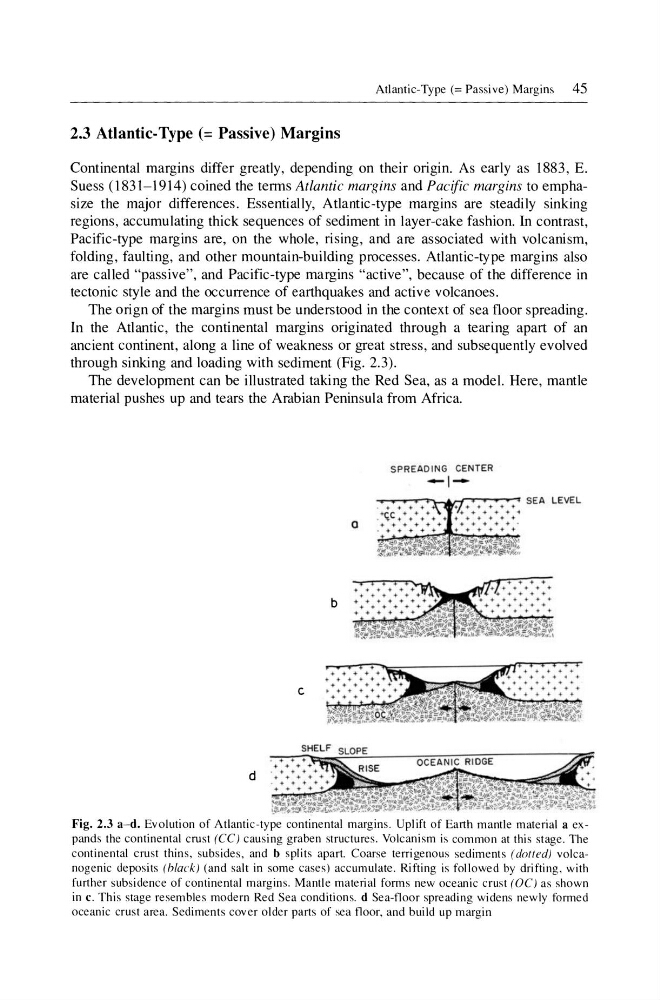
The orign of the margins must be understood in the context of sea floor spreading.
In the Atlantic, the continental margins originated through a tearing apart of an
ancient continent, along a line of weakness or great stress, and subsequently evolved
through sinking and loading with sediment (Fig. 2.3).
The development can be illustrated taking the Red Sea, as a model. Here, mantle
material pushes up and tears the Arabian Peninsula from Africa.
b
c
d
o
SPREAD ING CENTER
- 1...-...... ,...,...~--t.~-.--....... - ... SEA LEVEL
Fig. 2.3 a-d. Evolution of Atlantic-type continental margins. Uplift of Earth mantle material a expands the continental crust (CC) causing graben structures. Volcanism is common at this stage. The
continental crust thins, subsides, and b splits apart. Coarse terrigenous sediments (dOlled) volcanogenic deposits (h/ack) (and salt in some cases) accumulate. Rifting is followed by drifting, with
further subsidence of continental margins. Mantle material forms new oceanic crust (OC) as shown
in c. This stage resemble s modern Red Sea conditions. d Sea-floor spreading widens newly formed
oceanic crust area. Sediments cover older parts of sea floor, and build up margin
45
2.3 Atlantic-Type (= Passive) Margins
Continental margins differ greatly, depending on their origin. As early as 1883, E.
Suess (1831-1914) coined the terms Atlantic margins and Pacific margins to emphasize the major differences. Essentially, Atlantic-type margins are steadily sinking
regions, accumulating thick sequences of sediment in layer-cake fashion. In contrast,
Pacific-type margins are, on the whole, rising , and are associated with volcanism,
folding, faulting, and other mountain-building processes. Atlantic-type margins also
are called "passive", and Pacific-type margins "active", because of the difference in
tectonic style and the occurrence of earthquakes and active volcanoes.
The orign of the margins must be understood in the context of sea floor spreading.
In the Atlantic, the continental margins originated through a tearing apart of an
ancient continent, along a line of weakness or great stress, and subsequently evolved
through sinking and loading with sediment (Fig. 2.3).
The development can be illustrated taking the Red Sea, as a model. Here, mantle
material pushes up and tears the Arabian Peninsula from Africa.
b
c
d
o
SPREAD ING CENTER
- 1...-...... ,...,...~--t.~-.--....... - ... SEA LEVEL
Fig. 2.3 a-d. Evolution of Atlantic-type continental margins. Uplift of Earth mantle material a expands the continental crust (CC) causing graben structures. Volcanism is common at this stage. The
continental crust thins, subsides, and b splits apart. Coarse terrigenous sediments (dOlled) volcanogenic deposits (h/ack) (and salt in some cases) accumulate. Rifting is followed by drifting, with
further subsidence of continental margins. Mantle material forms new oceanic crust (OC) as shown
in c. This stage resemble s modern Red Sea conditions. d Sea-floor spreading widens newly formed
oceanic crust area. Sediments cover older parts of sea floor, and build up margin