

20 Origin and Morphology of Ocean Basins
CRUST
-.....~ ...... - (thickness exaggerated )
~-~-MANTLE
~~r---~t-- Outer COR E
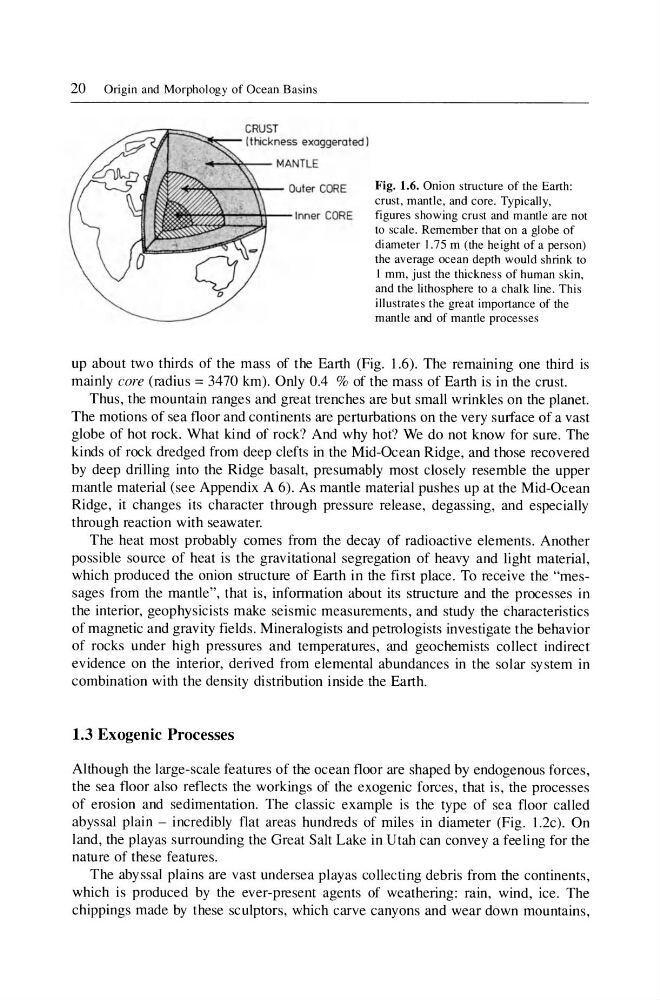
Fig. 1.6. Onion structure of the Earth:
crust, mantle, and core. Typically,
f5#.~r--,*,"-lnner CORE
figures showing crust and mantle are not
to scale. Remember that on a globe of
diameter 1.75 m (the height of a person)
the average ocean depth would shrink to
1 mm, just the thickness of human skin,
and the lithosphere to a chalk line . This
illustrates the great importance of the
mantle and of mantle processes
up about two thirds of the mass of the Earth (Fig. 1.6). The remaining one third is
mainly core (radius = 3470 km). Only 0.4 % of the mass of Earth is in the crust.
Thus, the mountain ranges and great trenches are but small wrinkles on the planet.
The motions of sea floor and continents are perturbations on the very surface of a vast
globe of hot rock. What kind of rock? And why hot? We do not know for sure. The
kinds of rock dredged from deep clefts in the Mid-Ocean Ridge, and those recovered
by deep drilling into the Ridge basalt, presumably most closely resemble the upper
mantle material (see Appendix A 6). As mantle material pushes up at the Mid-Ocean
Ridge, it changes its character through pressure release, degassing, and especially
through reaction with seawater.
The heat most probably comes from the decay of radioactive elements. Another
possible source of heat is the gravitational segregation of heavy and light material,
which produced the onion structure of Earth in the first place. To receive the "messages from the mantle", that is, information about its structure and the processes in
the interior, geophysicists make seismic measurements, and study the characteristics
of magnetic and gravity fields . Mineralogists and petrologists investigate the behavior
of rocks under high pressures and temperatures, and geochemists collect indirect
evidence on the interior, derived from elemental abundances in the solar system in
combination with the density distribution inside the Earth.
1.3 Exogenic Processes
Although the large-scale features of the ocean floor are shaped by endogenous forces,
the sea floor also reflects the workings of the exogenic forces, that is, the processes
of erosion and sedimentation. The classic example is the type of sea floor called
abyssal plain - incredibly flat areas hundreds of miles in diameter (Fig. 1.2c). On
land, the playas surrounding the Great Salt Lake in Utah can convey a feeling for the
nature of these features.
The abyssal plains are vast undersea playas collecting debris from the continents,
which is produced by the ever-present agents of weathering: rain , wind, ice. The
chippings made by these sculptors, which carve canyons and wear down mountains,
CRUST
-.....~ ...... - (thickness exaggerated )
~-~-MANTLE
~~r---~t-- Outer COR E
Fig. 1.6. Onion structure of the Earth:
crust, mantle, and core. Typically,
f5#.~r--,*,"-lnner CORE
figures showing crust and mantle are not
to scale. Remember that on a globe of
diameter 1.75 m (the height of a person)
the average ocean depth would shrink to
1 mm, just the thickness of human skin,
and the lithosphere to a chalk line . This
illustrates the great importance of the
mantle and of mantle processes
up about two thirds of the mass of the Earth (Fig. 1.6). The remaining one third is
mainly core (radius = 3470 km). Only 0.4 % of the mass of Earth is in the crust.
Thus, the mountain ranges and great trenches are but small wrinkles on the planet.
The motions of sea floor and continents are perturbations on the very surface of a vast
globe of hot rock. What kind of rock? And why hot? We do not know for sure. The
kinds of rock dredged from deep clefts in the Mid-Ocean Ridge, and those recovered
by deep drilling into the Ridge basalt, presumably most closely resemble the upper
mantle material (see Appendix A 6). As mantle material pushes up at the Mid-Ocean
Ridge, it changes its character through pressure release, degassing, and especially
through reaction with seawater.
The heat most probably comes from the decay of radioactive elements. Another
possible source of heat is the gravitational segregation of heavy and light material,
which produced the onion structure of Earth in the first place. To receive the "messages from the mantle", that is, information about its structure and the processes in
the interior, geophysicists make seismic measurements, and study the characteristics
of magnetic and gravity fields . Mineralogists and petrologists investigate the behavior
of rocks under high pressures and temperatures, and geochemists collect indirect
evidence on the interior, derived from elemental abundances in the solar system in
combination with the density distribution inside the Earth.
1.3 Exogenic Processes
Although the large-scale features of the ocean floor are shaped by endogenous forces,
the sea floor also reflects the workings of the exogenic forces, that is, the processes
of erosion and sedimentation. The classic example is the type of sea floor called
abyssal plain - incredibly flat areas hundreds of miles in diameter (Fig. 1.2c). On
land, the playas surrounding the Great Salt Lake in Utah can convey a feeling for the
nature of these features.
The abyssal plains are vast undersea playas collecting debris from the continents,
which is produced by the ever-present agents of weathering: rain , wind, ice. The
chippings made by these sculptors, which carve canyons and wear down mountains,