

306 Epilog
TERRESTtAL t
~ RADIATION
CO 2 , H20,ETC'
1 ~ ~
ATMOSPHERE
AEROS:::O:;LS ::.-_ _ ===:..
--=-t ~
?:~~ .. PRECIPITATION
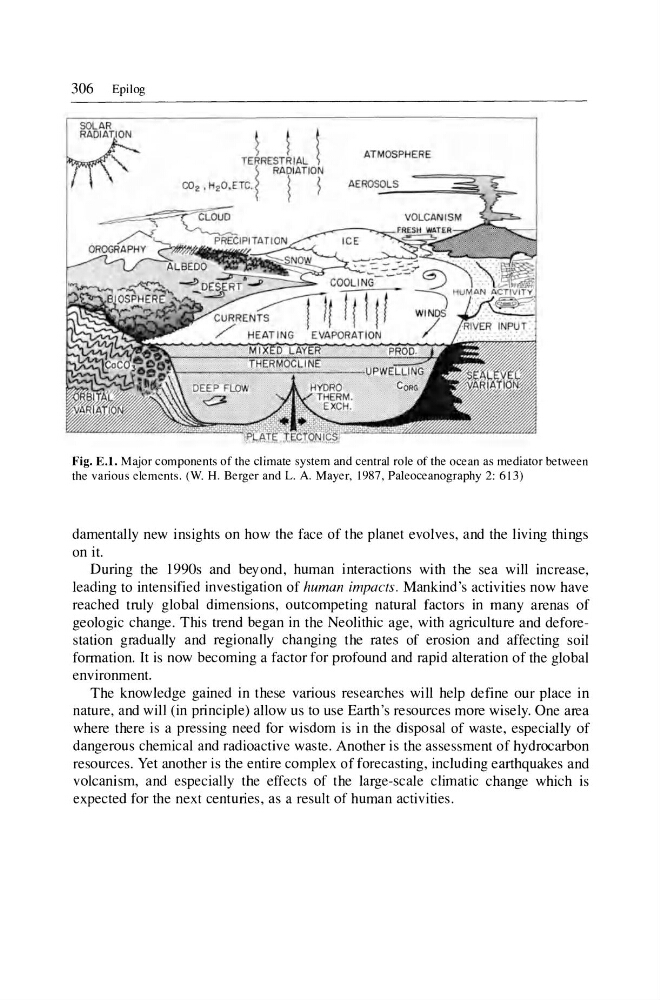
Fig. E." Major components of the climate system and central role of the ocean as mediator between
the various elements. (W. H. Berger and L. A. Mayer, 1987, Paleoceanography 2: 613)
damentally new insights on how the face of the planet evolves, and the living things
on it.
During the 1990s and beyond, human interactions with the sea will increase,
leading to intensified investigation of human impacts. Mankind 's activities now have
reached truly global dimensions, outcompeting natural factors in many arenas of
geologic change. This trend began in the Neolithic age, with agriculture and deforestation gradually and regionally changing the rates of erosion and affecting soil
formation. It is now becoming a factor for profound and rapid alteration of the global
environment.
The knowledge gained in these various researches will help define our place in
nature, and will (in principle) allow us to use Earth 's resources more wisely. One area
where there is a pressing need for wisdom is in the disposal of waste, especially of
dangerous chemical and radioactive waste. Another is the assessment of hydrocarbon
resources. Yet another is the entire complex offorecasting, including earthquakes and
volcanism, and especially the effects of the large-scale climatic change which is
expected for the next centuries, as a result of human activities.
TERRESTtAL t
~ RADIATION
CO 2 , H20,ETC'
1 ~ ~
ATMOSPHERE
AEROS:::O:;LS ::.-_ _ ===:..
--=-t ~
?:~~ .. PRECIPITATION
Fig. E." Major components of the climate system and central role of the ocean as mediator between
the various elements. (W. H. Berger and L. A. Mayer, 1987, Paleoceanography 2: 613)
damentally new insights on how the face of the planet evolves, and the living things
on it.
During the 1990s and beyond, human interactions with the sea will increase,
leading to intensified investigation of human impacts. Mankind 's activities now have
reached truly global dimensions, outcompeting natural factors in many arenas of
geologic change. This trend began in the Neolithic age, with agriculture and deforestation gradually and regionally changing the rates of erosion and affecting soil
formation. It is now becoming a factor for profound and rapid alteration of the global
environment.
The knowledge gained in these various researches will help define our place in
nature, and will (in principle) allow us to use Earth 's resources more wisely. One area
where there is a pressing need for wisdom is in the disposal of waste, especially of
dangerous chemical and radioactive waste. Another is the assessment of hydrocarbon
resources. Yet another is the entire complex offorecasting, including earthquakes and
volcanism, and especially the effects of the large-scale climatic change which is
expected for the next centuries, as a result of human activities.