

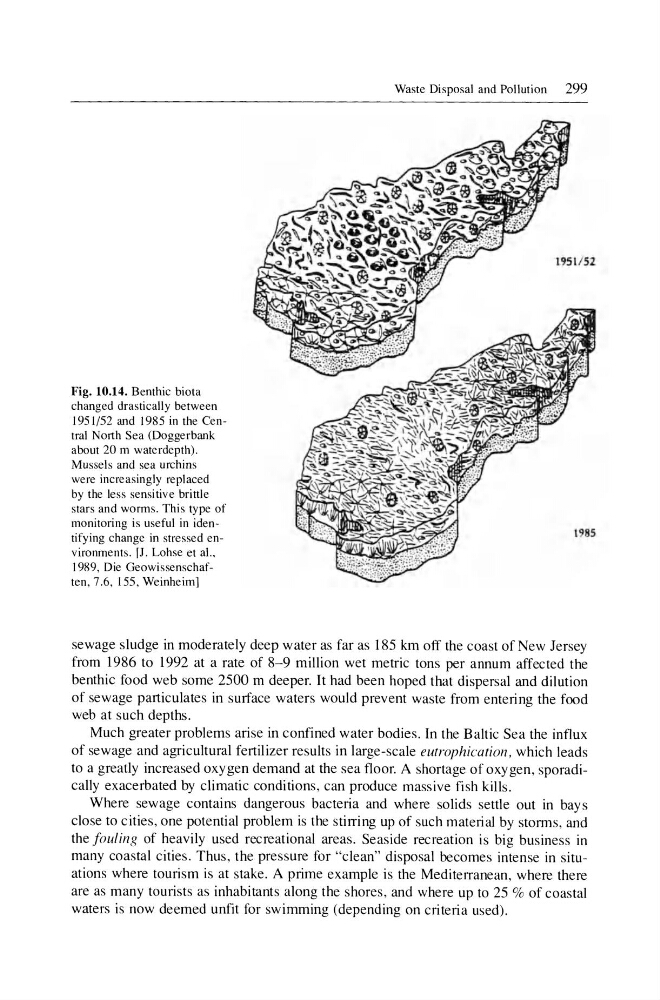
Fig. 10.14. Benthic biota
changed drastically between
1951(52 and 1985 in the Central North Sea (Doggerbank
about 20 m waterdepth).
Mussels and sea urchins
were increasingly replaced
by the less sensitive brittle
stars and worms. This type of
monitoring is useful in identifying change in stressed environments. [J. Lohse et aI.,
1989, Die Geowissenschaften, 7.6, 155, WeinheimJ
Waste Disposal and Pollution
299
sewage sludge in moderately deep water as far as 185 km off the coast of New Jersey
from 1986 to 1992 at a rate of 8-9 million wet metric tons per annum affected the
benthic food web some 2500 m deeper. It had been hoped that dispersal and dilution
of sewage particulates in surface waters would prevent waste from entering the food
web at such depths.
Much greater problems arise in confined water bodies. In the Baltic Sea the influx
of sewage and agricultural fertilizer results in large-scale eutrophication, which leads
to a greatly increased oxy gen demand at the sea floor. A shortage of oxy gen , sporadically exacerbated by climatic conditions, can produce massive fish kills.
Where sewage contains dangerous bacteria and where solids settle out in bays
close to cities, one potential problem is the stirring up of such material by storms, and
the fouling of heavily used recreational areas. Seaside recreation is big business in
many coastal cities. Thus, the pressure for "clean" disposal becomes intense in situations where tourism is at stake. A prime example is the Mediterranean, where there
are as many tourists as inhabitants along the shores, and where up to 25 % of coastal
waters is now deemed unfit for swimming (depending on criteria used).
changed drastically between
1951(52 and 1985 in the Central North Sea (Doggerbank
about 20 m waterdepth).
Mussels and sea urchins
were increasingly replaced
by the less sensitive brittle
stars and worms. This type of
monitoring is useful in identifying change in stressed environments. [J. Lohse et aI.,
1989, Die Geowissenschaften, 7.6, 155, WeinheimJ
Waste Disposal and Pollution
299
sewage sludge in moderately deep water as far as 185 km off the coast of New Jersey
from 1986 to 1992 at a rate of 8-9 million wet metric tons per annum affected the
benthic food web some 2500 m deeper. It had been hoped that dispersal and dilution
of sewage particulates in surface waters would prevent waste from entering the food
web at such depths.
Much greater problems arise in confined water bodies. In the Baltic Sea the influx
of sewage and agricultural fertilizer results in large-scale eutrophication, which leads
to a greatly increased oxy gen demand at the sea floor. A shortage of oxy gen , sporadically exacerbated by climatic conditions, can produce massive fish kills.
Where sewage contains dangerous bacteria and where solids settle out in bays
close to cities, one potential problem is the stirring up of such material by storms, and
the fouling of heavily used recreational areas. Seaside recreation is big business in
many coastal cities. Thus, the pressure for "clean" disposal becomes intense in situations where tourism is at stake. A prime example is the Mediterranean, where there
are as many tourists as inhabitants along the shores, and where up to 25 % of coastal
waters is now deemed unfit for swimming (depending on criteria used).