

Heavy Metals on the Deep-Sea Floor: Hot Vents
295
SEAWATER
... COLD (2°C)
... ALKALINE (pH - 7.8)
... OX IDIZING
"'S04 (2678 ppm)
"'METAL-D EFICIENT
{e.g. <0.06 ppb Fe
<0.06 ppb Mn
0.65 ppb Zn
0.45 ppb Cu}
... Mg {1 272 ppm}
PRECI PITATION
DUE TO
.,6, T
.,6,pH
• SATURATION
• HOT (350 0 C)
• ACID (pH-3.5)
• REDUCING
• H 2 S (250 ppm)
• METAL - RICH
(e.g. 80 ppm Fe
49 ppm Mn
6 ppm Zn
2ppm Cu)
• Mg - FR EE (0 ppm)
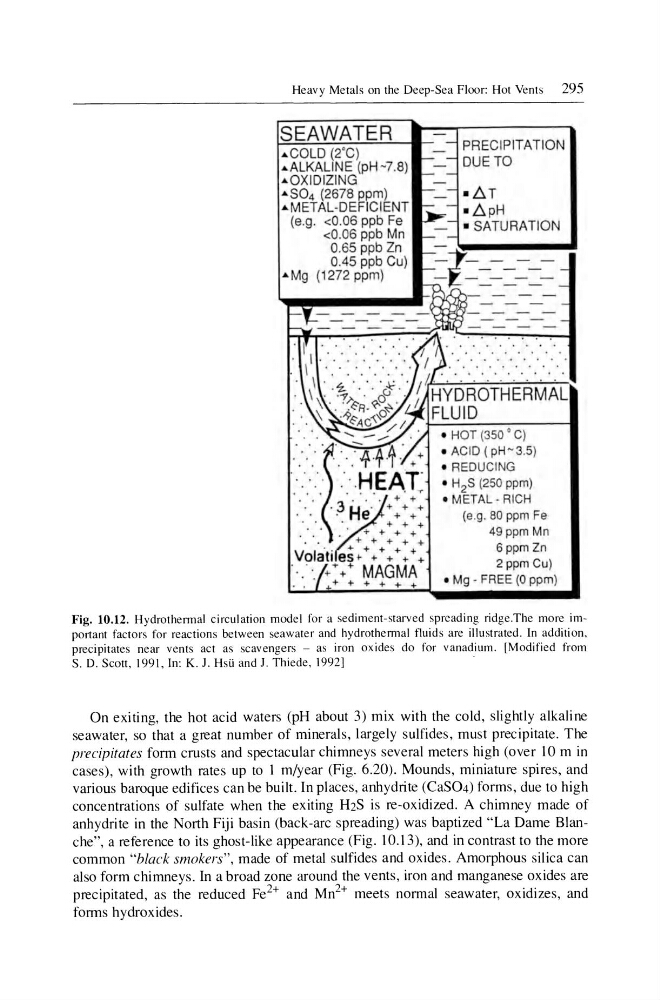
Fig. 10.12. Hydrothennal circulation model for a sediment-starved spreading ridge.The more important factors for reactions between seawate r and hydrothennal fluid s are illustrated. In addition,
precipitates near vents act as scav engers - as iron oxides do for vanadium. [Modified from
S. D. Scott, 1991 , In: K. J. HsU and J. Thiede, 1992]
On exiting, the hot acid waters (pH about 3) mix with the cold, slightly alkaline
seawater, so that a great number of minerals, largely sulfides, must precipitate. The
precipitates form crusts and spectacular chimneys several meters high (over 10m in
cases), with growth rates up to I m/year (Fig. 6.20). Mounds, miniature spires, and
various baroque edifices can be built. In places, anhydrite (CaS04) forms, due to high
concentrations of sulfate when the exiting H2S is re-oxidized. A chimney made of
anhydrite in the North Fiji basin (back-arc spreading) was baptized " La Dame Blanche", a reference to its ghost-like appearance (Fig. 10.13), and in contrast to the more
common "hlack smokers", made of metal sulfides and oxides. Amorphous silica can
also form chimneys. In a broad zone around the vents, iron and manganese oxides are
precipitated, as the reduced Fe 2 + and Mn 2 + meets normal seawater, oxidizes, and
forms hydroxides.
295
SEAWATER
... COLD (2°C)
... ALKALINE (pH - 7.8)
... OX IDIZING
"'S04 (2678 ppm)
"'METAL-D EFICIENT
{e.g. <0.06 ppb Fe
<0.06 ppb Mn
0.65 ppb Zn
0.45 ppb Cu}
... Mg {1 272 ppm}
PRECI PITATION
DUE TO
.,6, T
.,6,pH
• SATURATION
• HOT (350 0 C)
• ACID (pH-3.5)
• REDUCING
• H 2 S (250 ppm)
• METAL - RICH
(e.g. 80 ppm Fe
49 ppm Mn
6 ppm Zn
2ppm Cu)
• Mg - FR EE (0 ppm)
Fig. 10.12. Hydrothennal circulation model for a sediment-starved spreading ridge.The more important factors for reactions between seawate r and hydrothennal fluid s are illustrated. In addition,
precipitates near vents act as scav engers - as iron oxides do for vanadium. [Modified from
S. D. Scott, 1991 , In: K. J. HsU and J. Thiede, 1992]
On exiting, the hot acid waters (pH about 3) mix with the cold, slightly alkaline
seawater, so that a great number of minerals, largely sulfides, must precipitate. The
precipitates form crusts and spectacular chimneys several meters high (over 10m in
cases), with growth rates up to I m/year (Fig. 6.20). Mounds, miniature spires, and
various baroque edifices can be built. In places, anhydrite (CaS04) forms, due to high
concentrations of sulfate when the exiting H2S is re-oxidized. A chimney made of
anhydrite in the North Fiji basin (back-arc spreading) was baptized " La Dame Blanche", a reference to its ghost-like appearance (Fig. 10.13), and in contrast to the more
common "hlack smokers", made of metal sulfides and oxides. Amorphous silica can
also form chimneys. In a broad zone around the vents, iron and manganese oxides are
precipitated, as the reduced Fe 2 + and Mn 2 + meets normal seawater, oxidizes, and
forms hydroxides.