

292 Resources from the Ocean Roor
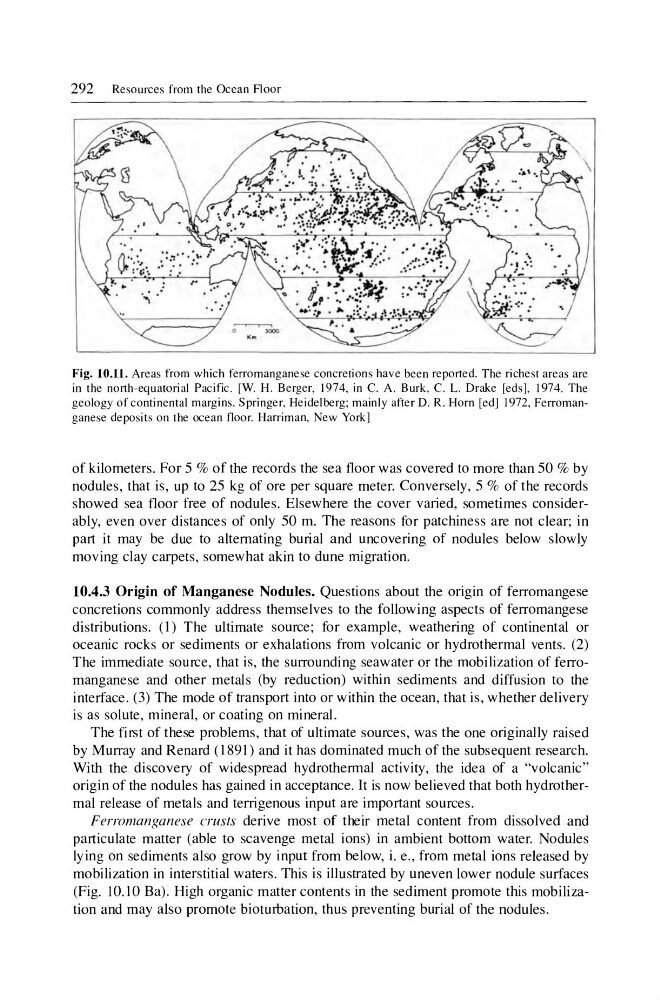
Fig. 10.11. Areas from which ferromanganese concretions have been reported. The richest areas are
in the north-equatorial Pacific . [w. H. Berger, 1974, in C. A. Burk, C. L. Drake reds], 1974. The
geology of continental margins. Springer, Heidelberg; mainly after D. R. Horn led] 1972, Ferromanganese deposits on the ocean floor. Harriman, New York]
of kilometers. For 5 % of the records the sea floor was covered to more than 50 % by
nodules , that is, up to 25 kg of ore per square meter. Conversely, 5 % of the records
showed sea floor free of nodules. Elsewhere the cover varied, sometimes considerably, even over distances of only 50 m. The reasons for patchiness are not clear; in
part it may be due to alternating burial and uncovering of nodules below slowly
moving clay carpets, somewhat akin to dune migration.
10.4.3 Origin of Manganese Nodules. Questions about the origin of ferromangese
concretions commonly address themselves to the following aspects of ferromangese
distributions. (J) The ultimate source; for example, weathering of continental or
oceanic rocks or sediments or exhalations from volcanic or hydrothermal vents. (2)
The immediate source, that is, the surrounding seawater or the mobilization of ferromanganese and other metals (by reduction) within sediments and diffusion to the
interface. (3) The mode of transport into or within the ocean, that is, whether delivery
is as solute, mineral, or coating on mineral.
The first of these problems, that of ultimate sources, was the one originally raised
by Murray and Renard (1891) and it has dominated much of the subsequent research.
With the discovery of widespread hydrothermal activity, the idea of a "volcanic"
origin of the nodules has gained in acceptance. It is now believed that both hydrothermal release of metals and terrigenous input are important sources.
Ferromanganese crusts derive most of their metal content from dissolved and
particulate matter (able to scavenge metal ions) in ambient bottom water. Nodules
lying on sediments also grow by input from below, i. e ., from metal ions released by
mobilization in interstitial waters. This is illustrated by uneven lower nodule surfaces
(Fig. 10.10 Ba). High organic matter contents in the sediment promote this mobilization and may also promote bioturbation, thus preventing burial of the nodules.
Fig. 10.11. Areas from which ferromanganese concretions have been reported. The richest areas are
in the north-equatorial Pacific . [w. H. Berger, 1974, in C. A. Burk, C. L. Drake reds], 1974. The
geology of continental margins. Springer, Heidelberg; mainly after D. R. Horn led] 1972, Ferromanganese deposits on the ocean floor. Harriman, New York]
of kilometers. For 5 % of the records the sea floor was covered to more than 50 % by
nodules , that is, up to 25 kg of ore per square meter. Conversely, 5 % of the records
showed sea floor free of nodules. Elsewhere the cover varied, sometimes considerably, even over distances of only 50 m. The reasons for patchiness are not clear; in
part it may be due to alternating burial and uncovering of nodules below slowly
moving clay carpets, somewhat akin to dune migration.
10.4.3 Origin of Manganese Nodules. Questions about the origin of ferromangese
concretions commonly address themselves to the following aspects of ferromangese
distributions. (J) The ultimate source; for example, weathering of continental or
oceanic rocks or sediments or exhalations from volcanic or hydrothermal vents. (2)
The immediate source, that is, the surrounding seawater or the mobilization of ferromanganese and other metals (by reduction) within sediments and diffusion to the
interface. (3) The mode of transport into or within the ocean, that is, whether delivery
is as solute, mineral, or coating on mineral.
The first of these problems, that of ultimate sources, was the one originally raised
by Murray and Renard (1891) and it has dominated much of the subsequent research.
With the discovery of widespread hydrothermal activity, the idea of a "volcanic"
origin of the nodules has gained in acceptance. It is now believed that both hydrothermal release of metals and terrigenous input are important sources.
Ferromanganese crusts derive most of their metal content from dissolved and
particulate matter (able to scavenge metal ions) in ambient bottom water. Nodules
lying on sediments also grow by input from below, i. e ., from metal ions released by
mobilization in interstitial waters. This is illustrated by uneven lower nodule surfaces
(Fig. 10.10 Ba). High organic matter contents in the sediment promote this mobilization and may also promote bioturbation, thus preventing burial of the nodules.