

1 Origin and Morphology of Ocean Basins
1.1 The Depth of the Sea
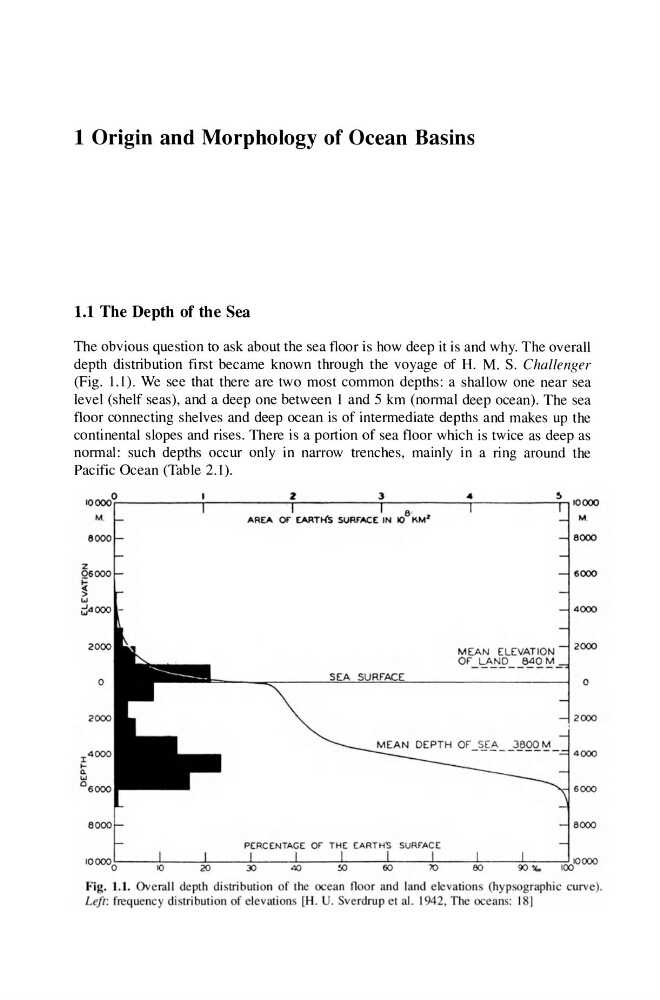
The obvious question to ask about the sea floor is how deep it is and why. The overall
depth distribution first became known through the voyage of H. M. S. Challenger
(Fig. 1.1). We see that there are two most common depths: a shallow one near sea
level (shelf seas), and a deep one between 1 and 5 km (normal deep ocean). The sea
floor connecting shelves and deep ocean is of intermediate depths and makes up the
continental slopes and rises . There is a portion of sea floor which is twice as deep as
normal: such depths occur only in narrow trenches, mainly in a ring around the
Pacific Ocean (Table 2. 1).
8 '
AREA ex EARTH's SURf"ACE IN 10 K"'"
8000
6 000
4000
2000
o
2000
Fig. 1.1. Overall depth distribution of the ocean floor and land elevations (hypsographic cUlVe).
Left: frequency distribution of elevations [H . U. Sverdrup et al. 1942, The oceans: IS]
1.1 The Depth of the Sea
The obvious question to ask about the sea floor is how deep it is and why. The overall
depth distribution first became known through the voyage of H. M. S. Challenger
(Fig. 1.1). We see that there are two most common depths: a shallow one near sea
level (shelf seas), and a deep one between 1 and 5 km (normal deep ocean). The sea
floor connecting shelves and deep ocean is of intermediate depths and makes up the
continental slopes and rises . There is a portion of sea floor which is twice as deep as
normal: such depths occur only in narrow trenches, mainly in a ring around the
Pacific Ocean (Table 2. 1).
8 '
AREA ex EARTH's SURf"ACE IN 10 K"'"
8000
6 000
4000
2000
o
2000
Fig. 1.1. Overall depth distribution of the ocean floor and land elevations (hypsographic cUlVe).
Left: frequency distribution of elevations [H . U. Sverdrup et al. 1942, The oceans: IS]