

266 Paleoceanography - the Deep-Sea Record
% TERTIARY
10 20 30 40 50 60 70 80 90 100
i
i
i
i
i
i
i
i
i
i
I>
I>
I>
E
I>
I>
:I:
I>
I>
lI>
a..
I>
167 .5 W
I>
0
I>
I>
~
I>
0
I>
lI>
li
0
III
III
::J
168 .0 C/)
i
i
i
I
I
I
I
I
I
I
100 90 80 70 6 0 50 40 30
20 10
% CRETACEOUS
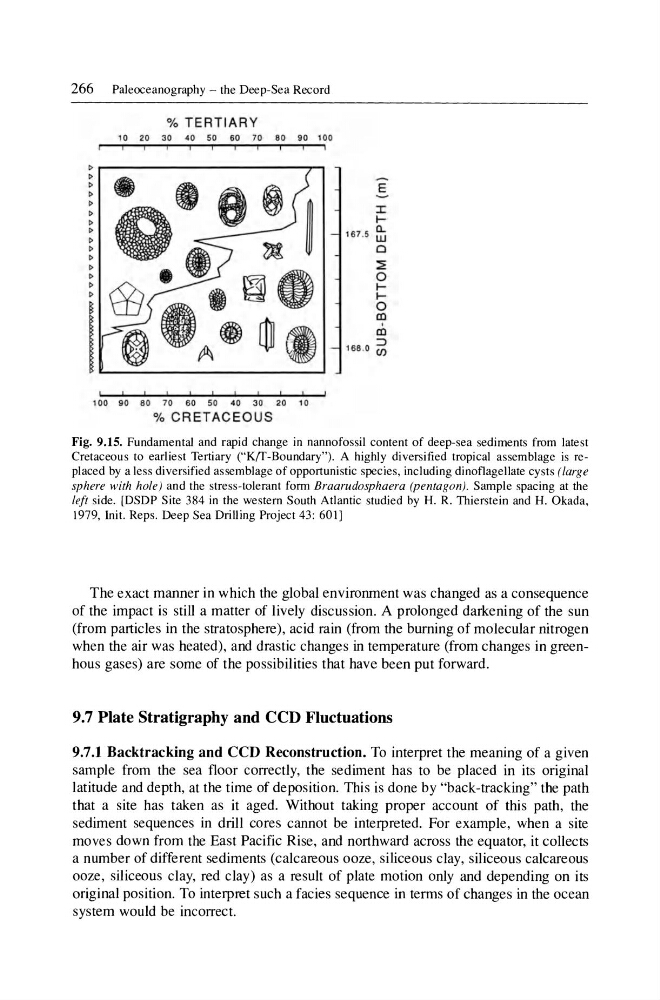
Fig. 9.15. Fundamental and rapid change in nannofossil content of deep-sea sediments from latest
Cretaceous to earliest Tertiary ("Krr-Boundary"). A highly diversified tropical assemblage is replaced by a less diversified assemblage of opportunistic species, including dinoflagellate cysts (large
sphere with hole) and the stress-tolerant form Braarudosphaera (pentagon). Sample spacing at the
left side. [DSDP Site 384 in the western South Atlantic studied by H. R. Thierstein and H. Okada,
1979, lnit. Reps. Deep Sea Drilling Project 43: 601)
The exact manner in which the global environment was changed as a consequence
of the impact is still a matter of lively discussion. A prolonged darkening of the sun
(from particles in the stratosphere), acid rain (from the burning of molecular nitrogen
when the air was heated), and drastic changes in temperature (from changes in greenhous gases) are some of the possibilities that have been put forward.
9.7 Plate Stratigraphy and CCD Fluctuations
9.7.1 Backtracking and CCD Reconstruction. To interpret the meaning of a given
sample from the sea floor correctly, the sediment has to be placed in its original
latitude and depth, at the time of deposition. This is done by "back-tracking" the path
that a site has taken as it aged. Without taking proper account of this path, the
sediment sequences in drill cores cannot be interpreted. For example, when a site
moves down from the East Pacific Rise, and northward across the equator, it collects
a number of different sediments (calcareous ooze, siliceous clay, siliceous calcareous
ooze, siliceous clay, red clay) as a result of plate motion only and depending on its
original position. To interpret such a facies sequence in terms of changes in the ocean
system would be incorrect.
% TERTIARY
10 20 30 40 50 60 70 80 90 100
i
i
i
i
i
i
i
i
i
i
I>
I>
I>
E
I>
I>
:I:
I>
I>
lI>
a..
I>
167 .5 W
I>
0
I>
I>
~
I>
0
I>
lI>
li
0
III
III
::J
168 .0 C/)
i
i
i
I
I
I
I
I
I
I
100 90 80 70 6 0 50 40 30
20 10
% CRETACEOUS
Fig. 9.15. Fundamental and rapid change in nannofossil content of deep-sea sediments from latest
Cretaceous to earliest Tertiary ("Krr-Boundary"). A highly diversified tropical assemblage is replaced by a less diversified assemblage of opportunistic species, including dinoflagellate cysts (large
sphere with hole) and the stress-tolerant form Braarudosphaera (pentagon). Sample spacing at the
left side. [DSDP Site 384 in the western South Atlantic studied by H. R. Thierstein and H. Okada,
1979, lnit. Reps. Deep Sea Drilling Project 43: 601)
The exact manner in which the global environment was changed as a consequence
of the impact is still a matter of lively discussion. A prolonged darkening of the sun
(from particles in the stratosphere), acid rain (from the burning of molecular nitrogen
when the air was heated), and drastic changes in temperature (from changes in greenhous gases) are some of the possibilities that have been put forward.
9.7 Plate Stratigraphy and CCD Fluctuations
9.7.1 Backtracking and CCD Reconstruction. To interpret the meaning of a given
sample from the sea floor correctly, the sediment has to be placed in its original
latitude and depth, at the time of deposition. This is done by "back-tracking" the path
that a site has taken as it aged. Without taking proper account of this path, the
sediment sequences in drill cores cannot be interpreted. For example, when a site
moves down from the East Pacific Rise, and northward across the equator, it collects
a number of different sediments (calcareous ooze, siliceous clay, siliceous calcareous
ooze, siliceous clay, red clay) as a result of plate motion only and depending on its
original position. To interpret such a facies sequence in terms of changes in the ocean
system would be incorrect.