

262 Paleoceanography - the Deep-Sea Record
E_
~ I
w ~ DETRITAL MINERAL GRAINS
~ ~ 0
50
-0.3
a
. Glac;ol
P
Preg loclal P
b
"0
r
w
~
. .
M
A
T
U
2 ~ y
A
M
A
G
A
U
3 ~ S
S
G
I
l
lS ~
8
R
6 ' &01%. 1
" .5
" .0
. 35
· lO
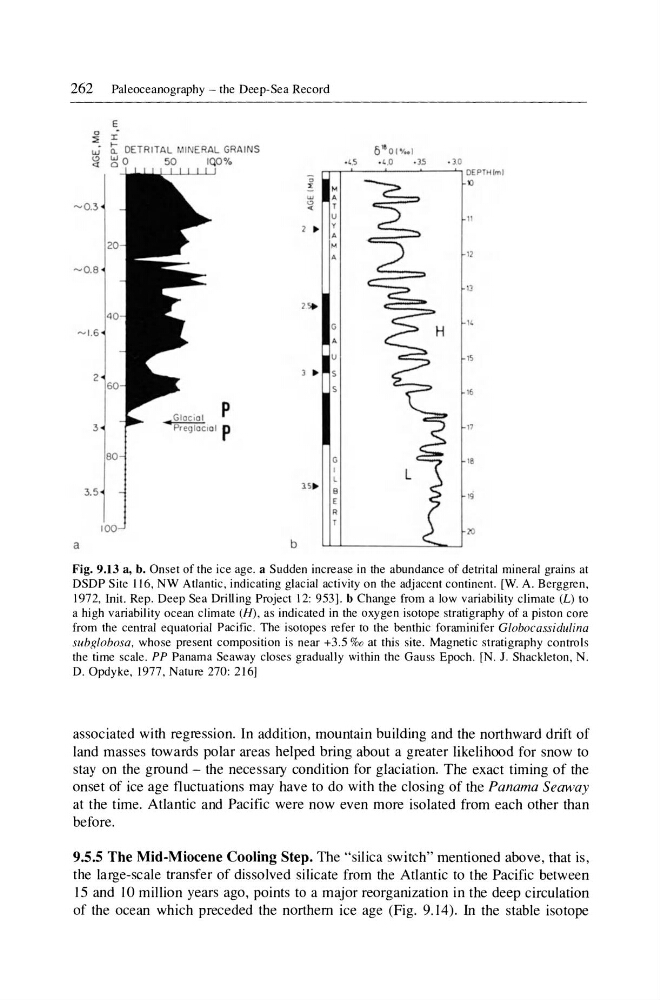
Fig. 9.13 a, b. Onset of the ice age. a Sudden increase in the abundance of detrital mineral grains at
DSDP Site 116, NW Atlantic, indicating glacial activity on the adjacent continent. [W. A. Berggren,
1972, Init. Rep. Deep Sea Drilling Project 12: 953] . b Change from a low variability climate (L) to
a high variability ocean climate (H), as indicated in the oxygen isotope stratigraphy of a piston core
from the central equatorial Pacific. The isotopes refer to the benthic foraminifer Globocassidulina
subglobosa, whose present composition is near +3.5 %0 at this site. Magnetic stratigraphy controls
the time scale. PP Panama Seaway closes gradually within the Gauss Epoch. [N. J. Shackleton, N.
D. Opdyke, 1977, Nature 270: 216]
associated with regression, In addition, mountain building and the northward drift of
land masses towards polar areas helped bring about a greater likelihood for snow to
stay on the ground - the necessary condition for glaciation. The exact timing of the
onset of ice age fluctuations may have to do with the closing of the Panama Seaway
at the time. Atlantic and Pacific were now even more isolated from each other than
before.
9.5.5 The Mid-Miocene Cooling Step. The "silica switch" mentioned above, that is,
the large-scale transfer of dissolved silicate from the Atlantic to the Pacific between
15 and 10 million years ago, points to a major reorganization in the deep circulation
of the ocean which preceded the northern ice age (Fig. 9.14). In the stable isotope
E_
~ I
w ~ DETRITAL MINERAL GRAINS
~ ~ 0
50
-0.3
a
. Glac;ol
P
Preg loclal P
b
"0
r
w
~
. .
M
A
T
U
2 ~ y
A
M
A
G
A
U
3 ~ S
S
G
I
l
lS ~
8
R
6 ' &01%. 1
" .5
" .0
. 35
· lO
Fig. 9.13 a, b. Onset of the ice age. a Sudden increase in the abundance of detrital mineral grains at
DSDP Site 116, NW Atlantic, indicating glacial activity on the adjacent continent. [W. A. Berggren,
1972, Init. Rep. Deep Sea Drilling Project 12: 953] . b Change from a low variability climate (L) to
a high variability ocean climate (H), as indicated in the oxygen isotope stratigraphy of a piston core
from the central equatorial Pacific. The isotopes refer to the benthic foraminifer Globocassidulina
subglobosa, whose present composition is near +3.5 %0 at this site. Magnetic stratigraphy controls
the time scale. PP Panama Seaway closes gradually within the Gauss Epoch. [N. J. Shackleton, N.
D. Opdyke, 1977, Nature 270: 216]
associated with regression, In addition, mountain building and the northward drift of
land masses towards polar areas helped bring about a greater likelihood for snow to
stay on the ground - the necessary condition for glaciation. The exact timing of the
onset of ice age fluctuations may have to do with the closing of the Panama Seaway
at the time. Atlantic and Pacific were now even more isolated from each other than
before.
9.5.5 The Mid-Miocene Cooling Step. The "silica switch" mentioned above, that is,
the large-scale transfer of dissolved silicate from the Atlantic to the Pacific between
15 and 10 million years ago, points to a major reorganization in the deep circulation
of the ocean which preceded the northern ice age (Fig. 9.14). In the stable isotope