

260 Paleoceanography - the Deep-Sea Record
~
"
/
! P ' - - -
;"""'- -- )
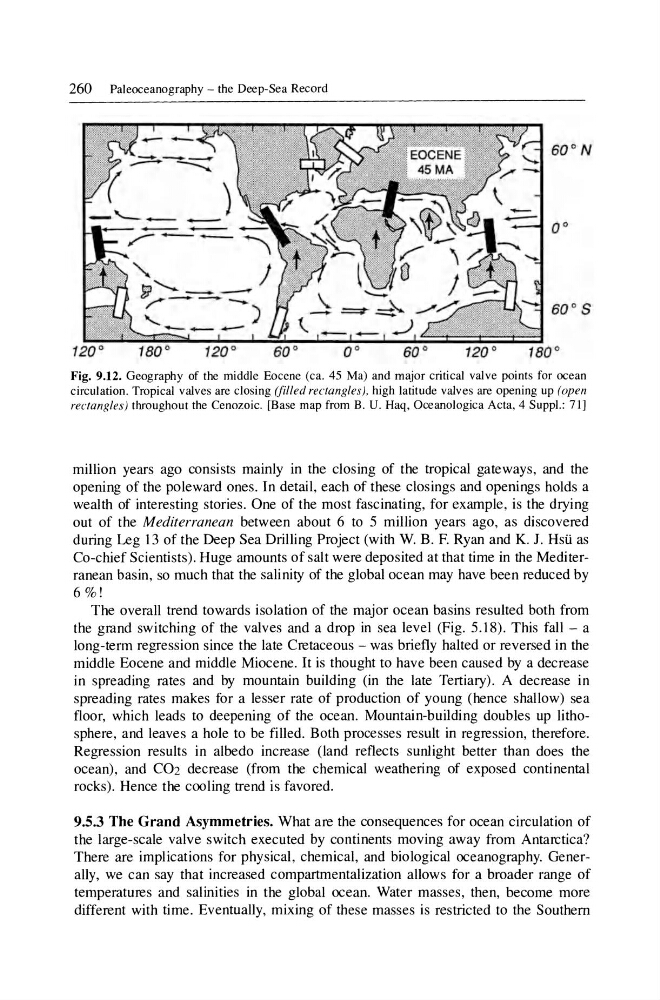
--Fig. 9.12. Geography of the middle Eocene (ca. 45 Ma) and major critical valve points for ocean
circulation. Tropical valves are closing (filled rectangles), high latitude valves are opening up (open
rectangles) throughout the Cenozoic. [Base map from B. U. Haq, Oceanologica Acta, 4 Suppl.: 71]
million years ago consists mainly in the closing of the tropical gateways, and the
opening of the poleward ones. In detail, each of these closings and openings holds a
wealth of interesting stories. One of the most fascinating, for example, is the drying
out of the Mediterranean between about 6 to 5 million years ago, as discovered
during Leg 13 of the Deep Sea Drilling Project (with W. B. F. Ryan and K. 1. Hsti as
Co-chief Scientists). Huge amounts of salt were deposited at that time in the Mediterranean basin, so much that the salinity of the global ocean may have been reduced by
6%!
The overall trend towards isolation of the major ocean basins resulted both from
the grand switching of the valves and a drop in sea level (Fig. 5.18). This fall - a
long-term regression since the late Cretaceous - was briefly halted or reversed in the
middle Eocene and middle Miocene. It is thought to have been caused by a decrease
in spreading rates and by mountain building (in the late Tertiary). A decrease in
spreading rates makes for a lesser rate of production of young (hence shallow) sea
floor, which leads to deepening of the ocean. Mountain-building doubles up lithosphere, and leaves a hole to be filled. Both processes result in regression, therefore.
Regression results in albedo increase (land reflects sunlight better than does the
ocean), and C02 decrease (from the chemical weathering of exposed continental
rocks). Hence the cooling trend is favored.
9.5.3 The Grand Asymmetries. What are the consequences for ocean circulation of
the large-scale valve switch executed by continents moving away from Antarctica?
There are implications for physical, chemical, and biological oceanography. Generally, we can say that increased compartmentalization allows for a broader range of
temperatures and salinities in the global ocean. Water masses, then, become more
different with time. Eventually, mixing of these masses is restricted to the Southern
~
"
/
! P ' - - -
;"""'- -- )
--Fig. 9.12. Geography of the middle Eocene (ca. 45 Ma) and major critical valve points for ocean
circulation. Tropical valves are closing (filled rectangles), high latitude valves are opening up (open
rectangles) throughout the Cenozoic. [Base map from B. U. Haq, Oceanologica Acta, 4 Suppl.: 71]
million years ago consists mainly in the closing of the tropical gateways, and the
opening of the poleward ones. In detail, each of these closings and openings holds a
wealth of interesting stories. One of the most fascinating, for example, is the drying
out of the Mediterranean between about 6 to 5 million years ago, as discovered
during Leg 13 of the Deep Sea Drilling Project (with W. B. F. Ryan and K. 1. Hsti as
Co-chief Scientists). Huge amounts of salt were deposited at that time in the Mediterranean basin, so much that the salinity of the global ocean may have been reduced by
6%!
The overall trend towards isolation of the major ocean basins resulted both from
the grand switching of the valves and a drop in sea level (Fig. 5.18). This fall - a
long-term regression since the late Cretaceous - was briefly halted or reversed in the
middle Eocene and middle Miocene. It is thought to have been caused by a decrease
in spreading rates and by mountain building (in the late Tertiary). A decrease in
spreading rates makes for a lesser rate of production of young (hence shallow) sea
floor, which leads to deepening of the ocean. Mountain-building doubles up lithosphere, and leaves a hole to be filled. Both processes result in regression, therefore.
Regression results in albedo increase (land reflects sunlight better than does the
ocean), and C02 decrease (from the chemical weathering of exposed continental
rocks). Hence the cooling trend is favored.
9.5.3 The Grand Asymmetries. What are the consequences for ocean circulation of
the large-scale valve switch executed by continents moving away from Antarctica?
There are implications for physical, chemical, and biological oceanography. Generally, we can say that increased compartmentalization allows for a broader range of
temperatures and salinities in the global ocean. Water masses, then, become more
different with time. Eventually, mixing of these masses is restricted to the Southern