

250 Paleoceanography - the Deep-Sea Record
sheets. The reason is that ice is depleted in 18 0. During buildup of the ice, therefore,
this heavier isotope stays preferentially in the ocean, increasing the 180/160 ratio
here. Shells grown in such water, then, are enriched in 18 0, and this enrichment is
added to the enrichment caused by the lowered temperature of the water. When the
glacial ice melts, the 180 / 16 0 ratio in the ocean decreases again (see Fig. 5.15).
Today, oxygen isotope stratigraphy forms the backbone of Pleistocene stratigraphy.
We use oxygen isotopes as a master template, to which other records must be
compared to determine their significance. This is also true for nonmarine sequences,
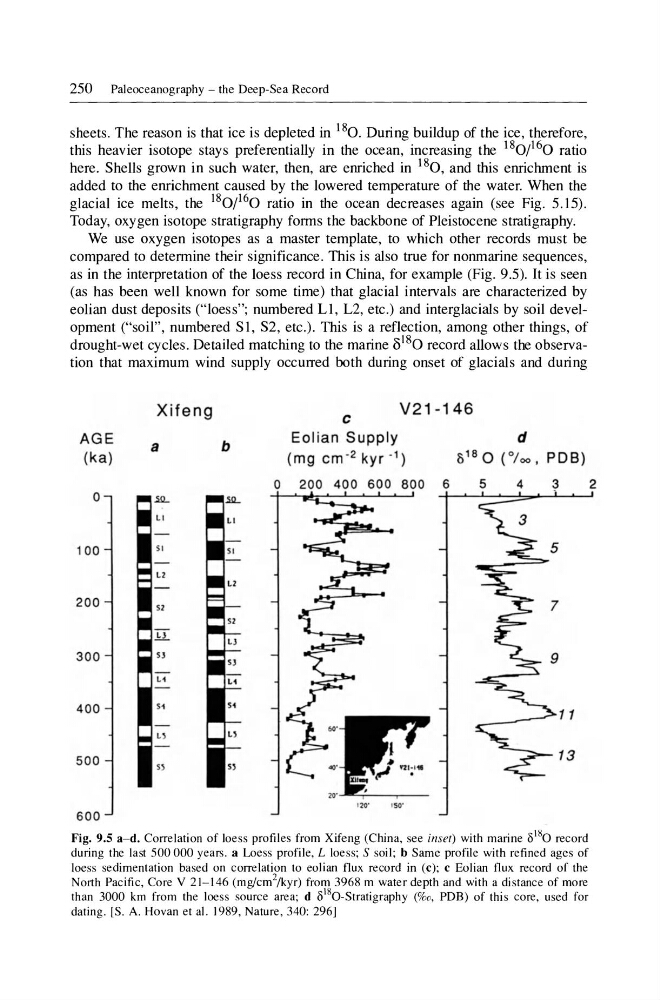
as in the interpretation of the loess record in China, for example (Fig. 9.5). It is seen
(as has been well known for some time) that glacial intervals are characterized by
eolian dust deposits ("loess"; numbered Ll, L2, etc.) and interglacials by soil development ("soil", numbered St, S2, etc.). This is a reflection, among other things, of
drought-wet cycles. Detailed matching to the marine 0 18 0 record allows the observation that maximum wind supply occurred both during onset of glaciais and during
Xi fen g
V21-146
c
AGE
b
Eolian Supply
d
a
(ka)
(mg cm - 2 kyr -1)
0 18 0 (°/00. POB)
0
200 400 600 800
6
5
4
3
0
LI
100
51
L2
200
52
300
5l
L1
400
51
11
L)
500
13
S~
120'
,,..
600
Fig. 9.5 a- d. Correlation of loess profiles from Xifeng (China, see inset) with marine SlgO record
during the last 500000 years . a Loess profile, L loess; S soil; b Same profile with refined ages of
loess sedimentation base d on correlation to eolian flux record in (c); c Eolian flux record of the
North Pacific, Core V 21- 146 (mg/cm 2 {kyr) from 3968 m water depth and with a distance of more
than 3000 km from the loess source area; d Sl 80-Stratigraphy (%0, PDB) of thi s core, used for
dating. [So A. Hovan et al. 1989, Nature. 340: 296]
2
sheets. The reason is that ice is depleted in 18 0. During buildup of the ice, therefore,
this heavier isotope stays preferentially in the ocean, increasing the 180/160 ratio
here. Shells grown in such water, then, are enriched in 18 0, and this enrichment is
added to the enrichment caused by the lowered temperature of the water. When the
glacial ice melts, the 180 / 16 0 ratio in the ocean decreases again (see Fig. 5.15).
Today, oxygen isotope stratigraphy forms the backbone of Pleistocene stratigraphy.
We use oxygen isotopes as a master template, to which other records must be
compared to determine their significance. This is also true for nonmarine sequences,
as in the interpretation of the loess record in China, for example (Fig. 9.5). It is seen
(as has been well known for some time) that glacial intervals are characterized by
eolian dust deposits ("loess"; numbered Ll, L2, etc.) and interglacials by soil development ("soil", numbered St, S2, etc.). This is a reflection, among other things, of
drought-wet cycles. Detailed matching to the marine 0 18 0 record allows the observation that maximum wind supply occurred both during onset of glaciais and during
Xi fen g
V21-146
c
AGE
b
Eolian Supply
d
a
(ka)
(mg cm - 2 kyr -1)
0 18 0 (°/00. POB)
0
200 400 600 800
6
5
4
3
0
LI
100
51
L2
200
52
300
5l
L1
400
51
11
L)
500
13
S~
120'
,,..
600
Fig. 9.5 a- d. Correlation of loess profiles from Xifeng (China, see inset) with marine SlgO record
during the last 500000 years . a Loess profile, L loess; S soil; b Same profile with refined ages of
loess sedimentation base d on correlation to eolian flux record in (c); c Eolian flux record of the
North Pacific, Core V 21- 146 (mg/cm 2 {kyr) from 3968 m water depth and with a distance of more
than 3000 km from the loess source area; d Sl 80-Stratigraphy (%0, PDB) of thi s core, used for
dating. [So A. Hovan et al. 1989, Nature. 340: 296]
2