

c
248 Paleoceanography - the Deep-Sea Record
o
E
- s
w
g 6
U
~ 7
~ 6 ~~_~
~ 9
10
6,+-~~~~~
z
y
w
v
u
10
o
50
100 ~
150
"
'" >... o
200 ~
z
. .
2 50 ~
3 00
o
"
....
~
'"
3 50 '"
..
400
4 50
50607011090 0)
11
0 .50 -0.50 -1 .50 -2.50
190 215 24 0 265
CARBONATE (%)
G ME NA RD II
00"
Tw
a
b
- 3,00
OXYGEN ISOTOPES (5 18 0)
- 2. 50
• I • I 1 I • I • I ~ I • I. I " I .. I ~ I' lot • I" I'" I " I"
~oo~--------------_ _______________________________________________ __
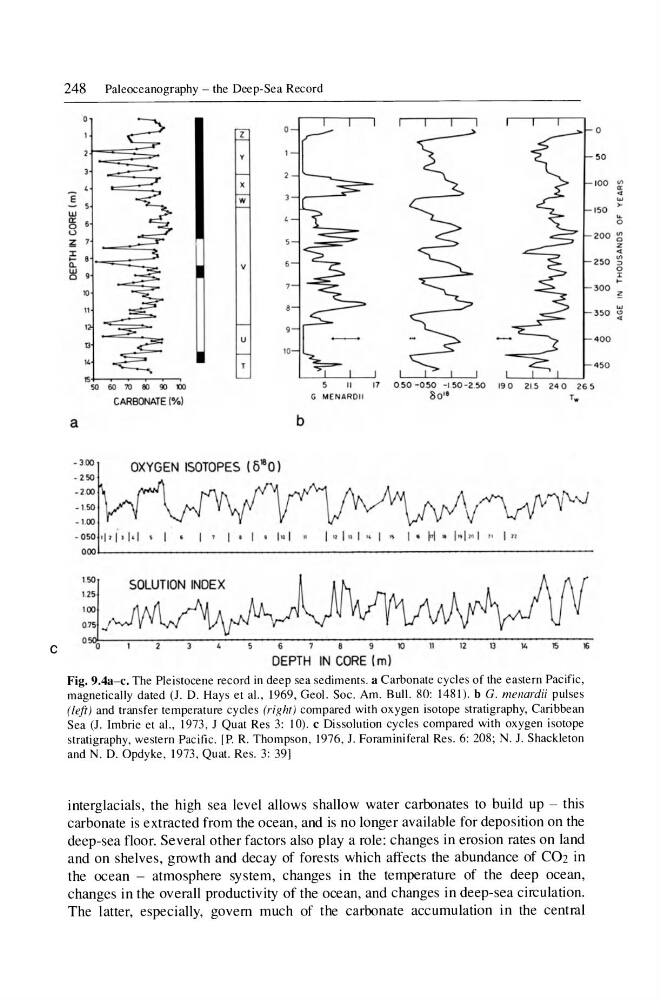
Fig. 9.4a- c. The Pleistocene record in deep sea sediments. a Carbonate cycles of the eastern Pacific,
magnetically dated (1. D. Hays et aI., 1969,Oeol. Soc. Am . Bull. 80: 1481). b G. menardii pulses
(left) and transfer temperature cycles (right) compared with oxygen isotope stratigraphy, Caribbean
Sea (1. Imbrie et aI., 1973, 1 Quat Res 3: 10). c Dissolution cycles compared with oxygen isotope
stratigraphy, western Pacific. [P. R. Thompson, 1976,1. Foraminiferal Res. 6: 208; N. 1. Shackleton
and N. D. Opdyke, 1973 , Quat. Res. 3: 39]
interglacials, the high sea level allows shallow water carbonates to build up - this
carbonate is extracted from the ocean, and is no longer available for deposition on the
deep-sea floor. Several other factors also playa role: changes in erosion rates on land
and on shelves, growth and decay of forests which affects the abundance of C02 in
the ocean - atmosphere system, changes in the temperature of the deep ocean,
changes in the overall productivity of the ocean, and changes in deep-sea circulation.
The latter, especially, govem much of the carbonate accumulation in the central
248 Paleoceanography - the Deep-Sea Record
o
E
- s
w
g 6
U
~ 7
~ 6 ~~_~
~ 9
10
6,+-~~~~~
z
y
w
v
u
10
o
50
100 ~
150
"
'" >... o
200 ~
z
. .
2 50 ~
3 00
o
"
....
~
'"
3 50 '"
..
400
4 50
50607011090 0)
11
0 .50 -0.50 -1 .50 -2.50
190 215 24 0 265
CARBONATE (%)
G ME NA RD II
00"
Tw
a
b
- 3,00
OXYGEN ISOTOPES (5 18 0)
- 2. 50
• I • I 1 I • I • I ~ I • I. I " I .. I ~ I' lot • I" I'" I " I"
~oo~--------------_ _______________________________________________ __
Fig. 9.4a- c. The Pleistocene record in deep sea sediments. a Carbonate cycles of the eastern Pacific,
magnetically dated (1. D. Hays et aI., 1969,Oeol. Soc. Am . Bull. 80: 1481). b G. menardii pulses
(left) and transfer temperature cycles (right) compared with oxygen isotope stratigraphy, Caribbean
Sea (1. Imbrie et aI., 1973, 1 Quat Res 3: 10). c Dissolution cycles compared with oxygen isotope
stratigraphy, western Pacific. [P. R. Thompson, 1976,1. Foraminiferal Res. 6: 208; N. 1. Shackleton
and N. D. Opdyke, 1973 , Quat. Res. 3: 39]
interglacials, the high sea level allows shallow water carbonates to build up - this
carbonate is extracted from the ocean, and is no longer available for deposition on the
deep-sea floor. Several other factors also playa role: changes in erosion rates on land
and on shelves, growth and decay of forests which affects the abundance of C02 in
the ocean - atmosphere system, changes in the temperature of the deep ocean,
changes in the overall productivity of the ocean, and changes in deep-sea circulation.
The latter, especially, govem much of the carbonate accumulation in the central