

242 Paleoceanography - the Deep-Sea Record
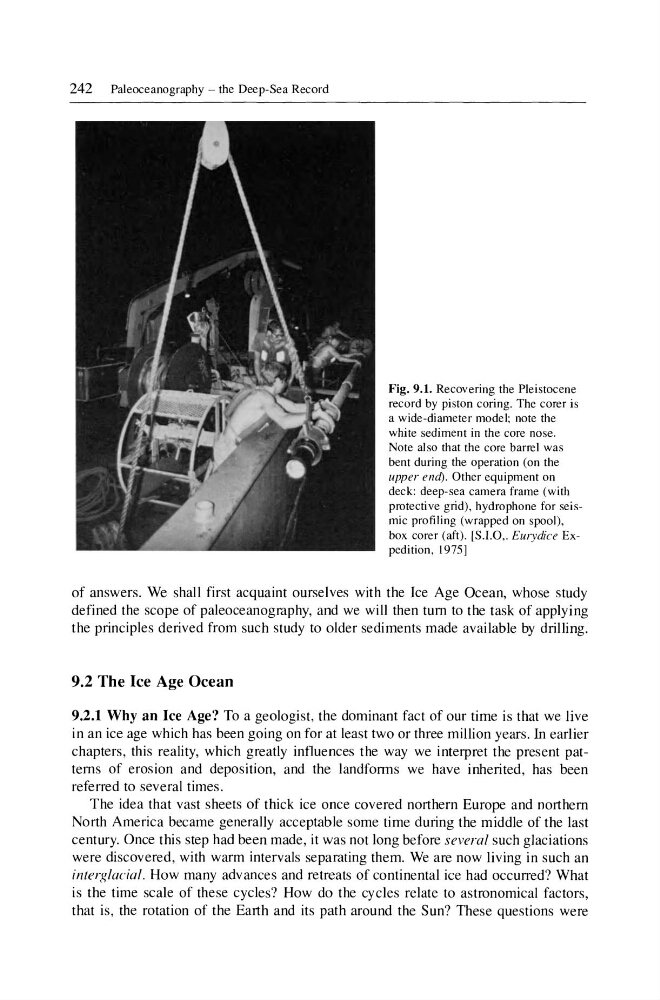
Fig. 9.1. Recovering the Pleistocene
record by piston coring. The corer is
a wide-diameter model; note the
white sediment in the core nose.
Note also that the core barrel was
bent during the operation (on the
upper end) . Other equipment on
deck: deep-sea camera frame (with
protective grid) , hydrophone for seismic profiling (wrapped on spool),
box corer (aft). [S .1.0,. Eurydice Expedition, 1975]
of answers. We shall first acquaint ourselves with the Ice Age Ocean, whose study
defined the scope of paleoceanography, and we will then tum to the task of applying
the principles derived from such study to older sediments made available by drilling.
9.2 The Ice Age Ocean
9.2.1 Why an Ice Age? To a geologist, the dominant fact of our time is that we live
in an ice age which has been going on for at least two or three million years. In earlier
chapters, this reality, which greatly influences the way we interpret the present patterns of erosion and deposition, and the landforms we have inherited, has been
referred to several times.
The idea that vast sheets of thick ice once covered northern Europe and northern
North America became generally acceptable some time during the middle of the last
century. Once this step had been made, it was not long before several such glaciations
were discovered, with warm intervals separating them. We are now living in such an
intelglacial. How many advances and retreats of continental ice had occurred? What
is the time scale of these cycles? How do the cycles relate to astronomical factors,
that is, the rotation of the Earth and its path around the Sun? These questions were
Fig. 9.1. Recovering the Pleistocene
record by piston coring. The corer is
a wide-diameter model; note the
white sediment in the core nose.
Note also that the core barrel was
bent during the operation (on the
upper end) . Other equipment on
deck: deep-sea camera frame (with
protective grid) , hydrophone for seismic profiling (wrapped on spool),
box corer (aft). [S .1.0,. Eurydice Expedition, 1975]
of answers. We shall first acquaint ourselves with the Ice Age Ocean, whose study
defined the scope of paleoceanography, and we will then tum to the task of applying
the principles derived from such study to older sediments made available by drilling.
9.2 The Ice Age Ocean
9.2.1 Why an Ice Age? To a geologist, the dominant fact of our time is that we live
in an ice age which has been going on for at least two or three million years. In earlier
chapters, this reality, which greatly influences the way we interpret the present patterns of erosion and deposition, and the landforms we have inherited, has been
referred to several times.
The idea that vast sheets of thick ice once covered northern Europe and northern
North America became generally acceptable some time during the middle of the last
century. Once this step had been made, it was not long before several such glaciations
were discovered, with warm intervals separating them. We are now living in such an
intelglacial. How many advances and retreats of continental ice had occurred? What
is the time scale of these cycles? How do the cycles relate to astronomical factors,
that is, the rotation of the Earth and its path around the Sun? These questions were