

Chemostratigraphy
239
is correct. One problem is that it is quite difficult to detect missing sections in a
magnetic reversal sequence. However, in conjunction with biostratigraphy, magnetostratigraphy has proved to be a powerful tool for global correlation, since reversals
are essentially instantaneous and world-wide (which is not generally true for biostratigraphic events).
8.7.4 Chemostratigraphy. Many chemical changes in the properties of ocean water
are world-wide, and are recorded in the composition of microfossil shells. Prime
examples are the stable isotopes of oxygen, carbon, and strontium. The records of
oxygen and carbon isotope ratios in calcareous fossils show cycles, steps, and trends,
which can be used to greatly refine stratigraphic resolution once a general framework
has been established. In the example given (Fig. 8.18) the first appearance datum
(FAD) of two phytoplankton species confirms the global synchroneity of a shift in
deep water Ol3C toward more negative values, within the latest Miocene. This shift
(which occurred about 6 million years ago) can be used for global correlation, once
its identity in a given core is determined. We shall discuss the significance of these
types of isotope changes in the context of paleoceanography (Chap. 9).
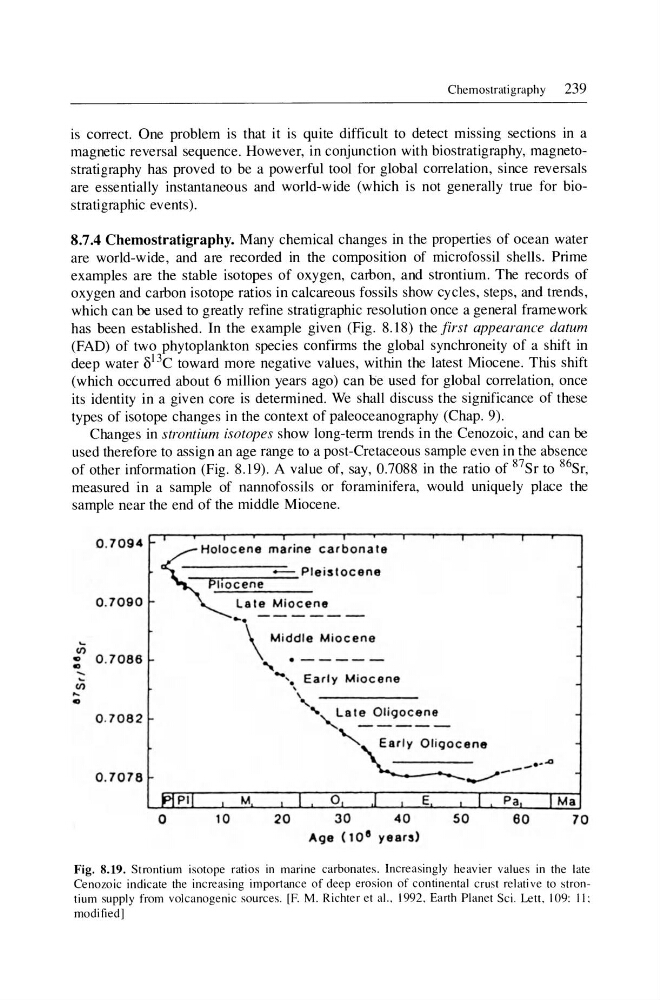
Changes in strontium isotopes show long-term trends in the Cenozoic, and can be
used therefore to assign an age range to a post-Cretaceous sample even in the absence
of other information (Fig. 8.19). A value of, say, 0.7088 in the ratio of 87Sr to 86Sr,
measured in a sample of nannofossils or foraminifera, would uniquely place the
sample near the end of the middle Miocene .
. 0 . 7094
0 . 7090
...
(f)
co
co
0 . 7086
..... ...
(f)
....
co
0 . 7082
0 . 7078
~
o l ocene marine carbona Ie
-:-=-=-::-_-_P l eislocene
Pliocene
Lale Mi ocene
- - - - - -
... \
Mi:d~~i::~
' " "". Early Miocene
\, -----',Lal~ O Ii QOCen~
" ' - , E71 .Y O ligocene
......
~ ...... ----. ........... - ~--~Pl/
I
o
J
E
I Pa
I Ma
o
10
20
30
40
50
60
70
AQe (10 8 years)
Fig. 8.19. Strontium isotope ratios in marine carbonates. Increasingly heavier values in the late
Cenozoic indicate the increasing importance of deep erosion of continental crust re lative to stron·
tium supply from volcanogenic sources. IF. M. Richter et al.. 1992. Earth Plane t Sci. Lett. 109: II;
modified]
239
is correct. One problem is that it is quite difficult to detect missing sections in a
magnetic reversal sequence. However, in conjunction with biostratigraphy, magnetostratigraphy has proved to be a powerful tool for global correlation, since reversals
are essentially instantaneous and world-wide (which is not generally true for biostratigraphic events).
8.7.4 Chemostratigraphy. Many chemical changes in the properties of ocean water
are world-wide, and are recorded in the composition of microfossil shells. Prime
examples are the stable isotopes of oxygen, carbon, and strontium. The records of
oxygen and carbon isotope ratios in calcareous fossils show cycles, steps, and trends,
which can be used to greatly refine stratigraphic resolution once a general framework
has been established. In the example given (Fig. 8.18) the first appearance datum
(FAD) of two phytoplankton species confirms the global synchroneity of a shift in
deep water Ol3C toward more negative values, within the latest Miocene. This shift
(which occurred about 6 million years ago) can be used for global correlation, once
its identity in a given core is determined. We shall discuss the significance of these
types of isotope changes in the context of paleoceanography (Chap. 9).
Changes in strontium isotopes show long-term trends in the Cenozoic, and can be
used therefore to assign an age range to a post-Cretaceous sample even in the absence
of other information (Fig. 8.19). A value of, say, 0.7088 in the ratio of 87Sr to 86Sr,
measured in a sample of nannofossils or foraminifera, would uniquely place the
sample near the end of the middle Miocene .
. 0 . 7094
0 . 7090
...
(f)
co
co
0 . 7086
..... ...
(f)
....
co
0 . 7082
0 . 7078
~
o l ocene marine carbona Ie
-:-=-=-::-_-_P l eislocene
Pliocene
Lale Mi ocene
- - - - - -
... \
Mi:d~~i::~
' " "". Early Miocene
\, -----',Lal~ O Ii QOCen~
" ' - , E71 .Y O ligocene
......
~ ...... ----. ........... - ~--~Pl/
I
o
J
E
I Pa
I Ma
o
10
20
30
40
50
60
70
AQe (10 8 years)
Fig. 8.19. Strontium isotope ratios in marine carbonates. Increasingly heavier values in the late
Cenozoic indicate the increasing importance of deep erosion of continental crust re lative to stron·
tium supply from volcanogenic sources. IF. M. Richter et al.. 1992. Earth Plane t Sci. Lett. 109: II;
modified]