

Stratigraphy and Dating
237
PHYTOPLANKTON
ZOOPLANKTON
Million
Age
Nannofossils
Diatoms
Forllminifera
Abunden~ ~ver3ity
Abundan~ ~ve"ity
Abundan~ ~ve"ity
o ----.:--;=--;-:-~~ll!~:~~ene
Neogene
Radiolaria
Abundan~ ~ver3lty
Miocene
25
Oh90cene
Pal.og.n. Eocene
Paleocene
65
Mee3tricMian
lal.
Campanian
Santonian
CretaceoU3 Coniacian
Turonian
,
, ,
100
Cenomanian
, ,
Albion
Aption
?
Early
Barremien
Cretaceous Hauterivian
Vahngi nian
140
Berriesian
Tilhon,on
lat.
Kimmeridgion
Jura~JSic
160
Oxfordion
Middl.
eollovion
Jurassic Bothonion
Bojoe;on
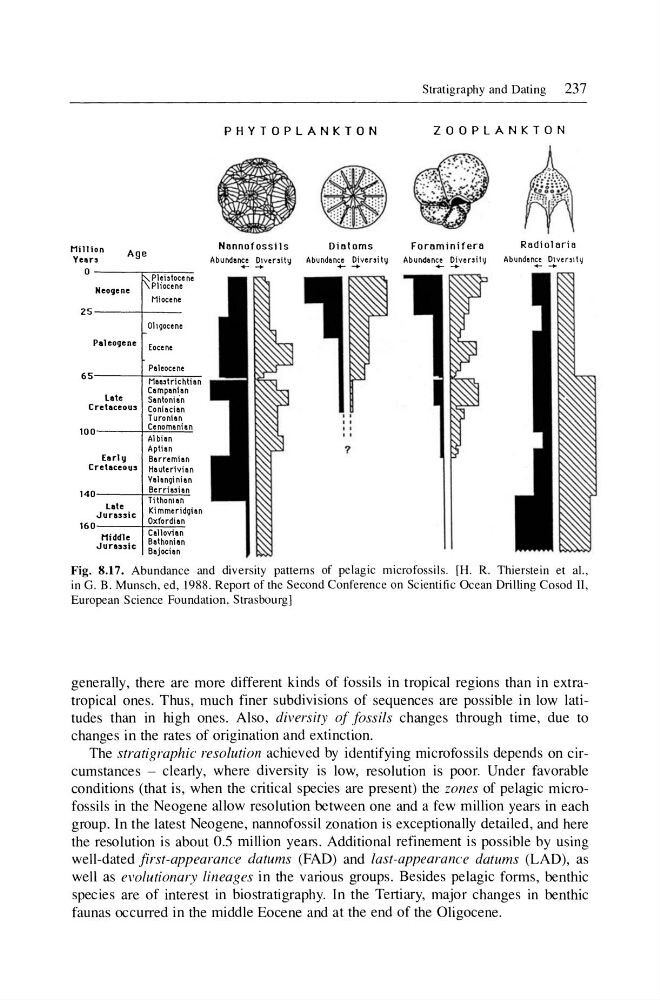
Fig. 8.17. Abundance and diversity patterns of pelagic microfossils. [H. R. Thierstein et aI. ,
in G . B. Munsch, ed, 1988. Report of the Second Conference on Scientific Ocean Drilling Cosod II ,
European Science Foundation, Strasbourg]
generally, there are more different kinds of fossils in tropical regions than in extratropical ones. Thus, much finer subdivisions of sequences are possible in low latitudes than in high ones. Also, diversity of fossils changes through time, due to
changes in the rates of origination and extinction.
The stratigraphic resolution achieved by identifying microfossils depends on circumstances - clearly, where diversity is low, resolution is poor. Under favorable
conditions (that is, when the critical species are present) the zones of pelagic microfossils in the Neogene allow resolution between one and a few million years in each
group. In the latest Neogene, nannofossil zonation is exceptionally detailed, and here
the resolution is about 0 .5 million years. Additional refinement is possible by using
well-dated first-appearance datums (FAD) and last-appearance datums (LAD), as
well as e\'olutionary lineages in the various groups. Besides pelagic forms, benthic
species are of interest in biostratigraphy. In the Tertiary, major changes in benthic
faunas occurred in the middle Eocene and at the end of the Oligocene.
237
PHYTOPLANKTON
ZOOPLANKTON
Million
Age
Nannofossils
Diatoms
Forllminifera
Abunden~ ~ver3ity
Abundan~ ~ve"ity
Abundan~ ~ve"ity
o ----.:--;=--;-:-~~ll!~:~~ene
Neogene
Radiolaria
Abundan~ ~ver3lty
Miocene
25
Oh90cene
Pal.og.n. Eocene
Paleocene
65
Mee3tricMian
lal.
Campanian
Santonian
CretaceoU3 Coniacian
Turonian
,
, ,
100
Cenomanian
, ,
Albion
Aption
?
Early
Barremien
Cretaceous Hauterivian
Vahngi nian
140
Berriesian
Tilhon,on
lat.
Kimmeridgion
Jura~JSic
160
Oxfordion
Middl.
eollovion
Jurassic Bothonion
Bojoe;on
Fig. 8.17. Abundance and diversity patterns of pelagic microfossils. [H. R. Thierstein et aI. ,
in G . B. Munsch, ed, 1988. Report of the Second Conference on Scientific Ocean Drilling Cosod II ,
European Science Foundation, Strasbourg]
generally, there are more different kinds of fossils in tropical regions than in extratropical ones. Thus, much finer subdivisions of sequences are possible in low latitudes than in high ones. Also, diversity of fossils changes through time, due to
changes in the rates of origination and extinction.
The stratigraphic resolution achieved by identifying microfossils depends on circumstances - clearly, where diversity is low, resolution is poor. Under favorable
conditions (that is, when the critical species are present) the zones of pelagic microfossils in the Neogene allow resolution between one and a few million years in each
group. In the latest Neogene, nannofossil zonation is exceptionally detailed, and here
the resolution is about 0 .5 million years. Additional refinement is possible by using
well-dated first-appearance datums (FAD) and last-appearance datums (LAD), as
well as e\'olutionary lineages in the various groups. Besides pelagic forms, benthic
species are of interest in biostratigraphy. In the Tertiary, major changes in benthic
faunas occurred in the middle Eocene and at the end of the Oligocene.