

230 Deep-Sea Sediments - Patterns, Processes, and Stratigraphic Methods
~ 350
8
E
a
b
Q,
7
.90
c 930
6 6
0
~
~ 5
1: 310
u.
~
o·
0
(,,)3
(,,) 290
N
2
8 270
1720
1800
1880
1960
2000
2800
3200
Year
Year
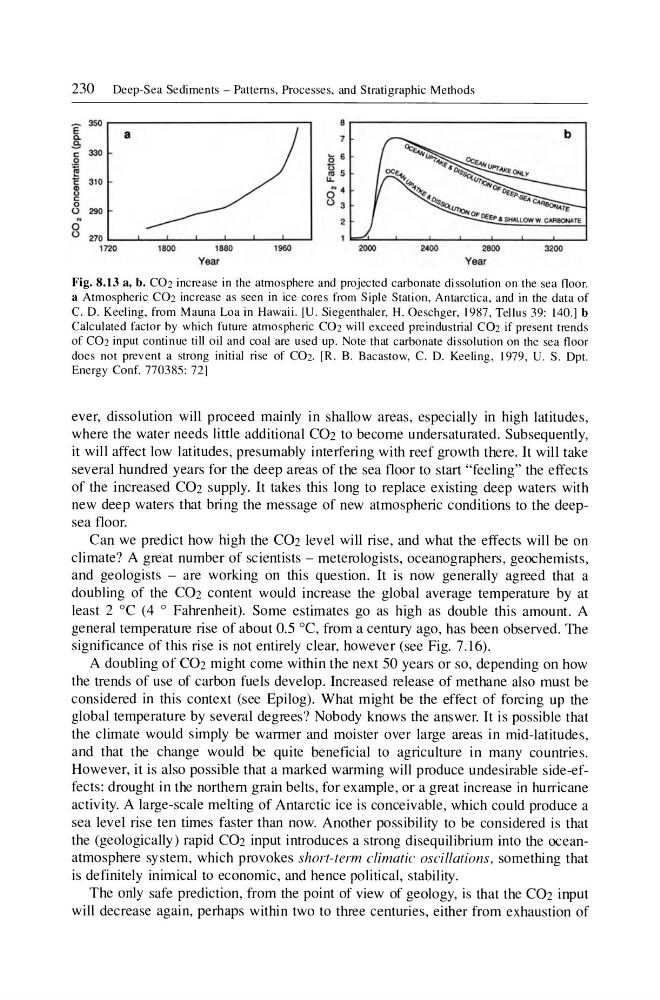
Fig, 8,13 a, b, C02 increase in the atmosphe re and projected carbonate dissolution on the sea floor.
a Atmospheric C02 increase as seen in ice cores from Siple Station, Antarctica, and in the data of
C. D. Keeling , from Mauna Loa in Hawaii. [U. Siegenthaler, H. Oeschger, 1987, Tellus 39: 140.] b
Calculated factor by which future atmospheric C02 will exceed preindustrial C02 if present trend s
of C02 input continue till oil and coal are used up . Note that carbonate dissolution on the sea floor
does not prevent a strong initial rise of C02. [R. B. Bacastow, C. D. Keeling , 1979, U. S. Dpt.
Energy Conf. 770385: 72]
ever, dissolution will proceed mainly in shallow areas, especially in high latitudes,
where the water needs little additional C02 to become undersaturated. Subsequently,
it will affect low latitudes , presumably interfering with reef growth there. It will take
several hundred years for the deep areas of the sea floor to start "feeling" the effects
of the increased C02 supply. It takes this long to replace existing deep waters with
new deep waters that bring the message of new atmospheric conditions to the deepsea floor.
Can we predict how high the C02 level will rise, and what the effects will be on
climate? A great number of scientists - meterologists, oceanographers, geochemists,
and geologists - are working on this question. It is now generally agreed that a
doubling of the C02 content would increase the global average temperature by at
least 2 °C (4 ° Fahrenheit). Some estimates go as high as double this amount. A
general temperature rise of about 0.5 °C , from a century ago, has been observed. The
significance of this rise is not entirely clear, however (see Fig. 7.16).
A doubling of C02 might come within the next 50 years or so, depending on how
the trends of use of carbon fuels develop. Increased release of methane also must be
considered in this context (see Epilog). What might be the effect of forcing up the
global temperature by several degrees? Nobody knows the answer. It is possible that
the climate would simply be warmer and moister over large areas in mid-latitudes,
and that the change would be quite beneficial to agriculture in many countries.
However, it is also possible that a marked warming will produce undesirable side-effects: drought in the northern grain belts, for example, or a great increase in hurricane
activity. A large-scale melting of Antarctic ice is conceivable, which could produce a
sea level rise ten times faster than now. Another possibility to be considered is that
the (geologically) rapid C02 input introduces a strong disequilibrium into the oceanatmosphere system, which provokes short-term climatic oscillations, something that
is definitely inimical to economic, and hence political, stability.
The only safe prediction, from the point of view of geology, is that the C02 input
will decrease again, perhaps within two to three centuries, either from exhaustion of
~ 350
8
E
a
b
Q,
7
.90
c 930
6 6
0
~
~ 5
1: 310
u.
~
o·
0
(,,)3
(,,) 290
N
2
8 270
1720
1800
1880
1960
2000
2800
3200
Year
Year
Fig, 8,13 a, b, C02 increase in the atmosphe re and projected carbonate dissolution on the sea floor.
a Atmospheric C02 increase as seen in ice cores from Siple Station, Antarctica, and in the data of
C. D. Keeling , from Mauna Loa in Hawaii. [U. Siegenthaler, H. Oeschger, 1987, Tellus 39: 140.] b
Calculated factor by which future atmospheric C02 will exceed preindustrial C02 if present trend s
of C02 input continue till oil and coal are used up . Note that carbonate dissolution on the sea floor
does not prevent a strong initial rise of C02. [R. B. Bacastow, C. D. Keeling , 1979, U. S. Dpt.
Energy Conf. 770385: 72]
ever, dissolution will proceed mainly in shallow areas, especially in high latitudes,
where the water needs little additional C02 to become undersaturated. Subsequently,
it will affect low latitudes , presumably interfering with reef growth there. It will take
several hundred years for the deep areas of the sea floor to start "feeling" the effects
of the increased C02 supply. It takes this long to replace existing deep waters with
new deep waters that bring the message of new atmospheric conditions to the deepsea floor.
Can we predict how high the C02 level will rise, and what the effects will be on
climate? A great number of scientists - meterologists, oceanographers, geochemists,
and geologists - are working on this question. It is now generally agreed that a
doubling of the C02 content would increase the global average temperature by at
least 2 °C (4 ° Fahrenheit). Some estimates go as high as double this amount. A
general temperature rise of about 0.5 °C , from a century ago, has been observed. The
significance of this rise is not entirely clear, however (see Fig. 7.16).
A doubling of C02 might come within the next 50 years or so, depending on how
the trends of use of carbon fuels develop. Increased release of methane also must be
considered in this context (see Epilog). What might be the effect of forcing up the
global temperature by several degrees? Nobody knows the answer. It is possible that
the climate would simply be warmer and moister over large areas in mid-latitudes,
and that the change would be quite beneficial to agriculture in many countries.
However, it is also possible that a marked warming will produce undesirable side-effects: drought in the northern grain belts, for example, or a great increase in hurricane
activity. A large-scale melting of Antarctic ice is conceivable, which could produce a
sea level rise ten times faster than now. Another possibility to be considered is that
the (geologically) rapid C02 input introduces a strong disequilibrium into the oceanatmosphere system, which provokes short-term climatic oscillations, something that
is definitely inimical to economic, and hence political, stability.
The only safe prediction, from the point of view of geology, is that the C02 input
will decrease again, perhaps within two to three centuries, either from exhaustion of