

Inventory and Overview
219
INCREASING FERTILlTY_
SUBTROPICAL:
OCEANIC
!
:
CONVERGENCE' DIVERGENCE
UPWELLING
AREA
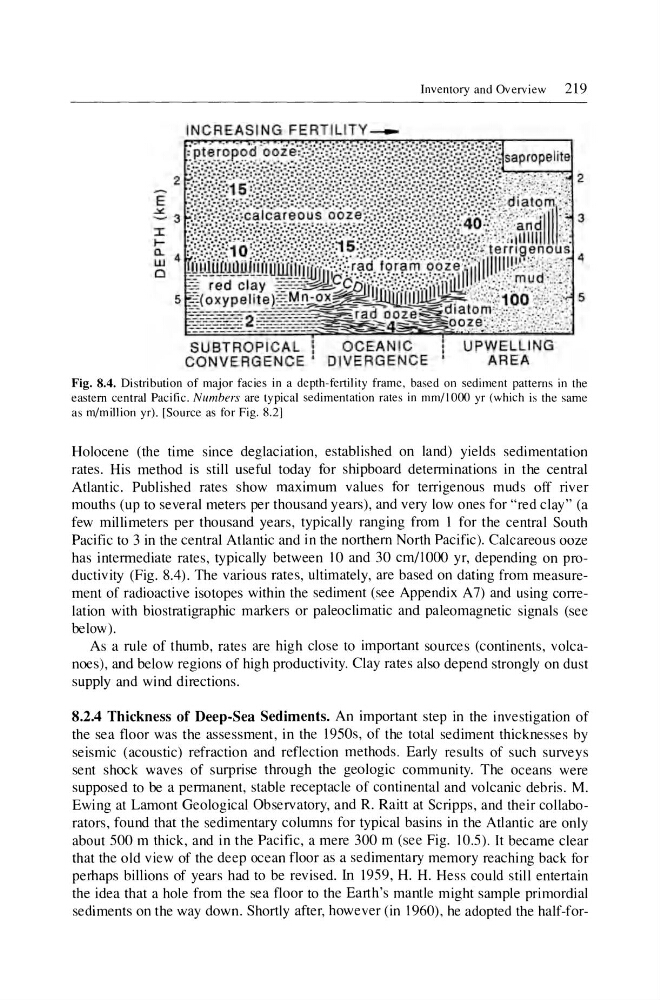
Fig. 8.4. Distribution of major facies in a depth-fertility frame , based on sediment patterns in the
eastern central Pacific. Numhers are typical sedimentation rates in mm/IOOO yr (which is the same
as rnlmillion yr). [Source as for Fig. 8.2]
Holocene (the time since deglaciation, established on land) yields sedimentation
rates. His method is still useful today for shipboard determinations in the central
Atlantic. Published rates show maximum values for terrigenous muds off river
mouths (up to several meters per thousand years) , and very low ones for "red clay" (a
few millimeters per thousand years, typically ranging from I for the central South
Pacific to 3 in the central Atlantic and in the northern North Pacific). Calcareous ooze
has intermediate rates, typically between 10 and 30 cm/lOoo yr, depending on productivity (Fig. 8.4). The various rates, ultimately, are based on dating from measurement of radioactive isotopes within the sediment (see Appendix A 7) and using correlation with biostratigraphic markers or paleoclimatic and paleomagnetic signals (see
below).
As a rule of thumb, rates are high close to important sources (continents, volcanoes), and below regions of high productivity. Clay rates also depend strongly on dust
supply and wind directions.
8.2.4 Thickness of Deep-Sea Sediments. An important step in the investigation of
the sea floor was the assessment, in the 1950s, of the total sediment thicknesses by
seismic (acoustic) refraction and reflection methods. Early results of such surveys
sent shock waves of surprise through the geologic community. The oceans were
supposed to be a permanent, stable receptacle of continental and volcanic debris . M.
Ewing at Lamont Geological Observatory, and R. Raitt at Scripps, and their collaborators, found that the sedimentary columns for typical basins in the Atlantic are only
about 500 m thick, and in the Pacific, a mere 300 m (see Fig. \0.5) . It became clear
that the old view of the deep ocean floor as a sedimentary memory reaching back for
perhaps billions of years had to be revised. In \959 , H. H. Hess could still entertain
the idea that a hole from the sea floor to the Earth's mantle might sample primordial
sediments on the way down. Shortly after, however (in 1960), he adopted the half-for-
219
INCREASING FERTILlTY_
SUBTROPICAL:
OCEANIC
!
:
CONVERGENCE' DIVERGENCE
UPWELLING
AREA
Fig. 8.4. Distribution of major facies in a depth-fertility frame , based on sediment patterns in the
eastern central Pacific. Numhers are typical sedimentation rates in mm/IOOO yr (which is the same
as rnlmillion yr). [Source as for Fig. 8.2]
Holocene (the time since deglaciation, established on land) yields sedimentation
rates. His method is still useful today for shipboard determinations in the central
Atlantic. Published rates show maximum values for terrigenous muds off river
mouths (up to several meters per thousand years) , and very low ones for "red clay" (a
few millimeters per thousand years, typically ranging from I for the central South
Pacific to 3 in the central Atlantic and in the northern North Pacific). Calcareous ooze
has intermediate rates, typically between 10 and 30 cm/lOoo yr, depending on productivity (Fig. 8.4). The various rates, ultimately, are based on dating from measurement of radioactive isotopes within the sediment (see Appendix A 7) and using correlation with biostratigraphic markers or paleoclimatic and paleomagnetic signals (see
below).
As a rule of thumb, rates are high close to important sources (continents, volcanoes), and below regions of high productivity. Clay rates also depend strongly on dust
supply and wind directions.
8.2.4 Thickness of Deep-Sea Sediments. An important step in the investigation of
the sea floor was the assessment, in the 1950s, of the total sediment thicknesses by
seismic (acoustic) refraction and reflection methods. Early results of such surveys
sent shock waves of surprise through the geologic community. The oceans were
supposed to be a permanent, stable receptacle of continental and volcanic debris . M.
Ewing at Lamont Geological Observatory, and R. Raitt at Scripps, and their collaborators, found that the sedimentary columns for typical basins in the Atlantic are only
about 500 m thick, and in the Pacific, a mere 300 m (see Fig. \0.5) . It became clear
that the old view of the deep ocean floor as a sedimentary memory reaching back for
perhaps billions of years had to be revised. In \959 , H. H. Hess could still entertain
the idea that a hole from the sea floor to the Earth's mantle might sample primordial
sediments on the way down. Shortly after, however (in 1960), he adopted the half-for-