

198 Imprint of Climatic Zonation on Marine Sediments
R •• ts forming in shallow wolf'!'
R •• f s grow upward to Sf'O I.v,",
,.,...,-.AWI
_ . ~ Fif·' ,L#;
~ .... ) ~ ,
'" ~' i
.
j "
• 1. ..
1"
t" ?
•
'ii
\.1
"
0
0
u
\- .. ~ ~
.. ~J
~
(1 .
.../'.>
",
. .1 l~'t1:=~Y"
~T. ~ ·
RHfs grow to remain 01 StoO I..,'"
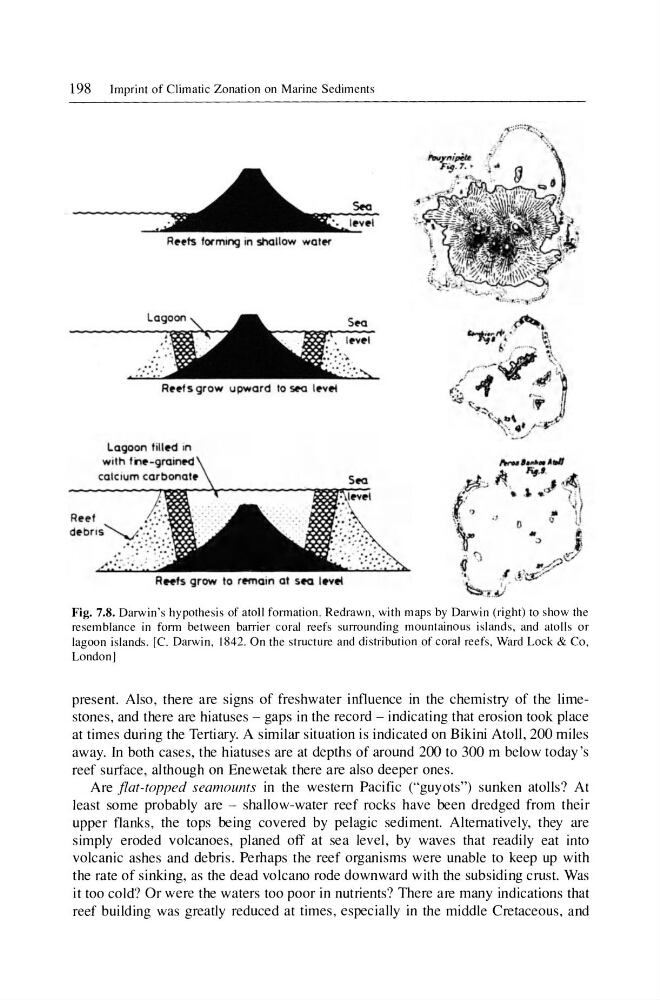
Fig. 7.8. Darwin 's hypothesis of atoll form ation. Redrawn , with maps by Darwin (right) to show the
resemblance in form between barrier coral reefs surrounding mountainous isl ands, and atolls or
lagoon islands. [C. Darwin, 1842. On the structure and distribution of coral reefs, Ward Lock & Co,
London]
present. Also, there are signs of freshwater influence in the chemistI)' of the limestones, and there are hiatuses - gaps in the record - indicating that erosion took place
at times during the Tertiary. A similar situation is indicated on Bikini Atoll , 200 miles
away. In both cases, the hiatuses are at depths of around 200 to 300 m below today's
reef surface, although on Enewetak there are also deeper ones.
Are flat-topped seamounts in the western Pacific ("guyots") sunken atolls? At
least some probably are - shallow-water reef rocks have been dredged from their
upper flanks, the tops being covered by pelagic sediment. Alternatively, they are
simply eroded volcanoes, planed off at sea level, by waves that readily eat into
volcanic ashes and debris . Perhaps the reef organisms were unable to keep up with
the rate of sinking, as the dead volcano rode downward with the subsiding crust. Was
it too cold? Or were the waters too poor in nutrients? There are many indications that
reef building was greatly reduced at times, especially in the middle Cretaceous, and
R •• ts forming in shallow wolf'!'
R •• f s grow upward to Sf'O I.v,",
,.,...,-.AWI
_ . ~ Fif·' ,L#;
~ .... ) ~ ,
'" ~' i
.
j "
• 1. ..
1"
t" ?
•
'ii
\.1
"
0
0
u
\- .. ~ ~
.. ~J
~
(1 .
.../'.>
",
. .1 l~'t1:=~Y"
~T. ~ ·
RHfs grow to remain 01 StoO I..,'"
Fig. 7.8. Darwin 's hypothesis of atoll form ation. Redrawn , with maps by Darwin (right) to show the
resemblance in form between barrier coral reefs surrounding mountainous isl ands, and atolls or
lagoon islands. [C. Darwin, 1842. On the structure and distribution of coral reefs, Ward Lock & Co,
London]
present. Also, there are signs of freshwater influence in the chemistI)' of the limestones, and there are hiatuses - gaps in the record - indicating that erosion took place
at times during the Tertiary. A similar situation is indicated on Bikini Atoll , 200 miles
away. In both cases, the hiatuses are at depths of around 200 to 300 m below today's
reef surface, although on Enewetak there are also deeper ones.
Are flat-topped seamounts in the western Pacific ("guyots") sunken atolls? At
least some probably are - shallow-water reef rocks have been dredged from their
upper flanks, the tops being covered by pelagic sediment. Alternatively, they are
simply eroded volcanoes, planed off at sea level, by waves that readily eat into
volcanic ashes and debris . Perhaps the reef organisms were unable to keep up with
the rate of sinking, as the dead volcano rode downward with the subsiding crust. Was
it too cold? Or were the waters too poor in nutrients? There are many indications that
reef building was greatly reduced at times, especially in the middle Cretaceous, and